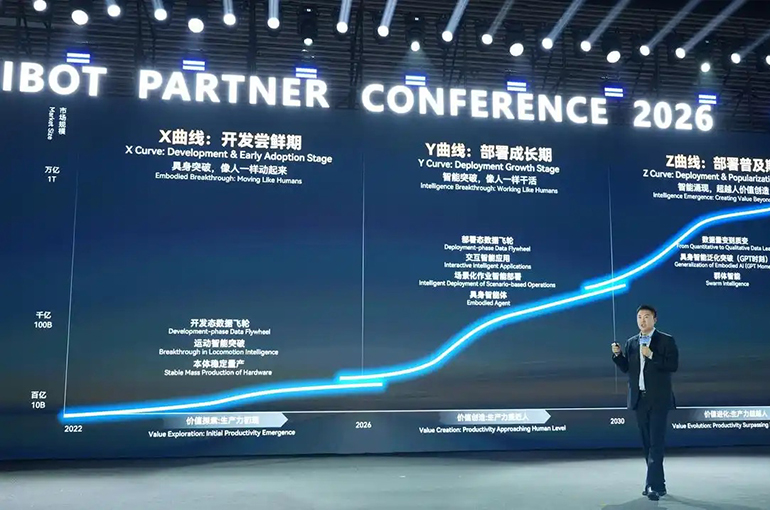
(Yicai), April 20 — AgiBot aims to achieve revenue of 10 billion yuan (US$1.4 billion) next year after several years of rapid sales growth, as the Chinese humanoid robotics startup is positive about embodied intelligence and its new ecosystem development strategy.
Confidence in achieving the goal comes from AgiBot’s outlook on the embodied intelligence industry and its new Yuansheng ecosystem initiative, founder, chairman and CEO Deng Taihua said at a partner conference on April 17. He noted that the surge in deliveries has led to rapid revenue growth over the past three years.
AgiBot’s total shipments jumped from 1,000 units at the beginning of last year to 5,000 units by the end of the year and 10,000 units by March 31st. Moreover, its revenue soared from RMB 300,000 (US$42,000) in 2023, when the Shanghai-based company was founded, to RMB 60 million (US$8.4 million) in 2024. 1.1 billion yuan (US$147 million) in 2025.
“AgiBot simultaneously drives mass production of robot platforms, iterates on AI models, open sources data, and builds an ecosystem platform,” said Peng Zhihui, co-founder, president, and chief technology officer. All efforts are aimed at driving embodied intelligence from an isolated capability to a foundational capability that can be used across the industry, he stressed.
At the conference, AgiBot said it plans to invest at least 2 billion yuan in the Yuansheng Ecosystem Initiative over the next five years to support industrial research and academic innovation, talent education and training, ecosystem partner development, and developer community operations.
Additionally, it announced four new robot platforms, six artificial intelligence models, seven practical industrial application solutions for robots, as well as a full-stack ecological technology system, AI Machine Architecture.
Deng said AgiBot is maintaining an investment-focused strategy at this stage, building product competitiveness through saturated R&D investments and supporting rapid growth in shipments and sales revenue.
“AgiBot is not in a hurry to pursue profitability and continues to focus on the long-term perspective,” Deng said. “With sufficient sales scale, R&D unit costs can be diluted and losses are expected to continue narrowing due to rapid sales growth. Profits will increase rapidly once the net income inflection point is reached.”
Peng pointed out that AgiBot has the ability to be “self-sustaining” and has sufficient capital, so there is no urgent need to raise funds in the primary market.
“The real watershed in the embodied intelligence business is not just applying AI models to the physical world, but embedding our products in real work scenarios,” Peng said, adding that over the past two years, AgiBot’s business logic has shifted from simply selling robots to delivering tangible application results, with the core metric being whether enough value is created for the customer.
Since late last year, AgiBot has spun off Qingtianzu, Lingjie Dian, Mifeng Technology, and AgiBot Kuotuo as subsidiaries, each focusing on robot leasing, dexterous hands, embodied intelligence data platform, and quadruped robots. A core executive directs each unit.
“In order to better facilitate the professional development of related businesses, we have separated some core businesses and operated them as subsidiaries,” Peng said. For example, he noted that AgiBot Kuotuo was created by separating out the quadruped robot business and is focused on scenario-specific applications and achieving faster commercialization.
With the support of AgiBot’s comprehensive capabilities, each division is expected to quickly grow into a leader in its respective niche market, Deng said.
In addition, AgiBot has invested in more than 20 early-stage companies over the past year and a half, with the aim of forming supply chain synergies and promoting the vigorous development of the entire industry, Deng said. He revealed that AgiBot plans to establish a corporate venture capital arm this year to drive its supply chain investment business.
Cai Bingzhen, director of Gaogong Robot Industry Research Institute, told Yicai that the four divisions can raise independent funding and their products can serve AgiBot and other companies.
According to Cai, AgiBot needs to overcome several challenges to achieve revenue of 10 billion yuan next year. For example, multi-scenario deployments require not only customer acceptance but also higher robot stability and AI model generalization ability, Cai noted, adding that as mass production scales up, the difficulty of supply chain management increases exponentially, testing the supply capabilities of component manufacturers and the development of the entire ecosystem.
Editor: Shihua Tang, Martin Kadyev