
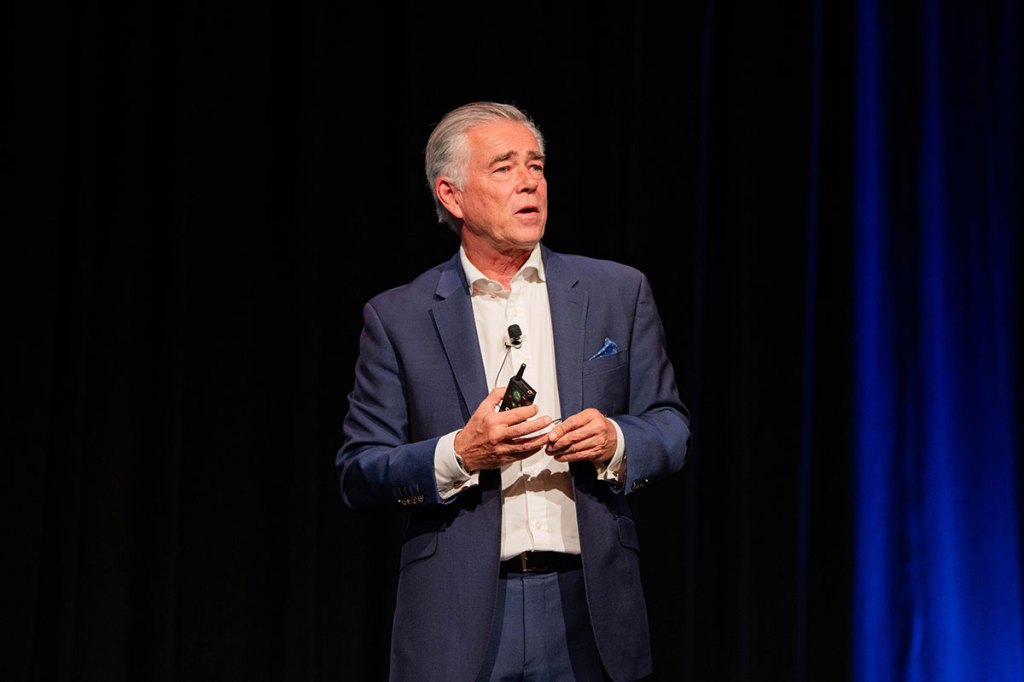
These are among the key messages from internationally renowned economist and strategist Jonathan Payne, who will headline the South Australian Chamber of Commerce’s upcoming Global Crossroads Business Luncheon.
The event is designed for executives, directors and decision-makers navigating an increasingly complex operating environment, providing practical insight into the global economic outlook, emerging geopolitical risks and opportunities for Australian businesses in a rapidly changing world.
Based on decades of experience advising governments, institutional investors and business leaders around the world, Payne believes the pace of change is accelerating and companies that fail to adapt risk being left behind.
His advice to CEOs is simple. “Embracing and adapting to the wonders of technological change.”
At the heart of that transformation is artificial intelligence, which Payne believes should no longer be viewed as a future opportunity, but as an immediate business priority, part of day-to-day leadership.
“Meet regularly with your team to review how AI is being used and see it as a friend, not a threat,” he says. “Identify people within your company who can lead the adoption of AI within your company.
“As business leaders, CEOs must lead from the front and be familiar with the latest AI models, their capabilities, and their relevance to the business.”
The consequences of delay are clear, he warns. “In a competitive market, if you don’t, your competitors will have a huge advantage over you.”
While technological disruption is changing the way businesses operate, Payne believes there are equally profound changes underway in the geopolitical landscape.
“We need to accept new geopolitical realities,” he says. “We now have an authoritarian axis of Russia, China, Iran, and North Korea. There is another great power competition. We have Donald Trump in the White House. The postwar rulebook has been torn apart.”
For business leaders, the implications are significant, he says. “The coming decades will not be the same as the past decades.”
Mr Payne believes Australian businesses should position themselves for the emerging world, rather than focusing on the old world.
“Look at the incredible rise of Asia,” he says. “Sadly, look at the decline of Europe and the rise of populism across the continent. Europe is in the midst of populist turmoil and social and economic upheaval. I hope there will be no disruption rather than change.”
Mr Payne believes Australia’s greatest economic opportunities lie within its own region.
“Australia should continue to look to Asia, including India, Indonesia and Vietnam, for business and economic opportunities,” he says. “The Asian economic model will prevail in the coming decades. We must accept this new economic reality.”
Mr Payne says Australian businesses are in a position to succeed if they are prepared to adapt. But he worries that the country’s political system is too focused on the short term and unable to address long-term national challenges.
“My concern is that there’s an instinctual urge in Canberra to get involved in frivolous tribal politics,” he says. “While politicians spend too much time bickering and attacking each other, our media is amplifying this reality-TV-style politics. The victim is our democratic system.”
He says election cycles prevent governments from making decisions that build long-term resilience.
“The short lifespan of election cycles ensures that our political parties’ primary focus is on getting re-elected rather than governing. Our political system is overly focused on short-term problem solving, with little attention paid to more substantive issues.”
He cited Australia’s fuel security as an example.
“When the conflict broke out in the Persian Gulf, Australia had just 30 days of fuel supplies, by far the lowest in the developed world,” he says.
“Even though Australia consumes more diesel per capita than any other country in the world, we only had a 30-day supply of diesel. Japan and South Korea each had around 210 days of fuel reserves.
“We have seen the equal incompetence of both major political parties in Canberra for decades. Energy security should be a national priority. Have they rectified this dangerous situation? No.”
As global uncertainty shows no sign of easing, the message is clear. Understanding the forces that are reshaping the world is no longer an option, it’s a competitive advantage.
Business leaders looking to stay ahead of the curve are encouraged to secure their seats at the South Australian Chamber of Commerce and Industry’s Global Crossroads Business Luncheon before tickets sell out.


