India’s technology future is being shaped by the powerful principle of democratizing artificial intelligence. The national vision of AI for Humanity emphasizes the need for advanced technologies to serve all citizens, enhance public well-being, and support inclusive growth. For this vision to become a reality, AI must work reliably at population scale across sectors such as healthcare, agriculture, education, finance, and governance. India’s emerging AI stack provides just this integration foundation, bringing together applications, models, compute, infrastructure, and energy into an integrated ecosystem that can impact the real world.
An AI stack is a complete set of tools and systems that enable artificial intelligence to work end-to-end. From the user-facing applications to the computing power and energy running behind the scenes, each layer plays a critical role in ensuring the scalability, reliability, and accessibility of AI solutions. India’s strategy is focused on strengthening all layers simultaneously so that innovation is integrated into day-to-day service delivery rather than being limited to isolated pilots.
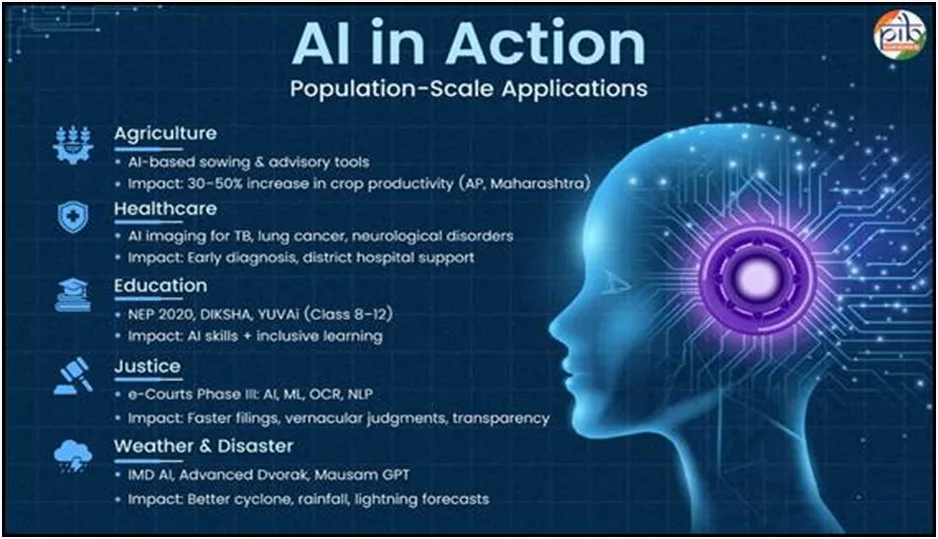
At the top level is the application layer, where AI directly impacts people’s lives. Across the country, AI applications are helping farmers make informed decisions, helping doctors detect diseases earlier, and improving the efficiency of public services. India’s ‘AI Diffusion’ approach prioritizes widespread adoption of real-world use cases so that the technology leads to tangible social and economic benefits.
Below the application is the AI model layer, which is the intelligence engine of the ecosystem. Under the IndiaAI mission, 12 indigenous AI models are being developed to address India’s unique needs. Startups building these sovereign models receive subsidized computing support, with up to 25% of costs covered by grants and equity, lowering barriers to entry.
BharatGen is driving India-centric infrastructure and multimodal models across billions to trillions of parameters. Meanwhile, IndiaAIKosh has emerged as a national repository hosting 5,722 datasets and 251 AI models provided by 54 entities across 20 sectors as of December 2025. Indian innovators are also exploring frontiers. Sarvam AI has developed large-scale language and speech models for Indian languages and is also developing Bbashini under the National Language Translation Mission. already hosts over 350 AI models and enables multilingual digital access.
Powering these models is the core of AI: the compute layer. India has committed over Rs 10,300 crore to the IndiaAI Mission and is expanding affordable access through the IndiaAI Compute Portal. This provides shared cloud access to over 38,000 GPUs and over 1,050 TPUs at subsidized rates of less than ₹100 per hour. A secure national GPU cluster with 3,000 next-generation processors has also been established for strategic applications.
Complementing this effort, the Rs 76,000-crore India Semiconductor Mission has approved 10 semiconductor projects and indigenous chip initiatives such as SHAKTI and VEGA processors are strengthening the country’s hardware capabilities. The National Supercomputing Mission has already deployed over 40 petaflops of capacity and is supported by flagship systems such as PARAM Siddhi-AI and AIRAWAT.
Equally important is the data center and network infrastructure layer, which is the home and highway for AI. India-wide fiber optic backbone and rapid 5G rollout currently covers 99.9% of districts and 85% of population, ensuring high-speed data movement. The country currently has about 960 MW of installed data centers, accounting for about 3% of the world’s data center capacity, and is expected to rapidly increase to 9.2 million kW by 2030.
MUMBAI – Navi Mumbai tops the list as the largest hub along with Bangalore, Hyderabad, Chennai, Delhi-NCR, Pune and Kolkata. Global technology leaders are building on this momentum with major initiatives such as Microsoft’s Rs 1,500-crore investment, Amazon’s Rs 2,900-crore cloud expansion and Google’s Rs 1,250-crore AI hub in Visakhapatnam.
It is the energy layer that supports the entire ecosystem. India met a record peak demand of 24,249 GW in 2025-26, while limiting the shortfall to just 0.03% and ensuring reliable power for AI workloads. The total installed capacity reached 509.7 GW, with non-fossil resources accounting for more than 51 percent. Plans to develop 57 GW of pumped storage and 43,220 MWh of battery storage will further stabilize the grid. The SHANTI Act also positions nuclear energy, including small modular nuclear reactors, as a reliable, clean power source for energy-intensive AI infrastructure.
These collaborative investments are building a resilient, sovereign, and inclusive AI ecosystem. India is empowering applications, models, computing, infrastructure and clean energy in parallel to ensure that artificial intelligence scales responsibly and equitably. Driven by a vision of AI for humanity, the India AI Stack transforms data and computing into real-world public value, driving innovation, independence, and well-being in the digital age.
(Courtesy of Srinagar Press Information Bureau)