image:
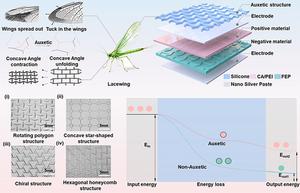
- Biologically inspired auxetic triboelectric nanogenerators exploit negative Poisson’s ratio to resolve interfacial mechanical mismatches. A “conformal self-adaptation” mechanism with bond curvature maximizes contact area and signal stability on curved surfaces.
- The optimized structure improves the bending mode energy conversion efficiency by a factor of 3.2 compared to the non-auxetic control and ensures robust energy harvesting performance even under dynamic deformation.
- The combination of an integrated self-powered sensor array and convolutional neural network deep learning model enables intelligent object recognition with 98.7% accuracy, demonstrating accurate human-machine interaction capabilities.
view more
Credit: Wei Wang, Xuechuan Wang*, Linbin Li, Yi Zhou, Wenlong Zhang, Long Xing, Long Xie, Yitong Wang, Ouyang Yue*, Xinhua Liu*.
Self-powered flexible sensors have revolutionary potential for wearable electronics and human-machine interfaces, but their widespread deployment remains constrained by dynamic mechanical mismatch at the device-skin interface and energy dissipation during complex deformations. Now, researchers at Shaanxi University of Science and Technology, led by Professors Xuechuan Wang, Ouyang Yue, and Xinhua Liu, have developed a biologically inspired auxetic triboelectric nanogenerator (Auxetic-TENG) that solves these fundamental challenges through negative Poisson’s ratio engineering.
Why this sensor is important
Traditional flexible materials exhibit positive Poisson’s ratio. This means that when stretched or bent, it contracts laterally, causing edge curling and delamination from curved surfaces such as joints. This mechanical mismatch significantly reduces the effective contact area, signal fidelity, and energy harvesting efficiency. New auxetic metastructures overcome this limitation by expanding laterally under axial strain and maintaining tight conformal contact through bond curvature.
Innovative design and mechanism
Inspired by the reentrant lattice structure of lacewing wings, the device features a hexagonal metastructure with triangular ligaments that create negative Poisson’s ratio behavior. Upon bending, the structure undergoes a dome-like cohesive expansion rather than a saddle-like anti-clast contraction. This “conformal self-adaptive” mechanism ensures gap-free contact with biological tissue while minimizing loss of mechanical energy. This metastructure integrates PEI-modified collagen as the positive triboelectric layer and micropatterned fluorinated ethylene propylene (FEP) as the negative layer, unified by an auxetic silicone framework.
outstanding performance
Auxetic-TENG provides an output voltage of 478V with an energy conversion efficiency of 13.8% in linear contact separation mode. It achieves an efficiency of 7.58% under complex bending conditions, which is important for wearable applications. This corresponds to a 3.2-fold improvement compared to the non-auxetic control (2.37%). The device maintains a stable output (58V) and delivers 3.175 V kPa.-1 Sensitivity with fast response time of 47ms. Combined with a convolutional neural network (CNN) deep learning model, the system achieves 98.7% accuracy on object recognition tasks and enables intelligent haptic recognition for diverse material classifications.
Application examples and future prospects
This bioinspired design establishes a universal strategy for mechanically adaptive, self-powered sensors that can monitor dynamic joint movements without signal degradation. This technology paves the way for advanced prosthetics, robotic skin, and human-machine interfaces that combine mechanical compliance, energy efficiency, and intelligent sensing. By turning mechanical mismatches into geometric adaptations, this research paves the way for next-generation wearable electronics that integrate seamlessly with the human body.
journal
nano micro characters
Research method
news articles
Article title
Bio-inspired auxetic metastructures enable ultra-efficient self-powered sensing with biomechanically adapted machine learning
Article publication date
March 18, 2026
Disclaimer: AAAS and EurekAlert! We are not responsible for the accuracy of news releases posted on EurekAlert! Use of Information by Contributing Institutions or via the EurekAlert System.