


Machine learning has made great strides, with the Transformer emerging as the leading architecture for language modeling. These models have revolutionized natural language processing by enabling machines to accurately understand and generate human language. The efficiency and scalability of these models remain significant challenges, especially as traditional attention mechanisms scale linearly with sequence length. Researchers aim to address this issue by exploring alternative methods that maintain performance while increasing efficiency.
A key challenge in this field is improving the efficiency and scalability of these models. Traditional attention mechanisms used by Transformer scale linearly with the length of the sequence, making them limiting for long sequences. Researchers are trying to address this issue by exploring alternative methods that maintain performance while increasing efficiency. One such challenge is the significant computational demands and memory usage associated with traditional attention mechanisms, which limits their ability to effectively handle long sequences.
Existing work includes structured state-space models (SSMs) that provide linear scaling during training and constant state size during generation, which are well suited for long-range tasks. However, integrating these models into existing deep learning frameworks remains challenging due to their unique structure and optimization requirements. While SSMs have demonstrated good performance on tasks requiring long-range dependencies, their integration and optimization within established deep learning frameworks requires assistance.

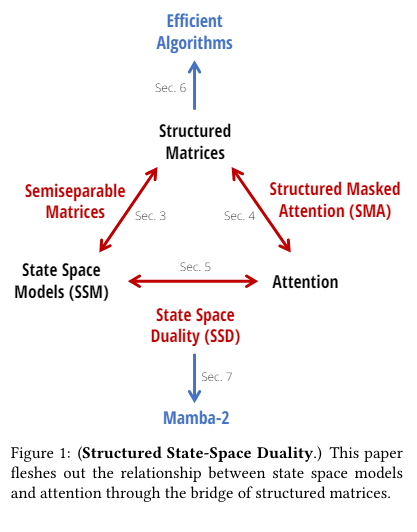
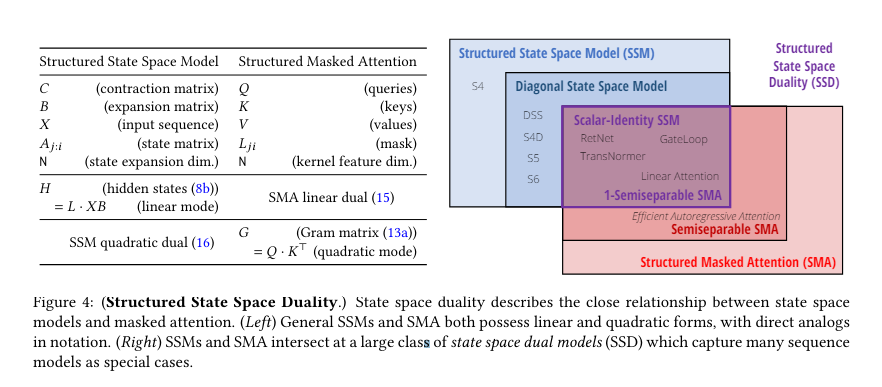
Researchers from Princeton and Carnegie Mellon Universities present the State Space Duality (SSD) framework, which combines SSM and attention mechanisms. This new architecture, Mamba-2, improves on selective SSM, achieving 2-8x speedup over its predecessor while maintaining performance competitive with Transformer. Mamba-2 leverages the efficiency of matrix multiplication units in modern hardware to optimize the training and inference process. The SSD framework allows us to leverage specialized matrix multiplication units, resulting in significant improvements in computational speed and efficiency.
At the core of Mamba-2's design is a set of efficient algorithms that exploit the structure of semi-separable matrices. These matrices allow for optimal compute, memory usage, and scalability tradeoffs, resulting in significant improvements in model performance. The research team improved Mamba-2 using a variety of techniques, including the use of matrix multiplication units on GPUs called tensor cores. These tensor cores significantly speed up the computational process. To further improve efficiency, the model integrates grouped value attention and tensor parallelism, borrowed from Transformer optimization. The Mamba-2 architecture also utilizes selective SSM, which can dynamically choose to focus on or ignore an input at each timestep, resulting in better information retention and processing. The training setup follows the GPT-3 specification, uses the Pile dataset, and follows the training recipes of previous models. These innovations allow Mamba-2 to balance compute and memory efficiency while maintaining high performance, making it a robust tool for language modeling tasks.

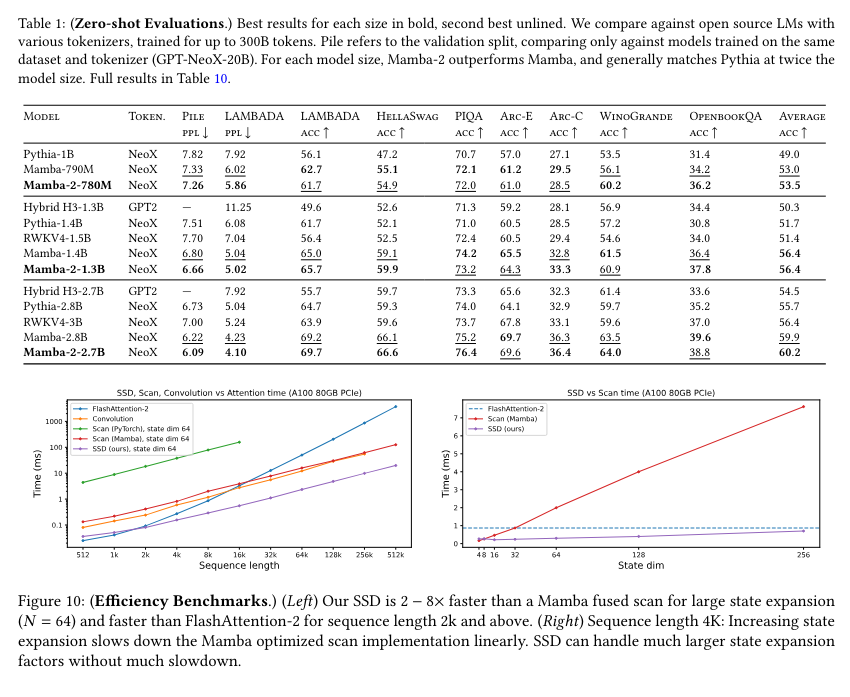
Mamba-2's performance has been verified across various benchmarks and has proven to be superior to previous models, achieving better perplexity and real-time performance, making it a robust alternative for language modeling tasks. For example, Mamba-2, with 2.7 billion parameters trained on 300 billion tokens, outperforms its predecessor and other models such as Pythia-2.8B and Pythia-6.9B in standard downstream evaluations. The model achieves notable results, including lower perplexity scores and faster training times, validating its effectiveness in real-world applications.
With regard to certain performance metrics, Mamba-2 shows significant improvements: it achieves a perplexity score of 6.09 on the Pile dataset versus 6.13 for the original Mamba model. Additionally, Mamba-2 achieves 2-8x faster training times through efficient use of tensor cores for matrix multiplication. These results highlight the efficiency of the model in handling large-scale linguistic tasks, making it a promising tool for future advances in natural language processing.

In conclusion, this work introduces an innovative method to bridge the gap between SSM and attention mechanisms, providing a scalable and efficient solution for language modeling. This advance not only improves performance but also paves the way for future developments in the field. The introduction of the SSD framework and the Mamba-2 architecture provides a promising direction for overcoming the limitations of traditional attention mechanisms in Transformer.
Please check paper. All credit for this research goes to the researchers of this project. Also, don't forget to follow us. twitter. participate Telegram Channel, Discord Channeland LinkedIn GroupsUp.
If you like our work, you will love our Newsletter..
Please join us 43,000+ ML subreddits | In addition, our AI Event Platform


Nikhil is an Intern Consultant at Marktechpost. He is pursuing a dual degree in Integrated Materials from Indian Institute of Technology Kharagpur. Nikhil is an avid advocate of AI/ML and is constantly exploring its applications in areas such as biomaterials and biomedicine. With his extensive experience in materials science, Nikhil enjoys exploring new advancements and creating opportunities to contribute.


