


This paper addresses the limitations of traditional machine learning approaches, which were developed primarily for data that resides in Euclidean space. In modern machine learning, we increasingly encounter structure-rich data that is non-Euclidean in nature and exhibits complex geometric, topological and algebraic structure. Extracting knowledge from such non-Euclidean data requires a broader mathematical perspective that goes beyond the traditional Euclidean framework. Traditional machine learning methods, developed primarily for Euclidean spaces, fall short when applied to data with complex geometric, topological and algebraic structure, such as the curvature of space-time or neural connections in the brain.
Traditional machine learning techniques are primarily based on Euclidean geometry, with data in flat, rectilinear spaces. While these techniques work well for many traditional applications, they struggle with non-Euclidean data that is common in fields such as neuroscience, physics, and advanced computer vision. For example, Euclidean geometry cannot adequately describe the curved spaces of general relativity, or the complex, interconnected structures of neural networks. Recognizing this limitation, the field of geometric deep learning has emerged, which seeks to extend traditional machine learning techniques to non-Euclidean domains by leveraging geometric, topological, and algebraic structures.
A team of researchers from UC Santa Barbara, Atmo, Inc, New Theory AI, Université Côte d'Azur and Inria, and UC Berkeley propose a comprehensive framework for modern machine learning that integrates non-Euclidean geometry, topology, and algebraic structures. The approach generalizes traditional statistical and deep learning methods to handle data that do not follow traditional Euclidean assumptions. The researchers developed a graphical taxonomy that categorizes these state-of-the-art techniques and makes it easier to understand their applications and relationships. The taxonomy clarifies existing methods and highlights areas for future research and development.
The proposed framework leverages the mathematical foundations of topology, geometry, and algebra to handle non-Euclidean data. Topology studies properties such as connectivity and continuity that persist under continuous transformations, which are important for understanding relationships within complex datasets. For example, in topological data analysis, data points are represented in structures such as graphs and hypergraphs to capture complex connections that go beyond the capabilities of Euclidean space.

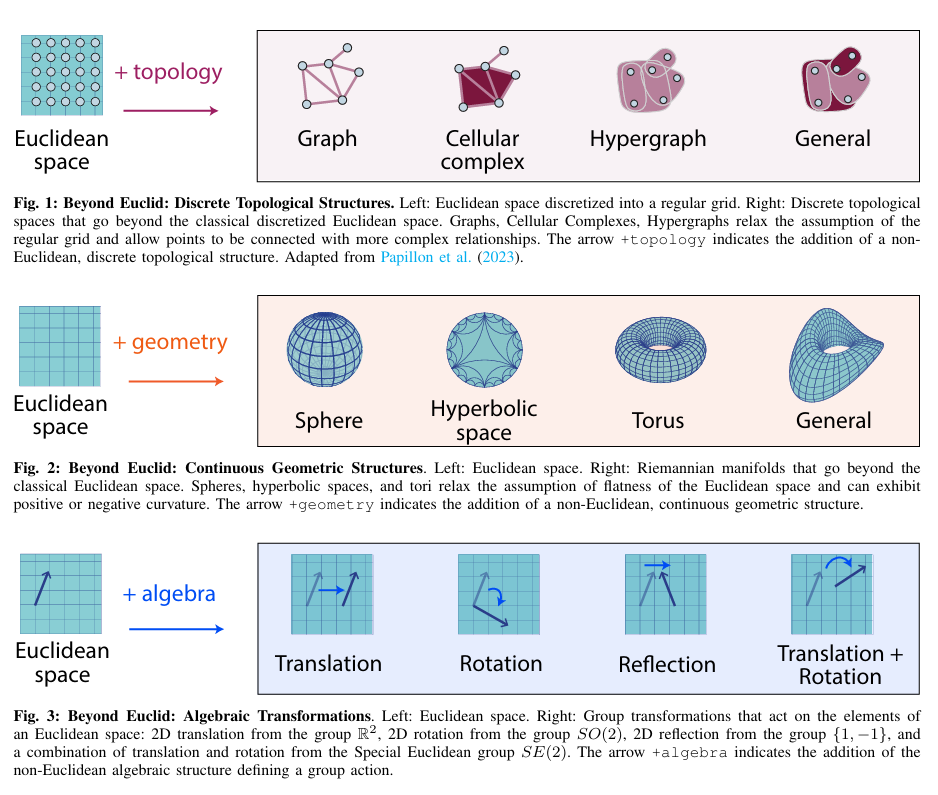
Geometry, specifically Riemannian geometry, is used to analyze data that resides on curved manifolds: spaces that resemble Euclidean space locally but can have curvature globally. Equipping these manifolds with Riemannian metrics allows researchers to define distances and angles that allow data to be measured and analyzed. This approach is particularly useful in fields such as computer vision, where images can be viewed as signals on curved surfaces, and in fields such as neuroscience, where brain activity can be mapped to complex geometric structures.
Algebra provides tools to study data symmetries and invariance through the action of groups. Groups, in particular Lie groups, describe transformations that preserve data structure, such as rotations and translations. This algebraic perspective is essential for tasks that require invariant features, such as object recognition in different orientations. Combining these mathematical tools, the proposed framework enhances the ability of machine learning models to learn from and generalize across non-Euclidean data spaces.
This paper successfully addresses the limitations of traditional machine learning methods in processing non-Euclidean data by proposing a comprehensive framework that integrates topology, geometry, and algebra. This approach broadens the scope of machine learning and opens up new avenues of research and application, marking a major advancement in the field. By bridging the gap between traditional machine learning and the rich mathematical structures underlying real-world data, this approach paves the way for a new era of machine learning that can better capture the inherent complexity of the world around us.
Please check paper. All credit for this research goes to the researchers of this project. Also, don't forget to follow us. twitter.
participate Telegram Channel and LinkedIn GroupsUp.
If you like our work, you will love our Newsletter..
Please join us 46k+ ML Subreddit


Shreya Maji is a Consulting Intern at MarktechPost. She did her B.Tech from Indian Institute of Technology (IIT), Bhubaneswar. An AI enthusiast, she enjoys staying updated with the latest advancements. Shreya is particularly interested in practical applications of cutting edge technologies, especially in the field of Data Science.


