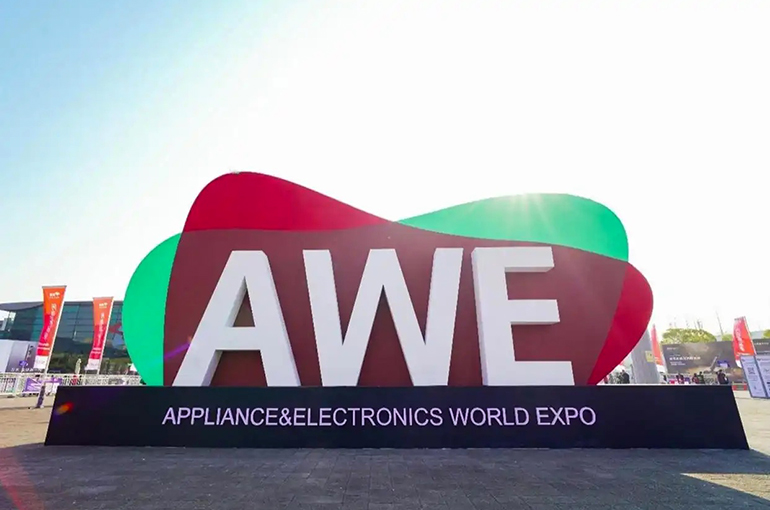
(Yicai) March 12 — The 2026 Appliance and Electronics World Expo opened in Shanghai today, with the participation of more than 1,200 of the world’s leading home appliance and consumer electronics companies, with some products already embedded with AI agents, highlighting the acceleration of the application of artificial intelligence technology.
Midea Group yesterday rolled out its smart home strategy centered on “one interconnected appliance network, one intelligent brain, and one open platform” just before the expo opened. It also debuted its own smart home AI agent, MevoX.
Held over four days, AWE is considered one of the world’s three major consumer electronics shows. This year’s event, with the theme of “Smart AI, Smarter Future”, went beyond its usual venue at the Shanghai New International Expo Center to add a pavilion in the Shanghai East Hub International Business Cooperation Zone dedicated to cutting-edge smart technology products, expanding the total area to 170,000 square meters.
“Midea will enhance the AI transformation of all home appliances in the next three years through an integrated smart home ecosystem,” said Zhao Lei, vice president and president of the Foshan-based company’s smart home business group.
“2026 will be a pivotal year for the evolution and large-scale adoption of AI applications in the home appliance sector,” said Yu Guitao, director of Fotile Group’s Intelligent Kitchen Home Appliance Research Institute.
Fotile has a long-term goal of building a smart kitchen that is completely managed by AI, and is co-developing a cooking robot with the Zhejiang Humanoid Robot Innovation Center. The company plans to begin closed beta testing of its open smart ecosystem among agents this year.
“Home appliance AI agents are evolving from passive command responders to proactive service assistants this year,” Wang Zhiguo, chief technology officer of Skyworth Group, told Yicai. Unlike the traditional model, where users issue commands and machines simply execute them, Wang pointed out that the upgraded AI agents are equipped with memory and autonomous execution capabilities.
For example, users can simply scan a connected Skyworth washing machine’s clothing tag via the mobile app, and the optimal wash mode will be automatically adjusted, Wang notes.
National standards for interconnectivity and interoperability
Recent developments have also created broad consensus among industry leaders to promote uniform national standards for smart home interconnectivity and interoperability.
Sun Liming, vice president of Ningbo-based Fotile, said the core competition in the consumer electronics industry is shifting from standalone product performance to the ability to build a cross-device, cross-service and cross-scenario ecosystem.
Skyworth will install Coolita OS, its proprietary operating system for smart home appliances, on all of its home appliances, as well as upgrade the AI agent built into the smart home control center built into every TV.
“We need to build a shared ecosystem and open the underlying technology platform so that products from all brands can connect and work together smoothly,” Zhao pointed out. He added that Midea’s smart home appliances already offer seamless interconnection with mobile phones and vehicles from multiple other brands.
The Ministry of Industry and Information Technology is leading the development of mandatory national standards on interoperability, targeting the “last barrier” that prevents consumers from enjoying a consistent, cross-brand smart home experience, said Qu Zongfeng, vice president of the China Academy of Home Appliances. “Only open collaboration can truly break down industrial silos and bring smart appliances into the home at scale.”
The standardization roadmap for the smart home industry was announced during the AWE opening ceremony. The China Home Appliances Association and the China Communication Standards Association will also hold private seminars at the expo to discuss the development of car and home interconnection standards.
“AI agents have been widely applied in smart home devices, and cross-category interconnection scenarios such as vehicle-home interaction have already been introduced,” an industry source told Yicai. “The national smart home interoperability standards are expected to be finalized and announced by the end of next year,” the official said.
Officials emphasized that smart home appliances can only penetrate the mass market by significantly improving the user experience.
Editor: Shihua Tang, Martin Kadyev