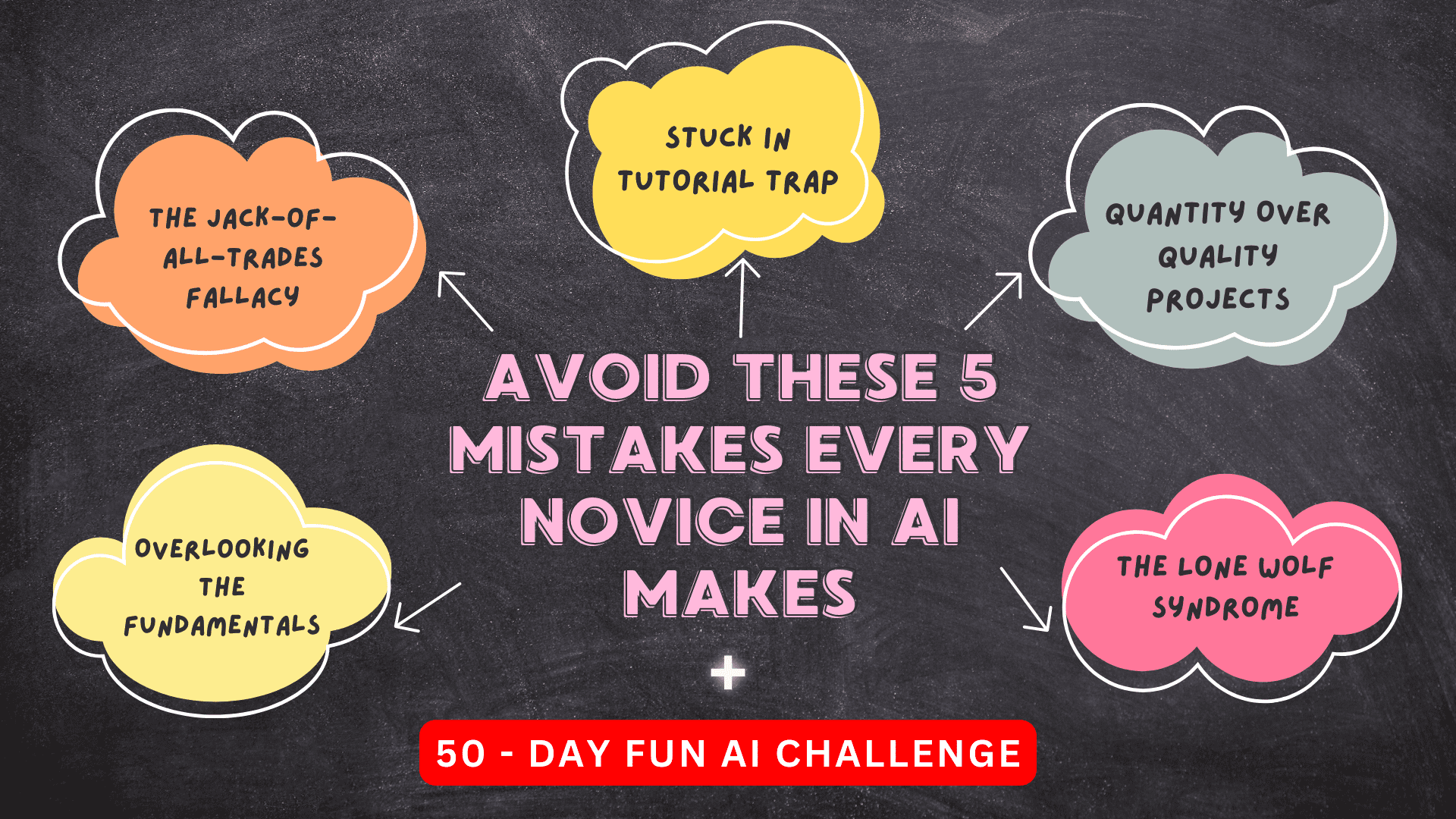
Image by author
Have you ever heard the following quote from Albert Einstein?
Insanity is doing the same thing over and over again and expecting different results.
This is the perfect reminder for anyone starting their AI journey. As a beginner, it's easy to feel overwhelmed by the sheer amount of information and resources available to you. You may find yourself making the same mistakes that countless others have made before you. But why waste time and energy repeating such mistakes when you can learn from their experiences?
As someone who has spoken with experienced practitioners in this field, I was always curious to learn about their AI journey. I quickly realized that many of them encountered similar challenges and pitfalls early on. That's why I'm writing this article. In order to share his 5 most common mistakes that AI beginners often make and help you avoid them.
So let's get started:
1. Ignoring the basics
Newbies to AI tend to get excited about fancy algorithms and powerful frameworks. However, just as a tree needs strong roots to grow, understanding AI requires a solid foundation. Ignoring the math behind these components can hold you back. Frameworks exist to help computers perform calculations, but it's important to learn the underlying concepts and not rely solely on black-box libraries or frameworks. Many beginners start with tools like scikit-learn, and while they may get results, they often have trouble analyzing performance or explaining the results. This usually happens because you ignore theory. Learning these core concepts is essential to being a successful AI developer.
Determining what skill sets separate great AI developers from beginners is not a simple one-size-fits-all answer. It's a combination of several factors. However, in this discussion of the fundamentals, it is important to emphasize the importance of problem solving, data structures, and algorithms. Most ML companies evaluate these skills during the hiring process, and mastering these skills will make you a stronger candidate.
2. Jack-of-all-trades fallacy
You may have seen LinkedIn profiles claiming expertise in AI, ML, DL, CV, NLP, etc. It's like a long list of mind-boggling skills. Maybe it's because of social media and the “full stack developer” trend that people compare AI to. But let's be real here. Living in a fantasy world is of no use. AI is a very vast field. Knowing everything is unrealistic and trying to know can lead to frustration and burnout. Think about it this way. It's like trying to eat an entire pizza in one bite, which is totally unrealistic, right? Instead, focus on getting really good at a particular area. By focusing and investing time in mastering one aspect of AI, you can make a meaningful impact and stand out in the competitive world of AI. So don't spread yourself too thin and let him focus on becoming an expert at one thing at a time.
3. Falling into the tutorial trap
I think the biggest mistake beginners make is getting overwhelmed by the countless online tutorials, courses, books, and articles available when learning AI. Learning and attending these courses is not a negative thing. However, my concern is that they may not find the right balance between theory and practice. Spending too much time on tutorials without actually applying what you've learned can lead to a frustrating situation known as “tutorial hell.” To avoid this, it's important to test your knowledge by working on real projects, trying out different datasets, and continually working to improve your results. Additionally, you will find that some of the concepts taught in the course do not necessarily work best for your particular dataset or problem. For example, I recently watched his session on adjusting LLM and Direct Preference Optimization with DeepLearning.ai. There, Huggingface research scientist ED Beeching said that his original Direct Preference Optimization paper used his RMSProp as the optimizer, but that Adam was found to be more effective. Ta. their experiments. These things can only be learned by gaining practical experience and diving into real work.
4. Quality over quantity projects
When beginners want to show off their AI skills, they are often tempted to create numerous projects to demonstrate their expertise. However, it is important to prioritize quality over quantity. The resume of someone who works for a major technology company will have 2-3 strong projects instead of his 6-10 small or mediocre projects like many other companies. often. This approach is beneficial not only to your job prospects but also to your studies. You can gain a deeper understanding of the subject. Rather than following YouTube tutorials or building a bunch of average projects, consider investing a month or so of your time and energy in a project that has long-term value. This approach steepens the learning curve and truly emphasizes understanding. It can also make your resume stand out from the crowd. Once you're employed, you won't have much trouble transitioning to your actual job.
5. Lone Wolf Syndrome
We understand that different people have different work preferences. Some people prefer to work alone, while others seek support. For those new to machine learning, it can be overwhelming, and working in isolation can hinder growth. We highly recommend joining the AI community on platforms like Reddit, Discord, Slack, LinkedIn, and Facebook. If you're new to the community, consider finding an AI mentor for guidance and support. Discuss your project with them, ask for advice, and learn about better approaches. This not only makes the learning process fun, but also saves you time. We don't recommend posting questions or contacting mentors as soon as you encounter a problem, but you should always try to solve it yourself first. But after a certain point, it's okay to ask for help. This approach will prevent burnout, enhance your learning, and ultimately make you feel good about yourself for having gained knowledge about what you tried and what didn't work.
50 Day Challenge: Boldly Embrace Your AI Skills and Level Up
In this article, we have discussed the 5 most common mistakes that beginners should definitely avoid.
I have exciting challenge For everyone. As a responsible member of this community, we encourage you to take action and apply these tips to your own AI efforts. Click here for the 50 Day Challenge.
1. Please write “Challenge Accepted” in the comment section below. (If the comment field does not appear, please reload the page. It may take some time to appear.)
2. Spend the next 50 days focusing on these 5 tips and implementing them in your AI learning.
3. Come back to this article after 50 days and share your experience in the comments. Let us know how these tips made a difference in your life and how they helped you grow as an AI practitioner.
We want to hear from you and learn about your progress. Additionally, if you have any suggestions or additional tips for other readers, please share them. Let's help each other grow.
kanwar mereen Kanwal is a machine learning engineer and technical writer with a deep passion for the intersection of data science, AI, and healthcare. She co-authored her e-book “Maximize Productivity with ChatGPT”. She champions diversity and academic excellence as her 2022 Google Generation Scholar of APAC. She has also been recognized as a Teradata Diversity in Tech Scholar, Mitacs Globalink Research Scholar, and a Harvard WeCode Scholar. Kanwal is a passionate advocate for change and she founded FEMCodes to empower women in STEM fields.