

Important facts:
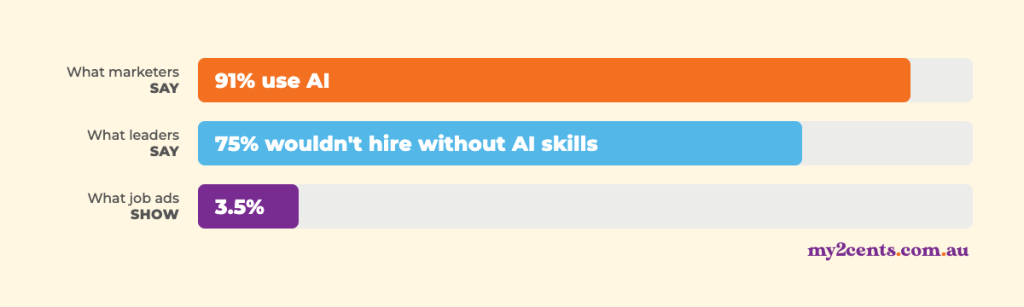
• 91% of Australian marketing businesses use AI (BizCover, 2025)
• 75% of Australian leaders would not hire without AI skills (Microsoft/LinkedIn WTI, 2024)
• 3.5% of around 13,000 marketing job ads in Australia seek AI skills (My2Cents, January-April 2026)
• 84% of university marketing curricula do not include AI content (My2Cents, March 2026)
• Bond University (79%) and UQ (61%) are clear positive outliers.
• One in four Australian employees use AI without telling their boss (AHRI, December 2025)
• Only 30% of Australian organizations have implemented AI policies in the workplace (KPMG, 2025)
91% of Australian marketers use AI. Three out of four leaders say they wouldn’t hire without it. Only 3.5% of marketing job ads actually ask for it.
Sydney, May 8, 2026 — 91% of Australian marketers say they use AI (BizCover, 2025). Three in four Australian business leaders say they would not hire someone without AI skills (Microsoft/LinkedIn Work Trend Index, 2024). Of the approximately 13,000 marketing job ads posted on Australia’s major job sites in the past four months, only 3.5 per cent are actually seeking job ads (My2Cents, April 2026).
own My2Cents analysis This reveals a major blind spot in hiring: a significant gap between what marketers claim they are doing with AI and what employers are actually looking for.
My2Cents evaluated the role of marketing against a four-level AI capability framework. Performative → Competent → Adoptive → Transformative. At the lowest level, performative-level roles reference AI in the company’s boilerplate, but do not require AI capabilities in the job description. At the highest level, “transformational” job advertisements explicitly require candidates to use AI to reimagine the way they do marketing work.
Main findings
- Performative AI is the most common form. Across the 13,000 roles analyzed, most references to AI appear in company boilerplate (terms like “AI-powered” or “AI-driven”) rather than actual role requirements. Common patterns include the same AI language repeated across unrelated roles for the same employer, AI-themed taglines attached to traditional event or content jobs, and references to job site matching algorithms as evidence that a role is “AI-enabled.”
- The university paradox. Australian universities are recruiting for AI capabilities that are rarely taught. In March 2026, My2Cents analyzed 629 marketing courses from 32 universities and found that 84% did not include any AI content. But universities are also one of the employer groups where AI is being used more explicitly in job advertising datasets. Bond University (79% of subjects mentioning AI) and the University of Queensland (61%) are clear outliers, although RMIT has recently added two AI-related units to its Bachelor of Commerce: AI in Marketing and Enterprise AI and Business Analytics.
- Shadow AI is a symptom of that. Employees are already using AI in the workplace, often without permission, guidance, or oversight. Around one in four Australian employees use AI tools without telling their boss (AHRI/HRM Magazine, December 2025) and one in three upload sensitive data without supervision (Josys, September 2025). Only 30% of Australian organizations have implemented AI policies in the workplace (KPMG, 2025).
- The mention of AI covers that gap. If high-performance AI appears in job ads, it’s mentioned in conferences. Managers now preface every suggestion with, “Well, I asked Claude…” In both cases, claims of advanced AI are far ahead of the capabilities to back them up.
Taken together, these findings point to a growing gap between how AI is used and how it is managed. Although 91% of Australian marketing companies say they use AI, only around 30% of Australian organizations have an AI policy in place in the workplace (KPMG, 2025). One in four employees are already using AI without telling their boss (AHRI, December 2025).
“The governance bomb has already been activated and is present on someone’s personal ChatGPT account, and the prompt contains live client data.” Chris Jowsey, co-host of My2Cents and founder of Nugget Digital, said:
The contradictions at universities seem to be getting even more serious. They are recruiting for AI capabilities that they may not yet be teaching consistently, but at the same time they are using AI in increasingly sophisticated ways to recruit and retain students.
”Systems often seem to move faster than the skills they produce. ” Dennis Rainey, co-host of My2Cents and director of Rainy Day Digital, said:
supporting data
According to ADMA’s State of AI in Marketing 2026 (n=1,092), 77% of Australian marketers use AI at work at least weekly and 52% daily. According to Microsoft’s 2024 Work Trend Index, the use of AI in the workplace is 84% across a subset of Australian knowledge workers.
methodology
BizCover’s 91% figure is based on the SME sample of 92 marketing companies in the 2025 Australian SME AI Report. The 3.5 per cent figure comes from My2Cents analysis of approximately 13,000 Australian marketing job ads published on major Australian job sites between January and April 2026, filtering out ads that explicitly mention AI by name. University curriculum data is based on March 2026 My2Cents analysis of publicly available course information across 32 Australian universities and 629 marketing subjects.
The full dataset and interactive competency assessment will be available soon at jobs.my2cents.com.au.
Read the full analysis: https://www.my2cents.com.au/p/the-saydo-gap-in-ai-marketing-hiring
source of information
• BizCover, Australian SME AI Report 2025 (Marketing Businesses subsample, n=92): https://www.bizcover.com.au/blog/how-marketing-businesses-are-adapting-to-ai-in-2025/
• Microsoft / LinkedIn, Work Trend Index Annual Report 2024: https://news.microsoft.com/source/2024/05/08/microsoft-and-linkedin-release-the-2024-work-trend-index-on-the-state-of-ai-at-work/
• ADMA, The State of AI in Marketing 2026 (n=1,092): https://adma.com.au/resources/what-1000-marketers-told-adma-about-ai-adoption-and-what-it-means-for-2026
• AHRI/HRM Magazine, 1 in 4 employees use AI without telling their managers, December 2025: https://www.ahri.com.au/articles/1-in-4-employees-use-ai-without-elling-managers
• QUT/AHRI, State of AI in HR Report Australia, December 2024: https://www.ahri.com.au/wp-content/uploads/AHRI-AI-in-HR-Report.pdf
• Josys / Censuswide, Shadow AI Report 2025, September 2025: https://josys.com/news/shadow-ai-report-australia
• KPMG/University of Melbourne, Trust in AI — Global Insights 2025: https://kpmg.com/au/en/insights/artificial-intelligence-ai/trust-in-ai-global-insights-2025.html
• IBM, Cost of Data Breach Report 2025: https://www.ibm.com/reports/data-breach
• DEWR, NSW Digital TAFE Center of Excellence, 14 April 2026: https://www.dewr.gov.au/newsroom/articles/digital-tafe-centre-excellence-new-south-wales
• My2Cents, Australian Marketing Job Advertisement Analysis (approximately 13,000 ads, January-April 2026): https://jobs.my2cents.com.au/
• My2Cents, Australian University Marketing Curriculum Analysis (32 universities, 629 subjects, March 2026)
About us:
My2Cents is an Australian marketing podcast and community run by Chris Jowsey (Nugget Digital) and Denise Rainey that shares real-time, aggregated data and actionable insights. https://www.my2cents.com.au/
Contact details:
chris jowsey
Co-host, My2Cents | Founder and Managing Director, Nugget Digital
Email: [email protected]
Mobile: 0487 789 600
LinkedIn: https://au.linkedin.com/in/chrisjowsey
Web: https://www.my2cents.com.au/
Dennis Rainey
Co-host, My2Cents | Director, Rainy Day Digital
LinkedIn: https://au.linkedin.com/in/rainey-day-digital


