

Artificial Intelligence (AI) is no longer a futuristic concept confined to research laboratories or science fiction. Today, it is one of the most transformative technologies shaping the global economy, influencing everything from healthcare and finance to agriculture, manufacturing, transportation, and consumer services.
Businesses, governments, and institutions worldwide are increasingly integrating AI into their operations to improve efficiency, automate processes, enhance decision-making, and create more personalized experiences. As data volumes continue to grow and computing power becomes more accessible, AI is moving from experimental applications to mission-critical business solutions.
The rise of generative AI, machine learning, natural language processing, and intelligent automation has accelerated adoption across nearly every industry. Organizations are investing heavily in AI technologies to remain competitive in an increasingly digital world.
According to Renub Research, the Artificial Intelligence Market is expected to grow from US$114.33 billion in 2025 to US$619.77 billion by 2034, registering an impressive compound annual growth rate (CAGR) of 20.66% between 2026 and 2034. Growing adoption of AI-driven automation, cloud computing, predictive analytics, and intelligent business solutions is expected to fuel this remarkable expansion.
Download Free Sample Report
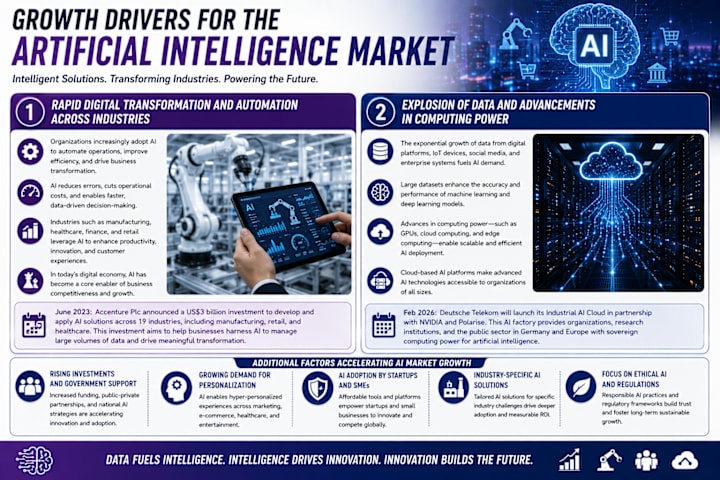
Artificial Intelligence Has Become a Foundation of Digital Innovation
Artificial Intelligence refers to technologies that enable machines and software systems to simulate aspects of human intelligence.
Through sophisticated algorithms and computational models, AI systems can learn from data, recognize patterns, make decisions, solve problems, and continuously improve performance.
Modern AI encompasses a wide range of technologies including machine learning, deep learning, natural language processing (NLP), computer vision, predictive analytics, robotics, and generative AI.
These technologies allow organizations to automate repetitive tasks, analyze vast datasets, optimize operations, and deliver highly personalized experiences.
As digital transformation accelerates globally, AI has become a foundational technology driving innovation across multiple sectors.
AI Is Reshaping Nearly Every Industry
The versatility of artificial intelligence is one of its greatest strengths.
In healthcare, AI supports medical imaging, disease diagnosis, drug discovery, treatment planning, and patient monitoring.
Financial institutions use AI for fraud detection, risk management, algorithmic trading, and personalized banking services.
Retailers rely on recommendation engines, inventory forecasting, pricing optimization, and customer service chatbots.
Manufacturers utilize AI-powered predictive maintenance, quality control systems, robotics, and production optimization tools.
Transportation companies employ AI for route planning, traffic management, autonomous vehicles, and logistics optimization.
The growing diversity of use cases continues expanding AI’s influence throughout the global economy.
Digital Transformation Is Accelerating Adoption
One of the most powerful drivers of AI market growth is the ongoing digital transformation of businesses and organizations worldwide.
Companies increasingly seek ways to improve efficiency, reduce costs, enhance customer experiences, and gain competitive advantages.
AI enables organizations to automate routine processes, improve operational accuracy, and accelerate decision-making.
As enterprises modernize their technology infrastructure, AI often becomes a central component of broader digital transformation initiatives.
Organizations across manufacturing, healthcare, retail, finance, logistics, and government sectors are integrating AI into core operations.
This widespread adoption continues fueling strong demand for AI solutions and services.
Automation Is Revolutionizing Business Operations
Automation remains one of the most compelling applications of artificial intelligence.
Businesses increasingly use AI-powered automation to streamline workflows, eliminate repetitive tasks, and improve productivity.
Automated systems can process transactions, analyze documents, manage customer inquiries, monitor equipment, and perform complex analytical tasks with minimal human intervention.
These capabilities help organizations reduce operational costs while improving accuracy and scalability.
As labor shortages and efficiency demands continue affecting industries worldwide, AI-driven automation is expected to become even more important.
Data Growth Fuels AI Development
The explosion of digital data has created ideal conditions for AI expansion.
Every day, billions of interactions generate massive amounts of information through websites, mobile applications, social media platforms, IoT devices, enterprise systems, and connected technologies.
Artificial intelligence thrives on large datasets because data serves as the foundation for machine learning and predictive modeling.
Greater data availability enables AI systems to learn more effectively, improve accuracy, and generate deeper insights.
Organizations increasingly recognize data as a strategic asset, creating strong demand for AI tools capable of extracting value from information.
The combination of expanding data volumes and advanced analytics continues accelerating market growth.
Cloud Computing Is Making AI More Accessible
Cloud computing has dramatically expanded access to artificial intelligence technologies.
Historically, deploying AI required substantial investments in hardware, infrastructure, and technical expertise.
Today, cloud-based AI platforms allow organizations of all sizes to access advanced machine learning tools, computing resources, and development environments on demand.
This accessibility has democratized AI adoption across industries.
Small and medium-sized enterprises can now implement AI solutions without building extensive internal infrastructure.
The growing availability of cloud-based AI services is expected to remain a major catalyst for market expansion.
Generative AI Creates New Opportunities
The emergence of generative AI has become one of the most influential developments in the technology sector.
Unlike traditional AI systems that primarily analyze and classify information, generative AI can create entirely new content, including text, images, videos, software code, and business insights.
Organizations increasingly use generative AI to enhance productivity, improve customer engagement, automate content creation, and accelerate innovation.
The technology is transforming industries such as marketing, software development, media, education, and customer service.
As generative AI capabilities continue advancing, demand for AI infrastructure, software platforms, and specialized services is expected to increase significantly.
Intelligent Decision-Making Is Driving Enterprise Investment
Modern organizations operate in increasingly complex and competitive environments.
Businesses must analyze vast amounts of information quickly to make informed decisions regarding operations, investments, risk management, and customer engagement.
AI-powered analytics tools help organizations identify patterns, forecast trends, assess risks, and optimize strategies in real time.
This capability enables faster and more accurate decision-making than traditional analytical methods.
The growing need for intelligent business insights continues encouraging enterprise investment in AI technologies.
As organizations prioritize agility and data-driven strategies, AI adoption is expected to expand further.
Machine Learning Remains a Core Technology
Machine learning continues to serve as one of the most important segments within the AI market.
These systems learn from data and improve performance over time without requiring explicit programming for every scenario.
Machine learning applications include recommendation systems, predictive maintenance, customer segmentation, fraud detection, and demand forecasting.
The technology’s flexibility makes it valuable across numerous industries and business functions.
As organizations seek scalable and adaptive solutions, machine learning remains central to AI development strategies.
Deep Learning Drives Advanced Capabilities
Deep learning represents one of the fastest-growing areas within artificial intelligence.
Using neural network architectures inspired by the human brain, deep learning systems excel at processing complex and unstructured data.
Applications include image recognition, speech recognition, language translation, facial recognition, and autonomous systems.
Deep learning enables many of the advanced capabilities associated with modern AI technologies.
Growing computational power and increasing data availability continue accelerating adoption of deep learning solutions globally.
Natural Language Processing Expands Human-Machine Interaction
Natural Language Processing (NLP) has become one of the most visible forms of artificial intelligence.
NLP technologies enable machines to understand, interpret, and generate human language.
Applications include virtual assistants, chatbots, translation services, sentiment analysis, content generation, and customer support systems.
Advances in NLP are making interactions between humans and machines increasingly natural and intuitive.
As businesses prioritize customer experience and automation, NLP adoption is expected to continue growing rapidly.
Healthcare Is Emerging as a Major AI Opportunity
Healthcare represents one of the most promising sectors for artificial intelligence adoption.
AI technologies assist healthcare professionals in diagnosing diseases, interpreting medical images, predicting patient outcomes, developing treatment plans, and accelerating drug discovery.
These capabilities improve clinical accuracy while reducing administrative burdens and operational costs.
The growing demand for precision medicine and personalized healthcare further strengthens AI’s role within the sector.
As healthcare systems worldwide seek greater efficiency and better outcomes, AI investment continues increasing.
Advertising and Media Are Leveraging AI for Personalization
Artificial intelligence is transforming advertising and media by enabling highly personalized consumer experiences.
AI systems analyze user behavior, preferences, and engagement patterns to optimize advertising campaigns and content recommendations.
Media organizations use AI for audience segmentation, automated editing, sentiment analysis, and content creation.
These capabilities improve marketing effectiveness while enhancing customer engagement.
As digital advertising continues dominating marketing budgets, AI-powered insights are becoming increasingly valuable.
Agriculture Benefits from Precision Intelligence
Agriculture is another sector experiencing substantial benefits from AI adoption.
Farmers use AI-powered technologies for crop monitoring, soil analysis, yield prediction, pest detection, irrigation optimization, and precision farming.
These solutions help improve productivity while reducing resource consumption.
Climate change, water scarcity, and growing food demand are increasing the need for intelligent agricultural technologies.
As farming becomes more data-driven, AI is expected to play an increasingly important role in sustainable food production.
Ethical and Privacy Concerns Remain Challenges
Despite its tremendous potential, artificial intelligence faces important challenges.
One of the most significant concerns involves ethics, privacy, and data security.
Many AI systems require access to large volumes of sensitive information, raising concerns about surveillance, data misuse, and cybersecurity risks.
Bias within AI algorithms can also lead to unfair outcomes in areas such as hiring, lending, healthcare, and law enforcement.
Ensuring transparency, accountability, and responsible AI development remains essential for maintaining public trust.
Governments and regulatory bodies worldwide are increasingly focusing on these issues, which may influence future deployment strategies.
Skills Shortages Continue to Limit Growth
The shortage of qualified AI professionals remains another major challenge.
Organizations worldwide compete for experts in machine learning, data science, software engineering, and AI research.
This talent gap can slow implementation timelines and increase development costs.
Educational institutions, governments, and private organizations are investing heavily in workforce development programs to address these shortages.
Building a strong AI talent pipeline will be crucial for sustaining long-term market growth.
United States Leads the Global Market
The United States remains the world’s most influential artificial intelligence market.
Strong technology leadership, extensive venture capital investment, advanced cloud infrastructure, and a vibrant startup ecosystem support continued innovation.
AI adoption is widespread across healthcare, finance, retail, manufacturing, defense, and technology sectors.
Major technology companies and research institutions continue driving breakthroughs in machine learning, generative AI, and cloud-based intelligence platforms.
In June 2025, the U.S. Food and Drug Administration launched Elsa, a generative AI tool designed to assist employees in improving operational efficiency and regulatory workflows.
United Kingdom Accelerates AI Adoption
The United Kingdom continues strengthening its position as a leading AI innovation hub.
The country’s strong digital infrastructure, thriving startup ecosystem, and government support initiatives encourage widespread adoption.
Financial services, healthcare, media, and public sector organizations increasingly integrate AI into operations.
Government-backed training programs are also helping develop a skilled workforce capable of supporting future growth.
India Emerges as a Global AI Powerhouse
India’s AI market is expanding rapidly due to digitalization, abundant technology talent, and strong IT services capabilities.
Organizations across banking, healthcare, education, agriculture, and e-commerce sectors increasingly adopt AI-driven solutions.
Government initiatives supporting digital infrastructure and innovation further accelerate market growth.
India’s combination of skilled talent and cost-effective development capabilities positions it as an important global center for AI services and innovation.
Saudi Arabia Invests Heavily in AI Transformation
Saudi Arabia is rapidly embracing artificial intelligence as part of its broader economic diversification strategy.
Government investments in smart cities, healthcare, energy, and digital transformation initiatives are creating strong demand for AI technologies.
The country has incorporated AI into national development plans and continues attracting international technology companies.
These efforts are helping position Saudi Arabia as a significant AI growth market within the Middle East.
Final Thoughts
The global artificial intelligence market is entering a period of extraordinary growth driven by digital transformation, automation, cloud computing, generative AI, and increasing demand for intelligent decision-making.
As organizations seek greater efficiency, innovation, and competitiveness, AI is becoming an indispensable component of modern business strategy.
With the market projected to grow from US$114.33 billion in 2025 to US$619.77 billion by 2034, opportunities abound for technology providers, investors, developers, and enterprises worldwide.
While challenges related to ethics, privacy, regulation, and talent shortages remain significant, the pace of innovation and adoption continues accelerating across virtually every industry.
As artificial intelligence becomes increasingly embedded in everyday life and business operations, it is poised to remain one of the most transformative technologies shaping the global economy over the next decade.

