

Arm’s disciplined philosophy on power efficiency helped the company grow in smartphones first, leaving it behind Intel and its PC-based mobile chips.
Chip designers haven’t abandoned their principles in the new era of AI computing, with new chip architectures giving us a glimpse of how future chips will be designed.
Arm this week announced a new Cortex-X4 high-performance core targeting mobile devices and a GPU called the G720.
The chipset also includes a Cortex-A720 performance core and a Cortex-A520 power efficient CPU, which can be paired with GPUs in smartphones, tablets and PCs.
The chipset package, dubbed TCS23, combines hardware and software technologies that work on the sidelines to improve AI performance.
The new CPU and GPU deliver higher performance and power efficiency than the previous generation Cortex-A3 released last year.
Cortex-X4 delivers 15% higher performance than Cortex-X3 and consumes 40% less power, Arm said.
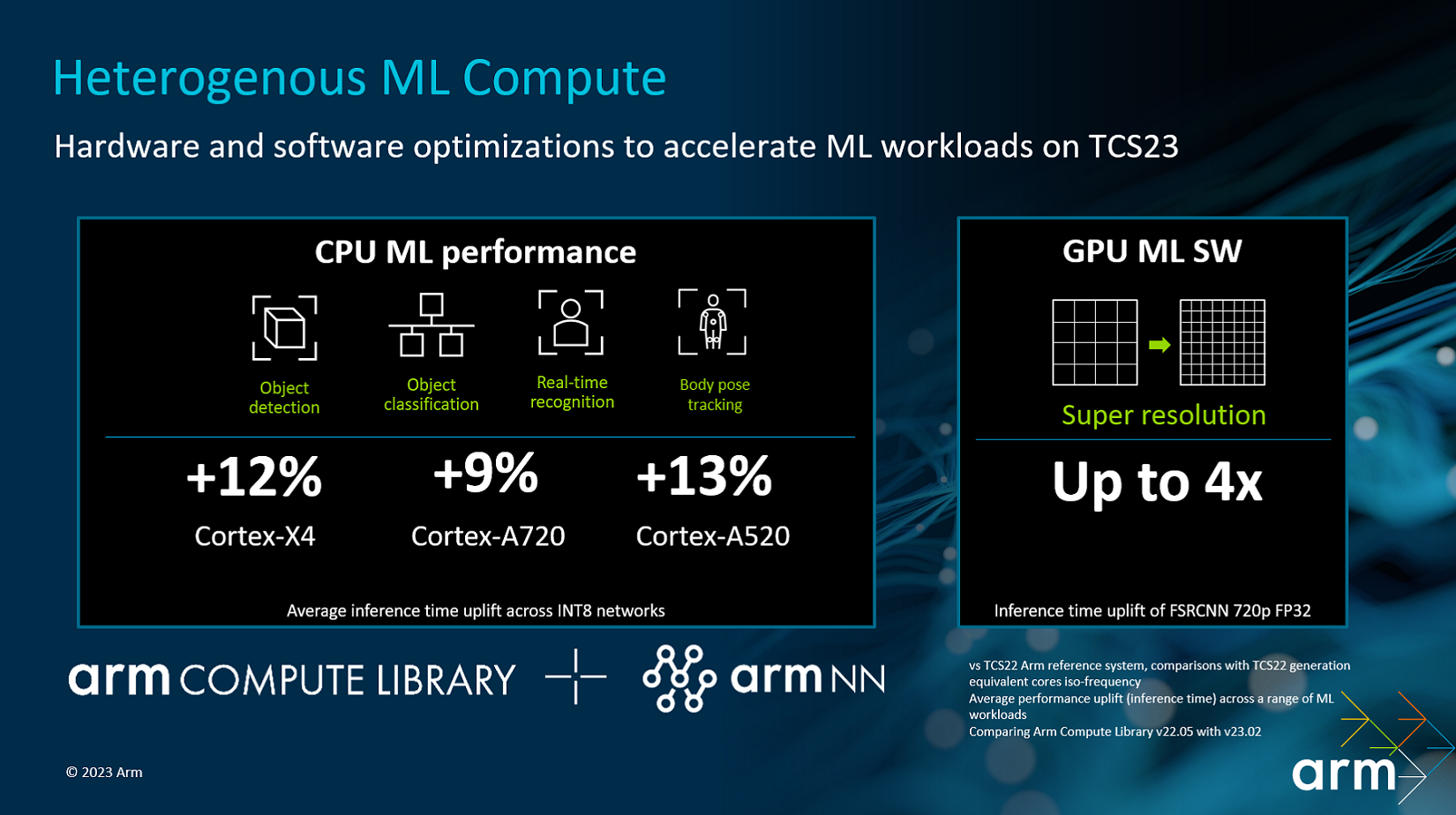
Arm measured 12% faster machine learning performance on the Cortex-X4 compared to last year’s Cortex-A3. The company measured a 9% improvement in ML performance on the Cortex-A720 (compared to the previous generation Cortex-A710) and a 13% improvement on the Cortex-A520 compared to last year’s Cortex-A510.
Arm noted a significant speedup of up to 4x in image upscaling on the G720 GPU using code optimized for fast super-resolution convolutional neural networks.
GPUs also use machine learning capabilities to reconstruct 3D scenes. The G720 GPU has 25% better peak performance and 22% less memory bandwidth usage than his previous generation G715, the company said in his blog entry.
The chipset includes 8 CPUs (1 Cortex-X4 CPU, 5 Cortex-A720 CPUs, and 2 Cortex-A520 CPUs), reducing the number of low-power A520 cores while increasing the number of high-performance cores increase the However, even with low-power CPUs, 32-bit mode has been dropped and only 64-bit applications are supported.
“Being 64-bit will only help partners improve their app development process while providing better compute performance and more security and ML features,” Arm said in another blog entry. says.
With 64-bit-only support, applications load up to 20% faster, “this helps us meet the insatiable demand for more compute across a variety of workloads, especially AI and AAA games,” says Arm. says Mr.
The reason chip makers are dropping 32-bit support is because most applications and operating systems like Windows 11 are only available in 64-bit mode.
Intel is also considering moving to a 64-bit chip architecture with the new x86S ISA.
The new Arm chip design also trained algorithms from Unity Technologies to balance power consumption between the CPU and GPU.
The chip supports nearly 100 Unity ML agents that use AI to predict the behavior of characters and simulations. Preprocessing offloads the GPU and CPU to create a scene from scratch. This is a new feature in Arm’s mobile his chipset.
Google, Qualcomm, Apple, Samsung and others have developed their own neural processors and put them in chips based on the Arm architecture. Arm provides the blueprint for the chip, and a customized neural chip sits on top of the Arm CPU. Many chip companies have licensed Arm’s GPU designs.
Arm said it “will continue to work on developing our GPUs and testing them for new applications for machine learning.”
Related


