
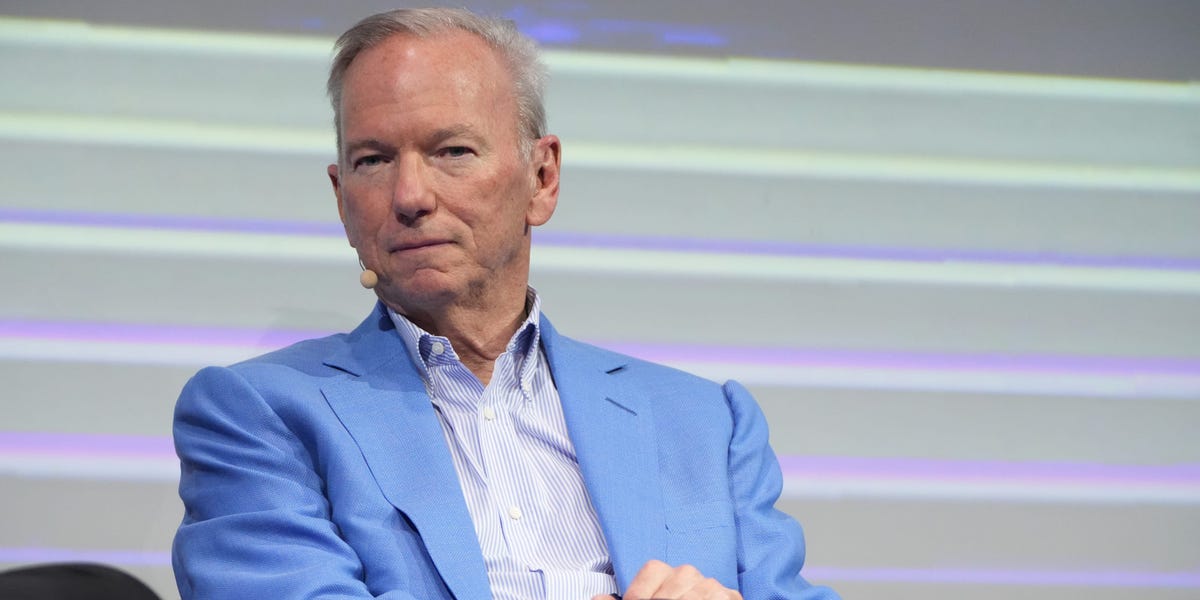
At Friday’s graduation ceremony at the University of Arizona, former Google CEO Eric Schmidt was met with boos when he spoke about AI, a touchy subject for those entering the workforce.
While other speakers received cheers and applause, Schmidt’s speech on the impact of modern technology on society struck a nerve.
“We thought we were adding stones to the cathedral of knowledge that humanity has built over centuries, but the world we built turned out to be more complex than we expected,” Schmidt said, referring to his contribution to modernity. “The same tools that unite us isolate us. The same platforms that give everyone a voice, like the ones you use today, have degraded the public sphere.”
Schmidt added: “In the years since I graduated, no one has sat down and decided to build a technology that would polarize our democracy and unsettle a generation of young people. That wasn’t the plan, but that’s what happened.”
When he mentioned AI, the students booed even louder.
“I know how a lot of people feel about this. I hear you. There’s fear,” Schmidt said, pausing briefly as the screams intensified. “There is a fear that your generation will inherit a future that has already been mapped out, with machines coming in, jobs evaporating, the climate collapsing, politics divisive, and a mess they did not create.”
Schmidt called these concerns “reasonable,” but encouraged people to adapt to the technology and participate in shaping how it will be used in the future.
“The question is not whether AI will shape the world; it will.” Schmidt said. “The question is, can you shape artificial intelligence?”
AI is transforming the global workforce, from the way companies screen potential candidates to the types of skills they seek. Research shows that even though more young people are incorporating AI into their daily lives, they are concerned about what it will mean for their careers.
The technology’s ability to automate many mechanical tasks has led some companies to reduce hiring for entry-level positions. Companies such as Klarna and IBM have already made AI-related job cuts.
A recent Pew Research Center survey found that nearly half of Americans feel “more anxious than excited” about the increasing prevalence of AI in daily life.
Some students had also planned to boo Schmidt ahead of the ceremony over sexual assault allegations made against him last year. Schmidt’s lawyer told Business Insider that the accusations are “trumped up.” In March, a judge ordered the lawsuit to be resolved through arbitration.
A University of Arizona spokesperson said the school invited Schmidt because of his “extraordinary” contributions to technology and innovation.
“He helped build Google into one of the world’s most influential technology companies and continues to advance research and discovery through major philanthropy and scientific initiatives, including a partnership to support important research at the University of Arizona,” the spokesperson said.
Nvidia CEO Jensen Huang also gave a commencement speech at Carnegie Mellon University last week. He took a more positive tone, arguing that AI will increase opportunities for young people to build anything they want. “AI is unlikely to replace you,” he said, acknowledging concerns about the job market. “But there are people who are using AI better than you.”