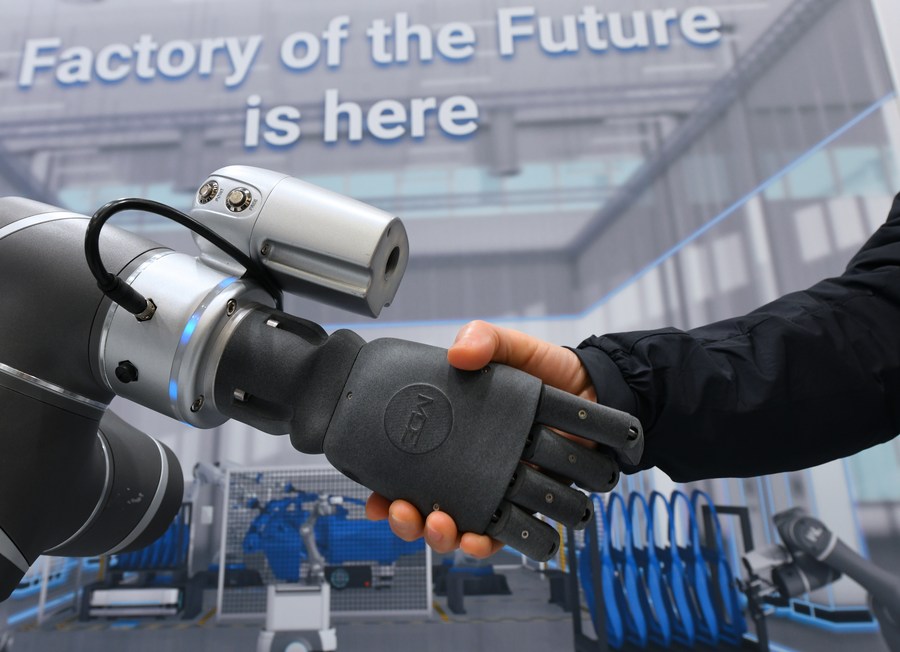
A visitor shakes hands with an intelligent robot at Hannover Messe 2023 in Hannover, Germany on April 19, 2023. (Xinhua/Ren Pengfei)
by Kai-fu Lee
AI 2.0 is coming now.
The cost of commercializing AI 1.0 is too high. Many industries want to take full advantage of AI 1.0, but collecting and labeling data is expensive and the processed data sets and models are isolated from each other. AI 2.0, on the other hand, can use ultra-large data without manual labeling to train underlying models with cross-domain knowledge, making it truly platform-enabled and capable of commercializing applications. Explore innovation.
Generative AI, or Artificial Intelligence Generated Content (AIGC), is popular in China and is the first amazing application of AI 2.0. AI 2.0 models can learn from data in multiple modalities such as text, images, audio, video, and even DNA and proteins to build different levels of cognitive intelligence such as generative, predictive, decision-making, and exploratory. .
So AI 2.0 is not just about the currently popular graphics chatbots and AIGC. These are just early applications of AI 2.0. AI will continue to have many practical application scenes and contribute greatly to high-quality development.
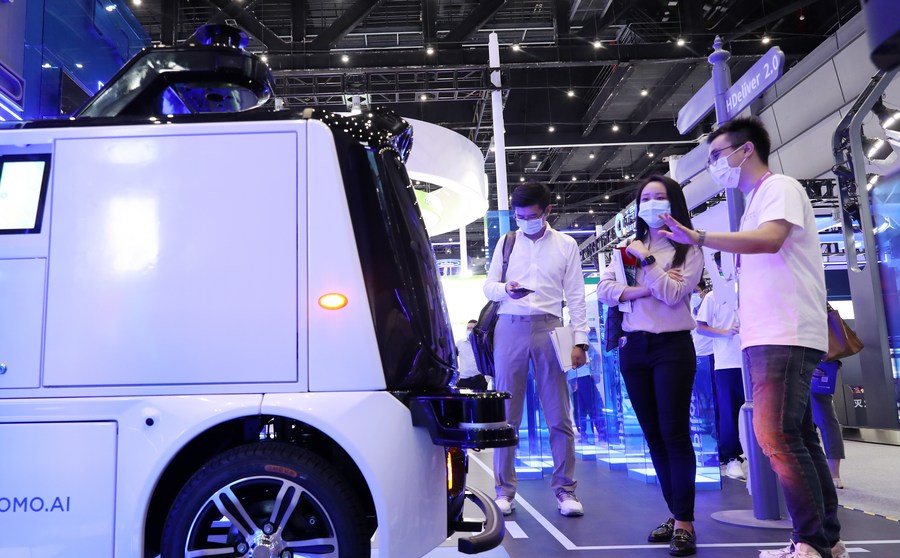
A staff member (R) introduces intelligent logistics vehicles at the 2022 World Artificial Intelligence Conference (WAIC) in Shanghai, East China, September 1, 2022. (Xinhua/Fang Zhe)
First, AI creates unprecedented economic value. According to PricewaterhouseCoopers, AI will create US$15.7 trillion in economic value by 2030. This is important for people’s livelihoods, including eradicating poverty and hunger.
Second, AI frees us from busy, heavy and repetitive tasks through efficient computing, allowing us to spend our precious time on more exciting and rewarding work.
Then, after taking over repetitive tasks, AI plays a key role in quantitative analysis and optimizing results. Coordination with AI will dramatically improve productivity, create opportunities for each individual to maximize their abilities, and contribute to high-quality development.
China’s traditional industries are under pressure from rising labor costs due to a shrinking workforce and slowing population growth. AI effectively addresses this challenge. It is expected to reduce operating costs, improve productivity, expand capacity, and lead to future revenue growth.
For example, XAG, a Guangzhou-based AI company aiming to advance agriculture, is already using AI technology in agricultural production for seed sowing, pesticide application, plant management, and even weather monitoring. Also, Insilico Medicine, an AI company headquartered in Hong Kong, along with other biotech companies, is using AI technology to support drug development, popularize the use of surgical robots, and use big data to improve personal We design unique treatment plans and promote the healthcare industry. .

Inspectors check results generated by an artificial intelligence (AI) model for blood cell testing in a laboratory at Xinqiao Hospital, affiliated with the Army Medical College, in Chongqing, southwestern China, on February 14, 2023. (Distributed by Shimbashi Hospital/Xinhua News Agency)
AI has bright prospects in terms of facilitating quality development, but can remain limited by a lack of creativity, empathy, and dexterity. And even in 2042, it’s possible that these abilities won’t be fully acquired.
AI is good at achieving optimization in a single domain, but it cannot set its own goals or think creatively across multiple domains. A lack of empathy and other emotions means that they are unable to achieve true emotional interaction with humans and provide the care that humans can. Some precise and complex tasks cannot be done by AI. AI has difficulty dealing with unknown or unstructured spaces, especially spaces that cannot be observed.
Also, be careful when applying AI.
False or malicious information is difficult for AI to distinguish. For example, if you tell an AI to create an ad asking parents to buy broken glass to feed their newborn baby, it will return terrible advice. It offers plausible answers to unfamiliar questions until its inaccuracies are clearly exposed.
How to legally apply AI 2.0 is another matter. AI can do customized brainwashing. In other words, AI can entice people into doing things they don’t want to do, shouldn’t do, or are illegal in a variety of ways.
The emergence of AI companies with monopoly power is undesirable, so issues related to antitrust must be taken seriously.
Last but not least, we have to confront the moral dilemma that AI poses. Please solve the trolley problem. In essence, choosing who lives and who dies is a moral judgment that cannot be entrusted to an emotionless AI. AI’s black box cannot explain the reasons for its decisions to the general public due to its different perception method from ours, leading to an exacerbation of the moral dilemma.
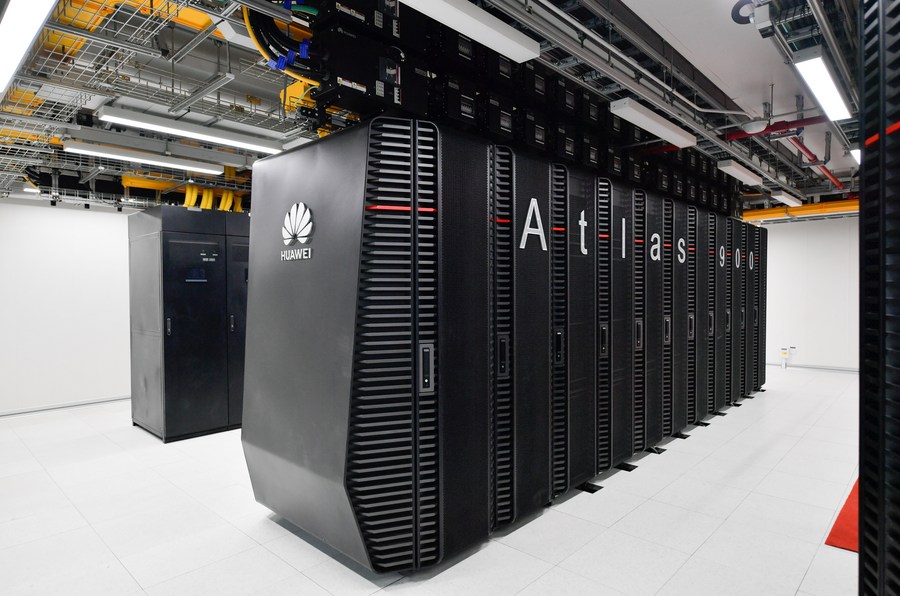
This photo taken on March 20, 2023 shows servers at the Tianjin Artificial Intelligence Computing Center in Tianjin, northern China. (Xinhua News Agency/Sun Fan Yue)
The future will come, but the Terminator will not. Technology is neutral and how we use it is up to us.
AI is not only a product of technological progress, but also a tool that helps us achieve development and improve ourselves. While working together to achieve further advances in AI, we need to make the public more aware of the short-term pain and long-term benefits.
Only by taking a rigorous and responsible approach in the process of accepting advances in AI technology can it achieve true “Tech for Good” and promote high-quality development.
Editor’s Note: Kai-Fu Lee is an AI expert, CEO of Sinovation Ventures, and former president of Google China.
The views expressed in this article are those of the author and do not necessarily reflect the position of Xinhua News Agency.■