

Quantum computing has the potential to solve many problems that are difficult for classical computers to solve because it can compute at breakneck speeds. Quantum Machine Learning (QML) is an emerging field exploring the intersection of quantum computing and machine learning. Several libraries and platforms facilitate the development of QML algorithms and applications. This article describes some popular ones.
Quantum computing uses quantum mechanics to perform computations. While classical computers use bits that can represent 0 or 1, quantum computers use qubits that can exist in multiple states at the same time. This allows quantum computers to perform certain types of computations much faster than classical computers, especially those related to optimization, machine learning, and cryptography.
However, building a quantum computer presents a significant technical challenge, as qubits are highly susceptible to environmental noise and require advanced error-correction techniques. Despite these challenges, there is great interest in the potential applications of quantum computing in fields such as drug discovery, materials science, and artificial intelligence.
Quantum computing has the potential to revolutionize many fields by solving problems currently unsolvable by classical computing. Quantum computing covers many areas and has the potential to impact nearly every area of science and technology. However, the technology is still in the early stages of development and has significant challenges to address in terms of hardware limitations, error correction, algorithm development, as well as scalability and reliability. Nevertheless, with continued research and development, quantum computing could bring significant advances and advances in many areas of science and technology.
In 2020, Google claimed to have achieved quantum supremacy with its Sycamore quantum computer, which completed in just 200 seconds what would have taken the world’s fastest supercomputer 10,000 years.
Other major players in the quantum computing space include IBM, Microsoft, Intel and Honeywell, all of which have developed their own quantum computing technologies and made them available to researchers and developers through cloud-based services. I’m trying
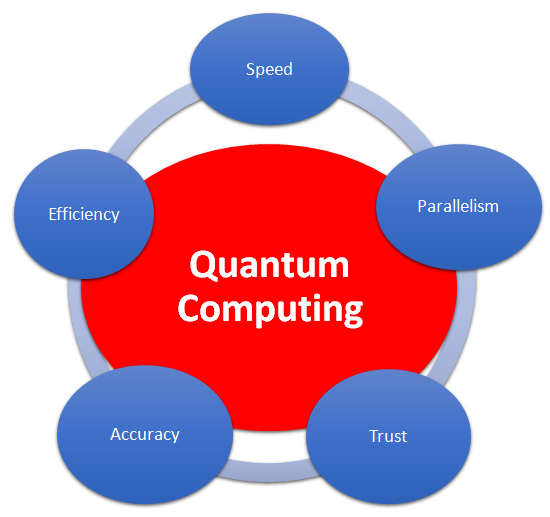
Key Benefits of Quantum Computing
speed: Quantum computers can solve certain problems much faster than classical computers, especially those related to data optimization, machine learning, and cryptography.
Parallel processing: Quantum computing enables massively parallel processing. This means that many computations can be performed simultaneously.
Quantum superposition: Quantum computing can take advantage of quantum superposition, which allows quantum bits (qubits) to exist in multiple states simultaneously. This allows for more complex calculations and faster problem solving.
Quantum Entanglement: Quantum computing can also take advantage of quantum entanglement. This allows us to connect qubits in such a way that the state of one qubit affects the state of other qubits. It can be used to perform certain kinds of calculations much faster than traditional computing.
Improved accuracy: Quantum computing has improved the accuracy of certain calculations over classical computing, such as simulating chemical reactions or modeling financial markets.
safety: Certain algorithms that are difficult to crack in classical computing can be easily cracked in quantum computing, so quantum computing has the potential to improve security over classical computing in areas such as cryptography.
Innovative applications: Quantum computing is a rapidly evolving new field that has the potential to enable a wide range of innovative applications in areas such as drug discovery, materials science and artificial intelligence.
Some of the potential applications of quantum computing are listed below.
- encryption: Quantum computers could break many of the cryptographic algorithms used to protect sensitive data. However, it can also be used to develop new, more secure encryption methods.
- optimization: Many real-world optimization problems, such as supply chain management and logistics, are very difficult to solve with conventional computers. Quantum computers can provide faster and more efficient solutions to these problems.
- Machine learning: Quantum machine learning algorithms can be used to analyze and classify large amounts of data more efficiently than traditional algorithms.
- Chemistry: Quantum computers can simulate molecular behavior and chemical reactions more accurately than classical computers, potentially leading to the development of new materials and drugs.
- finance: Quantum computing can be used to optimize portfolios, risk assessments and other financial calculations.
- weather forecast: Quantum computing can provide more precise and accurate weather forecasts by simulating complex weather patterns and climate models.
- Particle Physics: Quantum computing can be used to simulate particle interactions and accelerate the development of new theories and techniques in particle physics.
Integrating Machine Learning and Quantum Computing
Quantum Machine Learning (QML) is a field exploring the intersection of quantum computing and machine learning. It focuses on developing algorithms and techniques that exploit the unique properties of quantum computing to improve the efficiency and accuracy of machine learning tasks.
Quantum computers use quantum bits (qubits) to perform operations that can solve certain problems exponentially faster than classical computers. This speed is especially advantageous for large-scale data analysis tasks such as machine learning.
One of the main goals of quantum machine learning is to develop quantum algorithms that outperform classical machine learning algorithms on tasks such as classification, clustering, and regression. Proposed quantum machine learning algorithms include quantum support vector machines (QSVM), quantum principal component analysis (QPCA), and quantum k-means. One example of a quantum machine learning algorithm is the Quantum Approximate Optimization Algorithm (QAOA), which is used to solve optimization problems. QAOA is a hybrid algorithm that combines classical optimization and quantum operations to find the optimal solution to a problem.
Another example of quantum machine learning techniques are classical quantum-inspired algorithms. These algorithms are designed to mimic the behavior of quantum systems using classical computers, and may provide better performance for certain tasks.
Platforms and libraries for quantum machine learning
As already mentioned, QML is an interdisciplinary research area at the intersection of quantum computing and machine learning. Several libraries and platforms have emerged in recent years to facilitate the development of QML algorithms and applications. Here are some popular ones.
TensorFlow Quantum (TFQ)
https://www.tensorflow.org/quantum
TFQ is a library developed by Google that allows you to create quantum machine learning models in TensorFlow. It provides a high-level interface for building quantum circuits and integrating them into classical machine learning models.
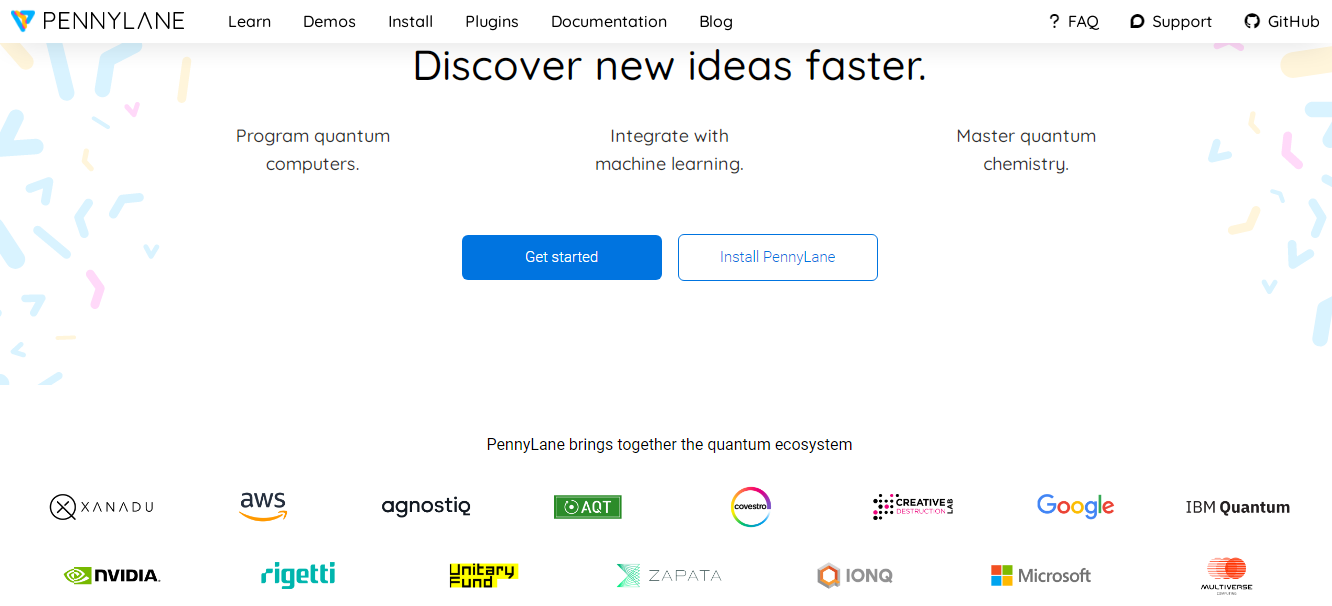
penny lane
https://pennylane.ai/
PennyLane is an open source software library for building and training quantum machine learning models. It provides a unified interface to various quantum hardware and simulators, allowing researchers to develop and test algorithms on various platforms.
Qiskit machine learning
https://qiskit.org/ecosystem/machine-learning/
Qiskit is an open source framework for programming quantum computers, and Qiskit Machine Learning is an extension that adds quantum machine learning algorithms to the toolkit. It offers a variety of machine learning tools, including classical machine learning models that can be trained on quantum data.
pikir
https://pyquil-docs.rigetti.com/en/stable/
Pyquil is a library for quantum programming in Python developed by Rigetti Computing. It provides a simple interface for building and simulating quantum circuits, enabling the creation of hybrid quantum-classical models for machine learning. Forest is a suite of software tools for developing and running quantum applications, also developed by Rigetti Computing. This includes his Pyquil and other tools for quantum programming, as well as a cloud-based platform for running quantum simulations and experiments.
IBM Q experience
https://quantum-computing.ibm.com/
IBM Q Experience is a cloud-based platform for programming and running quantum circuits on IBM’s quantum computers. It contains various tools for building and testing quantum algorithms, including quantum machine learning algorithms.
These are just some of the platforms and libraries available for quantum machine learning. As the field continues to grow, expect to see more tools and platforms emerge to support this exciting area of research.
Implementation scenario
The following code shows how to use quantum circuits to classify two data points into class 0 or class 1 based on the training data set.
Import from qiskit QuantumCircuit, Run, Aer
Import RawFeatureVector from qiskit.aqua.components.feature_maps
# Define training data and labels
training_data = [[1, 0], [0, 1]]
training_labels = [0, 1]

# Define feature map circuit
feature_map = RawFeatureVector(feature_dimension=2, data_map_func=lambda x: x)

# Define quantum circuit
qc = QuantumCircuit(2, 1)
qc.append(feature_map, [0, 1])
qc.h(0)
qc.cx(0, 1)

# Measure qubit 0 to obtain classification result
qc.measure(0, 0)

# Execute circuit on local simulator
backend = Aer.get_backend(‘qasm_simulator’)
job = execute(qc, backend, shots=1024)
result = job.result()

# Print classification result
counts = result.get_counts()
print(counts)
This code first defines a training data set containing two data points and their corresponding labels. Next, we define a feature map circuit that maps each data point to a quantum state. In this case, we use a RawFeatureVector feature map that maps each data point to a two-qubit state.
Next, we define a quantum circuit containing two qubits and one classical bit. We apply the feature map to two qubits, followed by the Hadamard gate on the first qubit, and his CNOT gate between the two qubits. Finally, we measure the first qubit to get the classification result.
Run the circuit on the local simulator and get the measurement result counts. The output will be a dictionary of measurements and their corresponding counts ({‘0’: 483, ‘1’: 541}, etc.).
The results show that the first data point was classified as belonging to class 0 approximately 47 percent of the time and class 1 approximately 53 percent of the time. The actual classification depends on the threshold used to interpret the measurement results.
An example of quantum machine learning for image classification
Below is an example of quantum machine learning applied to image classification using PennyLane and the TensorFlow quantum library.
import pennylane as qml
import tensorflow as tf
import tensorflow_quantum as tfq
from tensorflow.keras import layers

n_qubits = 4 # number of qubits to use in quantum circuit
n_classes = 3 # number of classes to classify images into

# Define a quantum circuit that will act as the classifier
dev = qml.device(“default.qubit”, wires=n_qubits)

@qml.qnode(dev)
def circuit(inputs, weights):
# Encoding the input data as quantum states
for i in range(n_qubits):
qml.RY(inputs[i], wires=i)

# Apply the trainable weights to the circuit
for i in range(n_qubits):
qml.Rot(*weights[i], wires=i)

# Measure the qubits to get the output probabilities
return [qml.probs(wires=i) for i in range(n_qubits)]

# Define the model using TensorFlow Quantum
inputs = tf.keras.Input(shape=(n_qubits,))
weights = tf.Variable(tf.random.uniform((n_qubits, 3)))
outputs = tfq.layers.PQC(circuit, weights)(inputs)
model = tf.keras.Model(inputs=inputs, outputs=outputs)

# Prepare the image classification data
(train_images, train_labels), (test_images, test_labels) = tf.keras.datasets.mnist.load_data()
train_images = train_images.reshape(-1, n_qubits)
test_images = test_images.reshape(-1, n_qubits)
train_labels = tf.keras.utils.to_categorical(train_labels, num_classes=n_classes)
test_labels = tf.keras.utils.to_categorical(test_labels, num_classes=n_classes)

# Train the model
model.compile(optimizer=tf.keras.optimizers.Adam(learning_rate=0.01),
loss=tf.keras.losses.CategoricalCrossentropy())
model.fit(train_images, train_labels, epochs=5)

# Evaluate the model on test data
test_loss, test_acc = model.evaluate(test_images, test_labels)
print(“Test accuracy:”, test_acc)
This code defines a quantum circuit using PennyLane that acts as a classifier for image data. This circuit encodes input data as quantum states and applies trainable weights to the circuit. The qubits are then measured to obtain output probabilities, which are used for image classification.
The model is defined using TensorFlow Quantum, which allows you to integrate quantum circuits with classical deep learning models. The data used in this example is his MNIST dataset of handwritten digits, preprocessed and prepared for image classification. After training the model for 5 epochs, the test accuracy is printed. In this example it is about 0.87. It shows how quantum machine learning can be applied to image classification tasks with promising results.
Quantum machine learning is an exciting and rapidly developing field that has the potential to revolutionize the field of machine learning by using classical algorithms to solve currently difficult problems. While there are still major challenges to be addressed, the potential benefits of quantum machine learning are significant and could have significant implications for many areas of science and technology.

