

Radiance caching

AMD's FSR Radiance Caching is a new technology aimed at reducing the performance cost of ray-traced or path-traced lighting and global illumination in games. First, let's explain the terminology in detail. Radiance refers to the amount and color of light emitted from a point on a surface in a particular direction. Loose caching, on the other hand, means reusing information rather than recomputing it every frame.
A practical goal is to use a learned approximation of the lighting environment to reduce the number of rays that need to be traced, allowing paths to be terminated early while capturing indirect lighting at an acceptable quality level.
Previous descriptions of FSR Radiance Caching have been vague, especially about how much of the system is actually “neural” and when learning occurs. At events like Computex, AMD called this feature Neural Radiance Caching and emphasized continuous learning. Later reviewer materials softened that wording and instead focused on “learning” and “intelligent prediction,” but the name FSR Radiance Caching remained.
To see what's really going on, we looked at the currently available SDK developer documentation. This page has been rewritten accordingly. Radiance Caching is implemented as a fully online machine learning system that trains continuously at runtime. There are no offline or pre-shipment training steps, no baked data bundled with the game, and no one-time compilation or learning phase on first launch. Instead, the neural model starts with default parameters and updates every frame using data generated by the game's path tracer.
The training data comes directly from the camera path traced into the scene. When a ray intersects a polygon, samples are emitted that capture the position, normal, view direction, albedo, and roughness, and are combined with an estimate of the radiance exiting the surface along that ray. These samples are used to update the cache, and in parallel, the same model is queried to provide radiance predictions that are used to terminate other passes early.
In this setting, radiance caching falls clearly into the category of runtime lighting algorithms, rather than precomputed lighting techniques like baked lightmaps. The cache itself is not a lookup table or a set of stored probes, but rather the learned weights of a neural network that approximates the radiation function of the current scene.
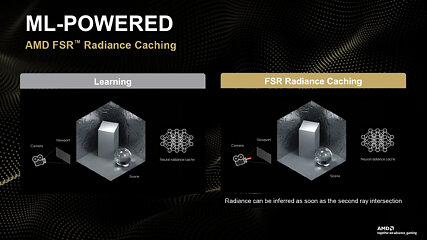
At runtime, the radiance cache is not used immediately when the ray first hits something. Instead, the rays are allowed to bounce around the scene until they are spread out enough that small details are no longer important. At that point, the renderer asks the cache for an estimate of the illumination and stops tracing any further rays. This “final gather” style approach helps hide errors from the cache and preserve hard-to-replace details such as small geometric features, self-shadowing, and reflections. Rays hitting mirror-like surfaces are difficult to approximate reliably, so they are tracked further.
If a cache returns lighting results, it is not used itself. The predictions are scaled by the same weights that the path would normally accumulate and blended back into the path tracer output. In practice, neural caching replaces the most expensive deeper bounces while remaining computationally consistent with traditional ray tracing.
The documentation also makes clear that this is not a freebie. Because the system is trained in real-time using noisy ray tracing samples, flickering and instability can occur, especially in difficult lighting situations. To control this, developers can adjust how quickly the model learns and how aggressively the predictions are smoothed over time. AMD also recommends using techniques like smart light sampling (ReSTIR), path guiding, and slightly coarsening the training rays to initially feed better data to the cache to reduce noise.
This also explains why Radiance Caching is not supported on older RDNA generations (this was also unclear in AMD's own reviewer guide). Older GPUs should be able to handle this just fine if it's pre-trained offline, shipped with the game, and only does inference, but the SDK makes it clear that training is a core part of the workload and is executed every frame. Efficient matrix computation, bandwidth, and support for high-performance machine learning backends are fundamental to the design of this feature, likely also using INT8.
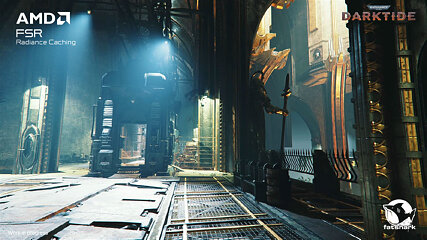
Radiance Caching is currently available as a technical preview for game developers, with early implementation planned for 2026. AMD has confirmed that Warhammer: Darktide will be one of the first titles to feature this feature.
NVIDIA employs a variety of techniques, also known as radiance caching in the broad sense, while AMD's implementation has a different focus. FSR Radiance Caching uses a continuously trained neural model to predict radiance directly, rather than storing radiance samples in probes, grids, or reservoirs. In that sense, a “cache” is not a traditional data structure, but a learned behavior of the network itself.


