- ■
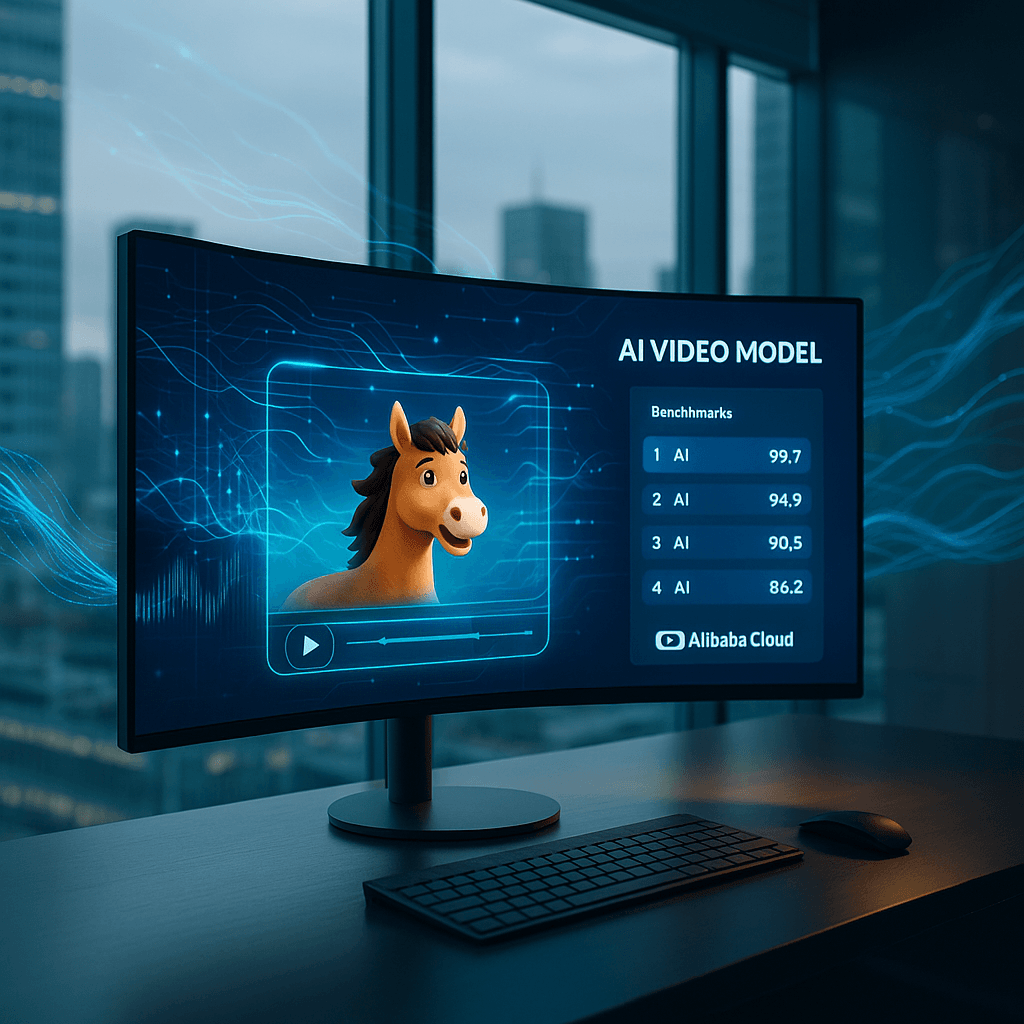
Alibaba confirms it has developed HappyHorse, an AI video model that is dominating performance benchmarks
- ■
The revelation ends speculation about the origins of the mysterious model and signals Alibaba’s serious AI ambitions.
- ■
HappyHorse’s strong benchmark performance puts it in direct competition with OpenAI’s Sora and Google’s Veo.
- ■
This confirmation shows that Chinese tech companies are rapidly closing the gap in generative AI capabilities.
Alibaba has confirmed that it is behind HappyHorse, a powerful AI video generation model that is climbing the leaderboards of global benchmarks, ending weeks of speculation in the AI world. The announcement positions the Chinese e-commerce giant as a serious competitor in the generative AI race, directly challenging OpenAI’s Sora and Google’s Veo in the increasingly competitive video compositing market.
Alibaba has just pulled back the curtain on one of AI’s worst kept secrets. The Chinese tech giant has confirmed that it is backing HappyHorse, an AI video generation model that has quietly climbed global performance leaderboards and sparked intense speculation across the developer community.
This approval marks a key moment in the AI arms race. According to CNBC, HappyHorse has impressive benchmark scores comparable to established players such as OpenAI’s Sora and Google’s Veo. The fact that Alibaba has kept its involvement secret until now suggests a deliberate strategy to let the technology speak for itself before naming it.
In recent weeks, AI researchers and developers have been discussing HappyHorse’s performance on standard video generation benchmarks. The model showed particular strength in temporal coherence and motion quality, two areas where AI video tools have historically struggled. Its sudden appearance on leaderboards with no clear attribution has sparked theories ranging from stealth startups to government labs.
Alibaba’s revelations are not just about claiming credit. This is a statement of intent in the generative AI market, where video synthesis is the next frontier after text and image generation. While Meta and Google have been relatively open about video AI development, Alibaba’s approach mirrors the strategy used by Chinese AI research institutes, which prefer to demonstrate capabilities before formally announcing them.
The timing is especially noteworthy given the current state of AI video generation. OpenAI’s Sora generated a lot of buzz in its February 2024 preview, but has not yet been widely released. Google’s Veo was launched for a limited number of users. That leaves an opening for competitors, and Alibaba seems poised to take advantage of it. The company is aggressively expanding its AI infrastructure through its cloud arm, Alibaba Cloud, which already powers numerous AI applications across Asia.
HappyHorse’s architecture and training methodology remain largely private, but its benchmark performance suggests it’s built on a transformer-based diffusion model similar to other state-of-the-art video generators. What sets this apart seems to be the optimization of longer, more consistent video sequences, although many competitors still produce inconsistent results in this area.
The confirmation also highlights how the Chinese tech giant is positioning itself in the next wave of AI. Nvidia chips are powering much of the Western AI boom, but Chinese companies have developed workarounds amid export restrictions and are investing heavily in alternative chip architectures and more efficient training methods. Alibaba’s ability to create a competitive video model suggests those efforts are paying off.
Alibaba’s entry will change the competitive landscape for developers and companies focused on the AI video field. The company has a track record of rapidly scaling technology through large-scale e-commerce and cloud platforms. If HappyHorse is integrated into Alibaba Cloud services, it will become widely accessible to businesses in Asia and beyond, potentially matching Western competitors in performance but undercutting them in price.
The revelation also raises questions about what else is in Alibaba’s AI pipeline. Companies rarely disclose just one major AI project, and HappyHorse’s secret rollout suggests other models may be in development that have not yet been publicly acknowledged.
Alibaba’s admission that it built HappyHorse shows that the Chinese tech giant is moving from a fast follower to a true innovator, and that the AI video generation race is truly global. As benchmark performance becomes less important than real-world deployment and accessibility, the question shifts from who can build the best model to who can get it into the most hands. With Alibaba’s large distribution network and cloud infrastructure, HappyHorse could quickly become a force in a market where OpenAI and Google have limited reach. For those betting on AI video becoming the next essential business tool, the field is becoming increasingly crowded.