
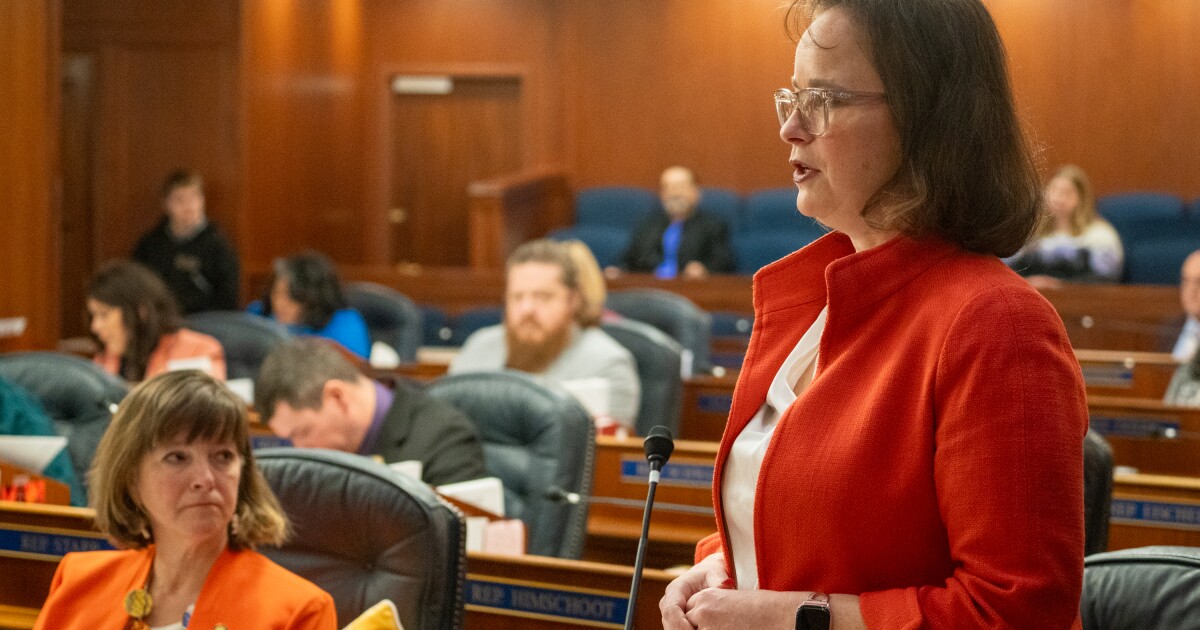
The Alaska House of Representatives on Friday unanimously voted to ban AI-generated child sexual abuse material, a long-standing priority for conservative Rep. Homer. Just before passing the bill, lawmakers significantly expanded its scope, including adding provisions that would severely limit children’s access to social media.
House Bill 47 started with a simple concept. It would amend state laws against child sexual abuse material, formerly known as child pornography, to cover images created with artificial intelligence.
Rep. Sarah Vance, R-Homer, said this is an effort to address gaps in state law.
“The current legal requirement is that you have to prove actual harm to the child,” she said. “What this bill says is that anything that produces indecent material of a minor will be criminalized to the same level as if it were a real child.”
The bill received broad bipartisan support.
“AI is advancing at lightning speed, and Alaska is behind the curve ball,” said Rep. Andrew Gray, D-Anchorage. “We really need guardrails as soon as possible to protect our children first and foremost, and to protect all of us.”
The new bill does more than just protect children. Thanks in large part to a series of amendments by Rep. Zach Fields, D-Anchorage, it also now includes limits on how adults can be depicted in AI.
Certain changes will make it a crime to create synthetic sexual images of real people. He pointed to a recent incident in which Elon Musk’s xAI allowed users of the company’s AI system Grok to create digitally “unclothed” images without the subjects’ consent, prompting an investigation by European Union regulators.
“I agree with the underlying bill, and I don’t think perverts should be able to create lewd sexual material about 19-year-olds,” Fields said.
Another amendment by Fields expands on this by making it a misdemeanor to harass or threaten someone with what the bill calls a “falsified digital likeness” (also known as a deepfake). Fields said this is an effort to combat so-called deepfake revenge porn.
Another amendment proposed by another member state would make AI companies liable to $1 million per incident if their systems are used to create child sexual abuse material.
Lawmakers added them to the bill without much debate or opposition, but Vance expressed concern that the restrictions would need to be narrowly tailored to pass First Amendment scrutiny.
But another addition to the bill drew more significant bipartisan backlash. It’s an extensive package that limits children’s social media use.
It covers a lot of ground. Anyone under the age of 18 in Alaska would need a parent or guardian’s permission to sign up for an account on a social platform, and the bill would give parents full access to their children’s accounts. By default, children will have a social media curfew of 10:30 p.m.
The package would also prevent platforms from advertising to minors or using algorithms to serve content based on minors or their interests. It would also outlaw what the bill calls “addictive features,” or features that reward “excessive or compulsive” use of social media.
Fields argued that regulating social media is a matter of public safety, pointing to a legislative official who was recently arrested for allegedly luring and exploiting children through Snapchat.
Additionally, Fields said this is an effort to reduce the influence of social media companies on children.
“I think the fundamental question with this amendment is: do parental rights trump the rights of predators? And, as we are hearing, do parental rights trump the rights of multinational corporations who are intentionally targeting children with addictive and destructive algorithms?” he said.
Fields said he drew inspiration from a similar proposal in Utah. More than a dozen other states have also passed versions proposed by Fields. While many companies have successfully faced legal challenges from the tech industry on First Amendment grounds, the Supreme Court last year upheld a Mississippi law restricting children’s social media access to remain in effect during pending challenges, suggesting the high court may accept similar restrictions.
Fields’ social media proposal drew bipartisan criticism when it was introduced Wednesday, but none of the criticism led lawmakers to oppose the bill as a whole.
Some lawmakers raised privacy concerns. For example, how do you determine if someone is over 18 or if they are someone’s parent? Others argued that the restrictions could be easily circumvented using widely available tools, such as virtual private networks that hide the origin of Internet traffic, or that the restrictions could violate the First Amendment rights of minors.
Rep. Dan Sadler, an Eagle River Republican, said he’s concerned the social media regulation package will stall the bill before it reaches the Senate.
“If I could vote one vote and get all of this into law and take effect, I would vote right away, preferably twice,” Sadler said. “But this is a very big problem, and I fear it will stall the rest of the good work contained in this bill.”
It wouldn’t be the first time. In 2024, a bill that would have required pornographic websites to verify the age of their users stalled in the Senate after a House member placed restrictions on children’s social media use.
But original sponsor Vance said he wasn’t worried. She was among a group of House lawmakers Friday who asked the Senate to tweak the bill before passing it.
“We have been working on this issue for years, and I know that members of the (Senate) and especially the (Judiciary Committee) plan to advance at least some of these measures,” she said.


