Synthesia, a British video technology startup, has grown into a global software company with annual revenue of more than $100 million by taking a broader view of its business model.
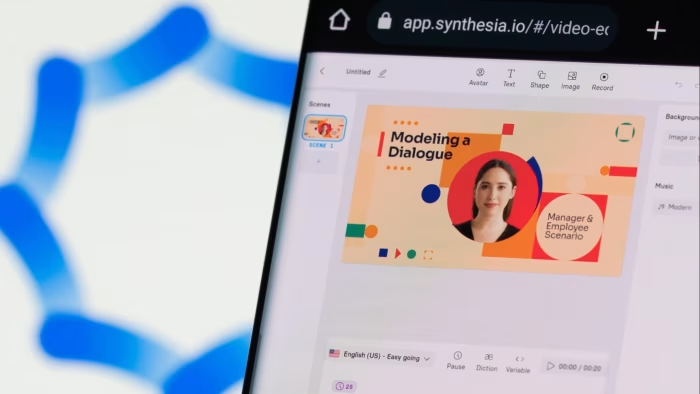
The London-based company develops an online platform that allows businesses to use artificial intelligence to transform text into professional-quality video, and initially offered its AI dubbing products to the video production departments of entertainment and advertising companies.
In the two years since its founding in 2017, the company had only 10 employees and was struggling with a lack of sales. However, management realized that the lack of growth could be due to the relatively niche nature of their product.
Daniel Barten, Synthesia’s head of strategy, said the company’s initial focus was “too narrow,” adding that AI dubbing only offered a solution to “a narrow step within the larger value chain of studio production.”
As Verten and his team continued to network with potential customers, it became clear that there was an even greater opportunity for AI platforms that enable businesses of all industries and sizes to quickly and easily create high-quality videos.
At that time, I realized that the company had to change. “Instead of targeting just a few entertainment studios, we started enabling everyone from small businesses to Fortune 500 companies to turn text-based content like employee training PDFs and customer support documents into engaging videos, all generated in-house using AI in minutes,” says Verten.
In the process, Verten said, the company has not only tapped into a larger market, but created an entirely new market by “making video creation fast, affordable, and accessible to everyone, not just professional video creators.”
Following a $180 million funding round earlier this year that valued the company at $2 billion, the company completed another significant pivot “from video generation to interactive video experiences” through the rollout of the third version of its platform, Verten explained.
The service, called Synthesia 3.0, aims to make videos more interactive through features such as in-video quizzes, clickable “calls to action” within videos, and AI agents that capture participants’ facial expressions and body movements.
These reinvention efforts have paid off. By April 2025, the company’s annual recurring revenue (the projected amount of money a company makes from subscriptions in a year) reached $100 million. Additionally, in the past 12 months, the number of customers who spent $100,000 or more in the first year of their contract has quadrupled, Verten said.
The net revenue retention rate, which measures how successful a company is at increasing spend from existing customers, is 140 percent, which shows the company is not only retaining its customer base, but also “growing revenue from customers through upsells and cross-sells,” Varten said.
According to the company’s financial results, its 2024 revenue increased 82% from the previous year to $58 million, but pre-tax losses more than doubled to $59 million due to a sharp increase in expenses. Head of corporate affairs Alexandru Voica attributed this to “more intentional spending” on new product development, such as video agents, and customer acquisition activities.
He added that “90% of Fortune 100 companies now use Synthesia to create training, support, and corporate communications videos.” The company said its customers include global news publisher Reuters, video conferencing platform Zoom, software group SAP, beer company Heineken and financial research firm Moody’s.
Synthesia has experienced countless challenges in trying to reinvent itself. Evolving from a niche platform to one targeted at all kinds of enterprise use cases, and then scaling it, introduced significant “technical and operational complexity,” Verten said.
On the technology side, the company responded by building an in-house IT infrastructure and products that can produce “thousands of videos per day for large enterprises.” Operationally, the company took steps to improve communication across teams and enable employees to work toward a “common” goal to avoid “organisational growth.” [too] fast”.
Like many AI companies, Synthesia has experienced challenges with user safety and trust. Customers are “demanding” that the company proves its technology is “secure, transparent, and auditable,” Voica explains, as AI models rely heavily on user data and the output can be biased if the underlying datasets aren’t representative of people from a variety of backgrounds. Verten said the company responded by implementing robust cybersecurity, governance, and moderation policies and mechanisms.
Synthesia previously faced criticism from the actors union Equity in 2023 when some of its AI-generated avatars were used to spread political propaganda supporting China and the Venezuelan government. Synthesia subsequently banned these clients from the platform and instituted stricter content moderation practices.
Varten says the lessons he and his colleagues learned to successfully pivot the company include focusing on solving real business problems rather than “chasing the hype.”
He also said technology companies need to “build trust from day one” through strong cybersecurity, data privacy and safety measures. Finally, he advises companies looking to reinvent themselves to focus on “one clear use case” instead of trying to do everything at once.
“Reinvention only works when technology, market focus and operations evolve together,” he says. “We moved to SaaS [‘software as a service’, a subscription model]build a web-based platform, [in terms of customers] We doubled the size of large companies. ”
But Synthesia’s reinvention isn’t finished yet. Verten said the company plans to focus on improving the platform’s intelligence, collaboration and personalization capabilities. The company intends to do this by developing an AI video agent that “accesses enterprise knowledge and responds in real time,” can be used seamlessly by different teams within the enterprise, and “adapts to each viewer’s role, language, and context,” he added.
“We see a future where video is no longer just a communication medium, but an interface between people and information, undergoing continuous learning, updating and improvement,” he concludes. “Our job is to continue to push those frontiers.”