Techniques that combine chemistry and AI have been used to detect chemical signs of life in ancient rocks dating back 3.3 billion years. This approach allows scientists to unlock previously inaccessible secrets of biomolecules in rocks that are more than 1.7 billion years old, and could help solve the mysteries of the origin of life and the evolution of biochemical processes, including photosynthesis, as well as help in the search for extraterrestrial life.
Ancient microfossils and carbon isotope signatures indicate that the oldest forms of life on Earth formed about 3.45 billion years ago. Conversely, there is little biochemical evidence that life was preserved in ancient rocks that have survived billions of years of geological processes. The earliest clear records of complex biomolecules such as lipids and porphyrins, each involved in the compartmentalization of early chemistry and metabolic pathways, date back approximately 1.7 billion years, leaving large gaps in the biochemical record spanning half of the known existence of life.
Now, an international team is turning to analytical chemistry and machine learning to fill this gap by elucidating biosignatures from rocks much older than 1.7 billion years. “Unlike previous studies, we are not looking for specific biomolecules such as lipids or sterols,” explains team leader Robert Hazen of the Carnegie Institution for Science in the United States. “Instead, we look for subtle clues in the distribution of all the small molecular fragments that result from the decay of the original molecule.”
biomolecule echo
To do this, the team first obtained 406 diverse samples. Most were from the collections of world-renowned paleontologists. Samples include ancient sediments, fossils, modern plants, animals, fungi, meteorites, and more. The researchers then analyzed them using pyrolysis, gas chromatography, and mass spectrometry. This effectively broke down both the organic and inorganic materials contained within, releasing chemical fragments that resembled echoes of long-degraded biomolecules.
The team then used about 75% of the samples to train a machine learning model to extract patterns from many chemical fragments, determine whether they were of living or abiotic origin, and whether they were produced by photosynthesis. The remaining 25% sample was used to test how well it worked, and the accuracy was found to be between 90% and 100%.
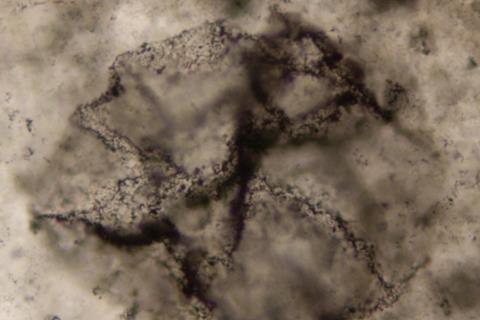
The method identified chemical fragments released from 3.3 billion-year-old sedimentary rocks in South Africa as biogenic, but no molecules associated with photosynthesis were detected. Meanwhile, photosynthetic molecules have been identified in another South African sample from about 2.5 billion years ago, extending the chemical record of photosynthesis by more than 800 million years.
“We were surprised [with that result]” says Hazen. “You and I could never see the patterns in those fragments, but AI can. It’s the distribution of hundreds to thousands of fragments that tells the story of ancient life. My dream is that this approach becomes the new standard approach in paleontology and astrobiology, because the exact same method can be used to look for life on Mars.”
“The work seems to be wide-ranging and well-conceived. The machine learning methodology itself is not new, but its application to geochemical systems like this is very novel,” says Tanay Cardona, who studies the origins of photosynthesis at Queen Mary University of London. “While the results themselves do not add a new perspective to the evolution of photosynthesis, they show that this methodology is complementary to and consistent with other approaches.”
Cardona thinks it would be interesting to extensively test older samples from the Archean era, which began 4 billion years ago. “In fact, when signs of oxygenic photosynthesis first appear convincingly, we need to test every available sample to try to figure it out,” he says. “This will be difficult because in many environments all types of metabolism occur at the same time and in the same place.”
Hazen says this is just the beginning. “We need thousands of well-documented and diverse samples. Several scientists have already contacted us to provide valuable new samples from Australia, South Africa, Greenland and Canada,” he says. “The more diverse the sample, the better the results and the more attributes we can reveal, such as different types of photosynthesis and prokaryotes and eukaryotes. The opportunities ahead are huge.”