

Earl de Jesus, CEO of Synopsys.Credit: Synopsys
The emergence of ChatGPT in late 2022 and early 2023 has fueled a new wave of AI trends. The semiconductor sector is getting the most attention in this trend. Because AI not only brings great business opportunities, but also the semiconductor industry as a whole, and chip design in particular, can achieve further breakthroughs with the help of AI.
Earl De Geus, Chairman and CEO of Synopsys, a maker of electronic design automation (EDA) tools, believes AI is indeed an important trend that could change the entire semiconductor industry, and indeed the world. However, there are still many challenges beyond technology itself, such as human resources, energy and geopolitics, to achieve this vision.
Below is a summary of Aart de Geus’ interview with DIGITIMES.
Q: How will AI trends change EDA tools?
answer: It goes back about 12 years ago. At the time, there were many questions about what the next growth direction for the semiconductor industry would be. At the time, I expected it to be “Smart Everything”. My conclusion was that smart everything would have a huge impact on the semiconductor industry. Because making everything smart requires a lot of computation, which creates a lot of demand for chips. Of course, no one could have predicted how big it would eventually grow.
It’s worth noting that machine learning (ML) was already emerging as a direction for technology development back then. Even before the advent of current generative AI, Synopsys had already invested in the ML space and upgraded its development tools. ML was so trendy at the time that a lot of manpower was invested in related technologies.
About five years ago, Synopsys began making further investments in the AI and automated design space. By early 2021, we will use our AI tools to tape the major circuits and have the first proof of a customer successfully manufacturing them.
Synopsys’ AI tools had a key feature called DSO (Design Space Optimization). Chip products that go through DSO have more computing power, lower power consumption, and in some cases, smaller size. Most importantly, product development time can be greatly reduced, and the design flow can be completed in about a third of the time (from 3 months to 1 month).
By early 2023, Synopsys AI tools have achieved over 100 tapeouts in automated design. By the middle of the year, that number had grown rapidly to his 230, which is a staggering rate of growth.
Overall, Synopsys introduced AI technology much earlier than the current generative AI boom. Therefore, we already have a certain advantage in terms of this technology.
The strength of the generative AI we see today is the ability to take vast amounts of different information and create interesting and valuable content. However, in many cases it is also possible to generate completely incorrect content. There is no room for error in the field of EDA tools. If one transistor doesn’t work, nothing works.
This does not negate generative AI. I think the one presented here is a great application. Synopsys has already employed several generative AI technologies internally. However, the range of use in EDA tools is still not very large.
Q: You seem to believe that the next generation of EDA tools will evolve in the direction of “automation of automation”. Will this direction solve the semiconductor labor shortage problem within 5 to 10 years?
answer: Exactly 37 years ago, Synopsys invented the so-called synthesizer. When the tool was first offered to users, about 2% said it would “take their jobs,” but 98% welcomed the convenience the new tool offered because it allowed them to be more efficient and do more.
Now, 35 years later, this is exactly the same situation. As automation tools become more powerful, the human intellect must look to: “What more can we do with these new tools?” How can we design new architectures and systems more creatively while reducing the amount of tedious work?
A few years ago, I said that we were moving out of the Moore’s Law era and into what I like to call “Sismoore’s Law.” SysMoore takes the longstanding concept of Moore’s Law and combines it with the systematic complexity of new and innovative technologies. Earlier Moore’s Law emphasized exponential growth in size. SysMoore’s law emphasizes systematic complex growth.
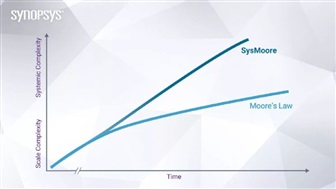
Photo: Earlier Moore’s Law emphasized exponential growth in scale. SysMoore’s law emphasizes systematic complex growth.Credit: Synopsys
For example, the functions and structures of automotive systems are becoming more and more complex with the progress of electrification and smart technology. No longer is a one-size-fits-all solution to all problems. Due to the different engineering and expertise required, the demand for semiconductor engineering is increasing, creating a talent shortage.
AI certainly unlocks more human potential and allows us to think about what more we can do. Most people will be very happy to find a useful tool that makes their job easier. They don’t say, “This tool has taken my job and I have nothing left to do.”
Well, chip design tools are different from normal tools. Adequate education and knowledge are required to use these tools. Therefore, the amount of educational resources invested affects the size of the talent pool. At the same time, economic benefits, such as how much you get paid for your work, also play a role.
In the 90’s some countries moved away from engineering. In those days, everyone wanted to be a banker or a lawyer. Now, jobs like engineering are at least returning to mainstream society, and you can definitely see an increase in interest from universities. But no matter what field you’re in, the core competence you need is to be able to handle complex tasks and figure out how to solve problems.
When I talk to engineering graduates, I always tell them that it is possible to be a deep engineer in your field, but knowing the adjacent fields is extremely valuable. Consider a car as an example. Hardware and software are now equally important. In addition to chip ICs, engineers also need to understand thermals, mechanics, and even reliability. These are all different domains. Having a broad perspective is something that every human being should have.
Q: With the push of AI, application-specific integrated circuits (ASICs) have become a very popular option in recent years. What are your thoughts on this new ASIC trend? Will more and more companies adopt this model?
answer: Regardless of the ASIC or standards market, I think the visible trend in the future will be more and more cross-industry collaboration of companies bringing different skills together to build great solutions.This is ultimately what is happening in autonomous driving development right now.
Similar developments will occur in the AI field. We can already see that some companies specializing in AI algorithms are working with chip design firms to develop faster and more performant chips. We are also working with cloud service providers to double the scale and availability of our compute. This is also why I believe that understanding the complexity of a system is just as important in AI as the expertise of each technology.
Another factor I would like to incorporate is that the trend to make things smaller, make more and make them cheaper, which is the premise of Moore’s Law, is still evolving. However, as this trend has slowed, people’s attention has gradually shifted to making different chiplets on the same chip work together more efficiently.
To achieve this, the signal transmission speed between chips must be fast enough. More complex manufacturing techniques may be required, greatly increasing design complexity. While some companies can handle all functions within an IC in-house, some products utilize technology from multiple design firms and require close teamwork.
This goes back to the importance of system complexity mentioned earlier. As systems become more complex, companies require an entirely different level of collaboration and cooperation. Product success is no longer determined by one company alone, he said. Also, the intersection between hardware and software is becoming more complex. As a result, interdisciplinary exchanges and cooperation will increase.
Q: What are the key attributes semiconductor companies need to succeed in future AI business opportunities?
answer: This is a very complex question, but it basically boils down to two key elements. The first is that what you do works. To that end, we cannot ignore the development trend of the technology industry. Whatever you do, you need to keep up with the constant changes in the market.
Past experience has shown that the tech sector is characterized by one or two key changes that determine what happens in the next generation. People have asked me why Synopsys has been so successful over the years, and one of the reasons is that we have never kept up with the exponential growth of the entire semiconductor industry. We are always on the cutting edge of technology.
The second factor, which I think has become more important than the first, is that you have to be really good with your partner. In other words, don’t think of yourself as just a supplier or client. Don’t interact with your partner solely on the basis of cost-effectiveness. We need to think about what our partners can do to create greater differentiation and advantage.
Reducing costs isn’t a bad thing, but increasing differentiation is even better. AI technology plays an active role here as well. AI technology is not only great for cost savings, but it can also create greater differentiation and unique advantages.


