image:
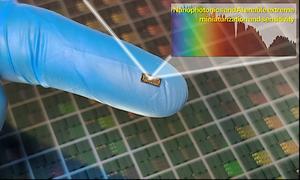
This small fingertip sensor uses photon-trapping surface nanostructures and artificial intelligence (AI) to accurately analyze diseases, check food quality, and detect contamination using both visible and near-infrared light, replacing bulky laboratory equipment.
view more
Credit: Image courtesy of the Institute for Integrated Nanodevices and Nanosystems, University of California, Davis.
For decades, the ability to visualize the chemical composition of materials, such as diagnosing diseases, assessing food quality, and analyzing contamination, relied on large, expensive laboratory instruments called spectrometers. These devices work by capturing light, using prisms or diffraction gratings to spread it into a rainbow, and measuring the intensity of each color. The problem is that spreading the light requires a long physical path, making the device inherently larger.
A recent study from the University of California, Davis (UC Davis) was reported. advanced photonicsaddresses the challenge of miniaturization, shrinking lab-grade spectrometers to the size of a grain of sand, aiming for a small spectrometer on a chip that can be integrated into portable equipment. The traditional approach of spatially spreading the light has been abandoned in favor of reconstruction methods. Rather than physically separating each color, the new chip uses only 16 different silicon detectors, each designed to respond slightly differently to incoming light. This is similar to feeding a mixed drink to a small number of specialized sensors, each sampling a different aspect of the drink. The key to cracking the original recipe is the second part of the invention: artificial intelligence (AI).
At the heart of this innovation are two technological advances. First, the team designed the surface of a standard silicon photodiode with a special photon-trapping surface texture (PTST). Although silicon is typically effective at sensing visible light, it is known to be poor at sensing near-infrared (NIR) light (wavelengths up to 1100 nm). Near-infrared (NIR) light is important for many applications, such as biomedical imaging, because it penetrates deeper into human tissue than visible light. The PTST surface acts like a cleverly engineered texture that forces NIR photons to scatter within a thin layer of silicon, rather than passing them straight through. This greatly increases the potential of the silicon to absorb light, making the entire chip sensitive over a wide spectral range.
This architecture goes beyond simple color detection and employs high-speed sensors to provide unique ultra-fast capabilities for measuring photon lifetimes. This temporal precision allows the device to capture fleeting interactions between light and matter that are invisible to traditional instruments.
Second, the chip uses a powerful fully connected neural network (AI). The 16 unique detectors capture only the encoded noisy signal, so the AI is trained on thousands of samples to learn the complex and hidden relationships between the raw output of the detectors and the original pure light spectrum. AI addresses this “inverse problem” and reconstructs the optical spectrum with high precision (about 8 nm resolution). This calculation method completely eliminates the need for bulky optical components.
The end result is a system with a minimal footprint (0.4 mm2), high sensitivity, and strong noise immunity. AI-enhanced chips can maintain signal clarity even in the presence of significant electrical interference, a major challenge in portable low-cost electronics. By extending the sensing range of silicon into the critical near-infrared spectrum and simultaneously delivering high performance through machine learning, this technology establishes a path to truly integrated, real-time hyperspectral sensing across applications ranging from advanced medical diagnostics to environmental remote sensing.
journal
advanced photonics
Article title
AI-enhanced photon trap spectrometer-on-chip on silicon platform with enhanced near-infrared sensitivity
Disclaimer: AAAS and EurekAlert! We are not responsible for the accuracy of news releases posted on EurekAlert! Use of Information by Contributing Institutions or via the EurekAlert System.