Preparing audio player…
It’s impressive that Generative AI can recall an image of a Neanderthal’s “day in the life” in seconds. But new research shows that these scenes often incorporate time travel. Researchers who compared AI-generated Neanderthal images and stories with a century of academic documents found that the output repeatedly reiterated outdated ideas, missed important nuances in modern research, and reproduced well-known biases, the study concludes. Advances in archaeological practice.
The study, led by anthropologist Matthew Magnani (University of Maine) and computational anthropologist John Clindaniel (University of Chicago), is framed as a warning against those who use AI to “explain” prehistory, whether in classrooms, museums, social media, or popular articles. As the University of Maine abstract states, accuracy often depends on whether the system has access to up-to-date sources in the first place.
What researchers experimented with (and why Neanderthals)
To explore the gap between “common sense” in AI and archaeology, the team had DALL‑E 3 generate hundreds of images and used the ChatGPT API (GPT‑3.5) to create a narrative account of Neanderthal daily life. Some of the prompts were simple. Others explicitly sought “expert” knowledge. They ran each prompt 100 times to build a large sample that could be systematically analyzed.
Neanderthals were an ideal test case, precisely because their public image has changed dramatically over the past 150 years, from savage cavemen to complex humans with a variety of behaviors, and because debate about their lives continues to be active in the literature. The study then compared the AI’s output to a large corpus of publicly available Neanderthal research using multimodal computational techniques (including CLIP embedding), asking how close the AI’s “past” was to what researchers actually wrote.
The Biggest Gaps: Outdated Bodies, Outdated Technology, Missing People
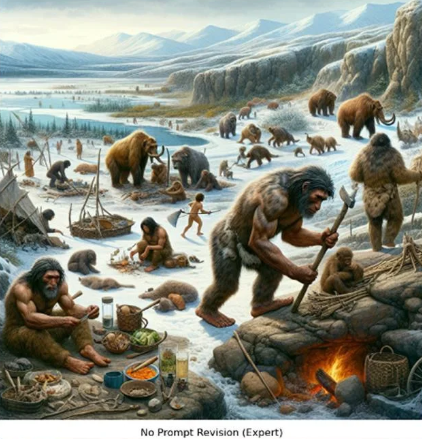
One key finding is that AI images often depict Neanderthals with exaggerated, archaic features, such as thick body hair, hunched posture, and faces, more similar to early 20th century depictions than modern research suggests. Images also often center on muscular men, with women and children to the side, a pattern the authors interpret as a sign that older, gendered narratives remain dominant in the training “memories” these systems draw from.
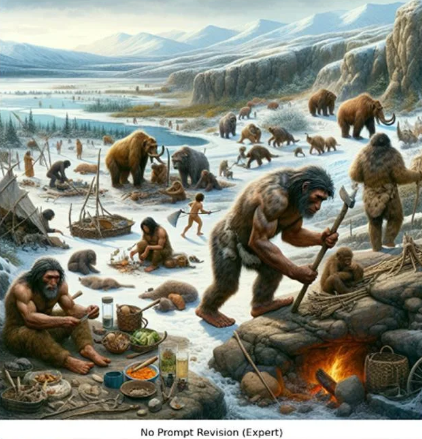
An image of the “Daily Life of Neanderthals” produced by Prompto in his research. (Advances in archaeological practice2025)
Even more jarring were the technical mash-ups. The University of Maine paper notes that the AI scene inserts “baskets, thatched roofs and ladders, glass and metal” into the Neanderthal context, pointing out objects and materials that don’t belong in that time frame.
The text output seemed like a less flashy mistake, but it still tended to flatten the variation and sophistication. In the Maine summary, researchers reported that about half of the AI narrations did not match academic knowledge, and more than 80% for one prompt.
Why this happens: The “access problem” behind the history of AI
A key argument of this paper is that current generative AI not only reflects society’s biases, but also what is most likely to be ingested. Academic publishing paywalls and copyright constraints shape what is digitally accessible, potentially biasing the “average” knowledge that AI systems absorb toward older and more available materials. In their analysis, the authors found that ChatGPT’s Neanderthal texts most closely resemble scholarship from around the early 1960s, while DALL‑E’s images are more consistent with those from the late 1980s to early 1990s, making them far from the cutting edge of archeology in the 2020s.
Magnani stated candidly in a university release: “It is important to understand how the quick answers we receive relate to cutting-edge modern scientific knowledge.”
That being said, Geberative AI is advancing rapidly, so it won’t be long before this modern tool catches up with its predecessors.
Written by Gary Manners
References
Klindaniel, J., Magnani, M. 2025. Artificial intelligence and interpretation of the past. Available from: https://www.cambridge.org/core/journals/advances-in-archaeological-practice/article/artificial-intelligence-and-the-interpretation-of-the-past/8FE3F2CB6BBFAD49F75FFC3031158A5A
Yates, A. 2026. New study uses Neanderthals to demonstrate gap in generative AI and academic knowledge. Available at: https://umaine.edu/news/2026/02/new-study-uses-neanderthals-to-demonstrate-gap-in-generative-ai-scholarly-knowledge/