
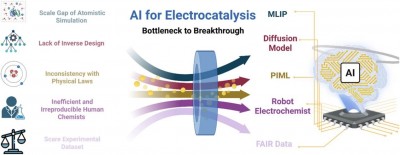
Newswise — Despite intense global investment in clean energy technologies, electrocatalyst development continues to struggle with deep challenges. Atomistic simulations rarely translate to device-scale performance, experimental workflows remain labor-intensive and difficult to reproduce, and most machine learning models lack physical interpretability. At the same time, the demand for efficient catalysts for hydrogen production and carbon-neutral chemical manufacturing continues to grow. The rapid expansion of artificial intelligence (AI) capabilities, from physics-based models to autonomous experiments, has opened up new possibilities, but also exposed systemic weaknesses in data quality and integration. Based on these challenges, a comprehensive reassessment of how AI should be implemented in electrocatalysis is urgently needed.
To address this need, a review was published in December 2025 (DOI: 10.1016/j.esci.2025.100515). electronic science The study, by an international team of researchers from the University of Michigan, Xiamen University, and Oxford University, examines 30 years of AI-powered electrocatalyst research. Rather than enumerate past success stories, the authors identify why many AI approaches have failed to make a real-world impact and how recent advances in machine learning, data infrastructure, and laboratory automation may ultimately change that trajectory. This review positions the field at a critical moment, where strategic choices may determine whether AI achieves a true breakthrough or continues to make significant incremental progress.
The authors identify five structural bottlenecks that limit the effectiveness of AI in electrocatalysis. These are the mismatch between atomic-scale models and macroscopic performance, the immaturity of reverse catalyst design, poor physical consistency of black-box algorithms, inefficient manual experiments, and lack of reliable experimental data. To overcome these barriers, recent research has introduced machine learning interatomic potentials that can simulate dynamic catalyst restructuring on an unprecedented scale, alongside generative AI models that suggest new materials rather than simply screening known materials.
Equally transformative is the rise of physics-based machine learning. This embeds electrochemical laws directly into neural networks, enabling predictable and interpretable models. This review also highlights the emergence of autonomous “robotic electrochemists” that integrate AI decision-making with high-throughput synthesis and testing. Taken together, these developments suggest that electrocatalysis is moving from a field of trial and error to a closed-loop, self-improving discovery system, as long as data quality and model transparency are treated as core scientific priorities.
Importantly, the authors caution against viewing AI as a universal solution. They emphasize that poorly curated data and physically inconsistent models risk amplifying errors rather than accelerating discoveries. Rather, they argue that the most impactful advances will come from combining AI with electrochemical theory, standardized data practices, and interdisciplinary collaboration. In their view, the real value of AI is not in replacing human expertise, but in allowing scientists to ask deeper questions and explore areas of chemistry that were previously inaccessible.
If these challenges can be addressed, AI-powered electrocatalysts could significantly accelerate the deployment of clean energy technologies, from large-scale hydrogen production to carbon-neutral fuel synthesis. This review suggests that the next breakthroughs are likely to occur where automated laboratories, physics-based models, and open data infrastructure converge. The lessons outlined here have the potential to influence how AI is applied more broadly, beyond energy applications and across chemistry and materials science. By reframing AI as an integrated scientific partner rather than a standalone tool, this work points to a future where catalyst discovery is faster, more reliable, and more directly connected to real-world impact.
###
References
Toi
10.1016/j.esci.2025.100515
Original source URL
https://doi.org/10.1016/j.esci.2025.100515
About electronic science
electronic science – The Diamond Open Access Journal is published online on ScienceDirect in collaboration with KeAi. electronic science Founded in 2021 by Nankai University (China), it aims to publish high-quality academic papers on the latest and best scientific and technological research in relevant interdisciplinary fields. eenergy, eelectrochemistry, eelectronics, and eenvironment. electronic science provides insight, innovation and imagination to these fields by building on continuous discoveries and inventions. now electronic science indexed by SCIE, CAS, Scopus and doge. The first impact factor is 36.6is ranked #1 in the field of electrochemistry.


