
Researchers at the University of Toronto’s Faculty of Engineering leveraged artificial intelligence to discover six new 3D printable superalloys in a matter of weeks. These include nickel-cobalt-chromium formulations that outperform industry standard aerospace alloys at extreme temperatures.
The researchers developed the alloy in a near-autonomous laboratory that used computer modeling and machine learning to select the metal composition, robotic equipment to manufacture and test the samples, and then used the resulting data to decide which formulations to consider.
This closed-loop approach has the potential to dramatically accelerate the discovery of alloys designed to withstand the extreme heat, pressure, and corrosive conditions found within jet engines, nuclear power plants, and other harsh environments.
“There is a huge demand for materials that can withstand large fluctuations in temperature and pressure,” said Professor Yu Zou of the University of Toronto, Canada Research Chair in Materials and Manufacturing for Extreme Environments and project leader.
Additive manufacturing, commonly known as 3D printing, adds additional complexity to alloy design.
The metal must not only withstand extreme operating conditions, but also respond predictably to the rapid heating and cooling associated with laser-based printing. Alloys developed for traditional casting or forging can crack, deform, or otherwise degrade performance when printed layer by layer.
Printable alloys have the potential to allow manufacturers to create complex parts that cannot be manufactured using traditional methods, or to vary material properties across a single part. For example, a part may change from a hard, heat-resistant exterior to a lighter interior.
Many high-performance alloys in use today consist primarily of nickel or cobalt, mixed with small amounts of up to 10 other elements. Even small changes in the elements or their ratios can lead to large changes in the alloy’s strength, hardness, oxidation resistance, and printability.
This creates tens of thousands of potential formulations, making discovering new alloys through traditional trial-and-error experiments a costly and time-consuming endeavor.
To explore this vast design space more efficiently, Zou’s team collaborated with University of Toronto materials science professor Jason Hattrick-Simpers to develop an AI-guided alloy discovery process.

Tyler Irving / University of Toronto
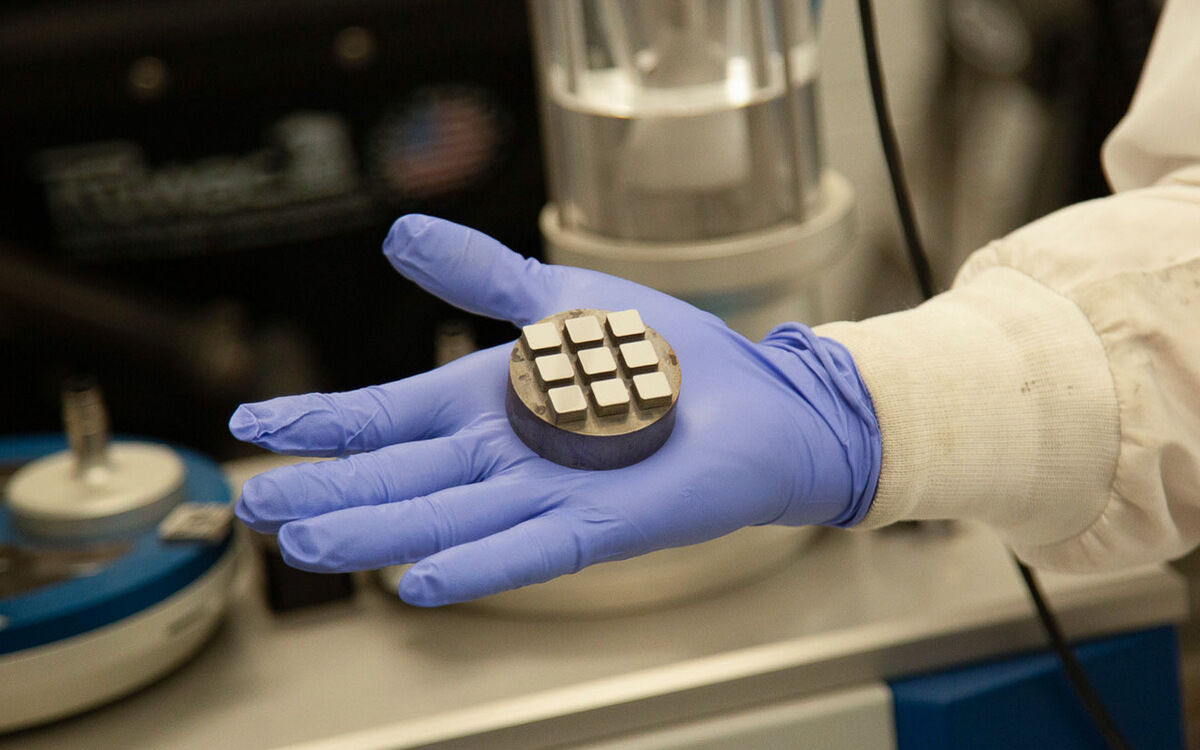
Computer modeling, machine learning, and robot-assisted manufacturing were used to design, manufacture, and test these nickel-cobalt-chromium alloy samples. The information from these tests is fed back into the model and informs the next iteration of the process.
Autonomous Driving Alloy Laboratory
The project, supported in part by the University of Toronto’s Acceleration Consortium, combines computer modeling, machine learning and robot-assisted manufacturing to create what researchers describe as a self-driving lab.
The Acceleration Consortium is a global partnership of government, academic institutions, and industry applying AI and automation to materials discovery.
The University of Toronto’s platform uses a data-lean active learning model that starts with a relatively small number of experiments, rather than requiring large databases of information about existing alloys.
The system selects several compositions to manufacture and test. Data from these experiments is fed back into a machine learning model, which uses the results to identify the most promising formulations for the next round.
This process allows the system to incrementally map largely unexplored areas of alloy design with minimal human intervention.
Ajay Talbot, a doctoral student in Zou’s lab and lead author of a paper describing research at NPJ Advanced Manufacturing, said the autonomous driving lab is helping overcome one of the biggest obstacles to applying AI to materials science.
“One of the problems we often encounter when trying to use AI to design materials is that most machine learning models require large amounts of data about material properties in order to learn,” he said. “But if you’re working in a part of the design space that hasn’t been explored yet, that data doesn’t exist, so you’re kind of flying blind.”
Active learning models navigate this uncharted territory by strategically selecting new experimental groups based on what is learned from previous results.
To demonstrate this platform, the researchers focused on compositionally complex alloys (combinations of three or more major metals) made from nickel, cobalt, and chromium.
Within weeks, the self-taught lab combined these three metals to create an alloy comparable to aerospace superalloys used by NASA.

Tyler Irving / University of Toronto
Ajay Talbot, a doctoral student at the University of Toronto, holds a sample of a metal alloy made of nickel, cobalt and chromium created in an autonomous driving lab.
Discovery of aerospace superalloys
Nickel, cobalt, and chromium are important components of aerospace superalloys because of their strength, heat resistance, and antioxidant properties.
Researchers at the University of Toronto first tasked their autonomous driving lab with identifying an alloy that could maintain its hardness at temperatures of up to 1,112 degrees Fahrenheit (600 degrees Celsius), comparable to conditions found at the front of a jet engine.
“The industry standard in this area is nickel-based alloys such as Inconel 625. However, we have found an alloy made with 12% nickel, 62% cobalt, and 26% chromium that is better at maintaining hardness even at extremely high temperatures,” says Talbot. “Even with just three ingredients, our alloy outperformed Inconel 625, an alloy of more than 10 different elements, by 4.5% in lab tests.”
Nickel- and chromium-rich alloys were designed to withstand high-temperature oxidation at the back end of jet engines, where temperatures can reach 1,830F (1,000C).
At these temperatures, oxide scale can form on exposed metal, causing gradual wear and deterioration of the material.
Autonomous Driving Lab identified a formulation of 36% nickel, 14% cobalt, and 50% chromium that exhibited exceptional performance in oxidation resistance at high temperatures, outperforming Inconel 625 by 85%.
Although these laboratory results place the new formulation firmly in the realm of high-temperature superalloys, the research is still in the material discovery stage and does not represent a jet engine component suitable for flight.
The research team is currently working on developing an alloy that can withstand temperatures up to 2,192 F (1,200 C).
The research team also plans to increase the complexity of the system by expanding beyond the three main metals.
The next generation could incorporate 10-12 elements, potentially opening the door to additional enhancement mechanisms and useful trait combinations.
“This nickel, cobalt and chromium system contains just three elements. Overall, it’s a relatively simple system,” says Talbot.
However, this three-metal experiment demonstrated that the closed-loop discovery platform can rapidly identify high-performance materials that depart significantly from the traditional isometric formulations preferred by researchers.
As self-driving labs generate more experimental data, they will be able to manipulate increasingly complex alloy systems, potentially tailoring new superalloys for specific aerospace, power generation, and advanced manufacturing applications.
“There’s still a lot out there waiting to be discovered,” Talbot said.
Author biography
Shane Lasley, Metal Tech News

Having covered mining for over 18 years, Shane is known for his insight and in-depth analysis of mining, mineral exploration and technical metals.


