December 19, 2025
Johor Bahru – In a former multipurpose hall atop the Johor Bahru City Council building, a 12-metre screen displays live footage from 555 CCTV cameras monitoring every corner of Malaysia's southern capital.
The Johor Bahru Integrated Operations Control Center (JBIOCC), located in the heart of Johor Bahru city, can also use artificial intelligence (AI) to track traffic flow, detect potholes and capture mealbugs in real-time. This is the technology application that helped JB pip's capital Kuala Lumpur become Malaysia's first 'advanced smart city' on October 28.
JB residents can use the system via a mobile app and the council's digital map to receive information on everything from traffic conditions and parking availability to flood warnings and public toilet cleanliness ratings.
“This command center will help solve three major problems often faced in JB: traffic congestion, public safety and urban management,” JBIOCC commander Dr Choo Kok Wah told The Straits Times during his visit on December 4.
Dr Chew, who is also JB City Council's deputy commissioner for urban transport, said the control center's AI can detect problems through CCTV cameras long before a complaint is lodged.
With this system, the average time to resolve garbage disposal issues is less than three hours, and potholes are repaired within 24 hours, he said.
“Without AI, you may have to wait until ground maintenance teams detect these issues during inspections or through complaints from the public,” Dr. Choo said.
AI in the control center can also detect traffic congestion early and adjust the timing of traffic lights to speed up traffic flow.
“Police will also request the use of this system to help solve crimes such as robbery, theft and kidnapping. Facial and car number recognition can be used to locate the perpetrator and the vehicle he is traveling in,” he said.
JB's 'Advanced Smart City' tag refers to Level 3 of the four-point rating system awarded to municipal councils under the Ministry of Housing and Local Government's Malaysia Smart City Framework. To achieve this, Congress needs to implement technology that can enhance administrative capacity.
In contrast, Kuala Lumpur City Hall (DBKL) is at Level 1 “smart city early adopter” status, which it achieved in 2023, meaning the city council is in the planning stages to implement technology in its daily operations, DBKL officials told ST.
The highest level is “Visionary Smart City”, where local governments implement more high-tech applications to complete their smart city plans.
The National Smart City Framework, launched in 2018, aimed to encourage Malaysian cities to leverage technology to ensure a better quality of life. This includes improving transport mobility, deterring crime, reducing congestion and pollution, and increasing the transparency of government data to the public.
The main challenge in JB is traffic congestion. More than 300,000 vehicles pass through the causeway every day, cutting off a major artery in and out of the city, on top of the already high volume of private vehicle use. The city is also facing water pollution in its rivers, with Johor Menteri Besar Ong Hafiz Ghazi admitting in August that Tebrau River is one of the most polluted rivers in the country. Water supply outages occur frequently due to both pollution and aging pipelines.
JBIOCC was built at a cost of more than RM105 million (S$33 million) to address these issues, according to local media reports at the time of its launch in 2023.
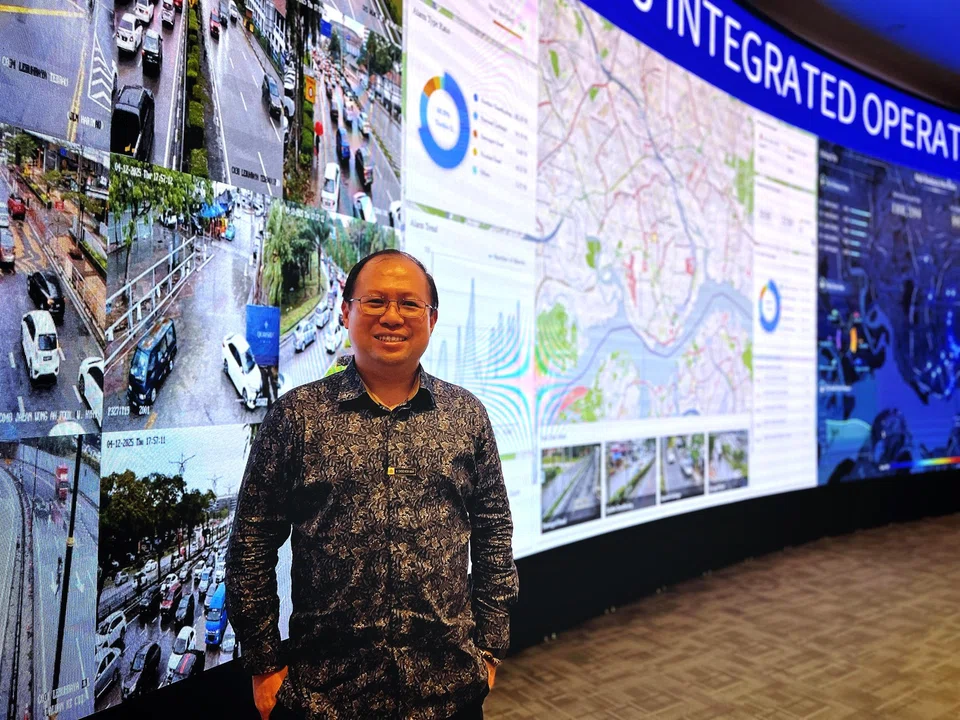
Dr Choo Kok Wah said AI is being used at the control center to detect problems using surveillance cameras, long before residents lodge complaints. Photo: Straits Times
But analysts told ST that the “advanced smart city” tag masks a disconnect between technology and real-world impact. Johor may be ahead of the curve in introducing technology to local councils, but its infrastructure and enforcement is in dire need of modern updates, they said.
Associate Professor Mohd Fadil Med Din from Universiti Teknologi Malaysia said: “Reality check: Assessment measures ability, not results.''
He said residents still faced congestion, delays in waste collection, parking stress and river pollution. “These are multi-institutional, physical infrastructure and governance issues that cannot be solved by technology alone,” he added.
Malaysian Urban Design Association president Dr Shuhana Shamsuddin also warned local authorities that Malaysia's smart city plans must be accompanied by urban designs that are friendly to local people, climate and culture.
“My main concern is that Malaysia is treating smart cities as an end rather than a means to an end,” she told ST.
But whether or not it is an “advanced smart city”, many JB residents told ST they were unaware of the online tools they could access to make their lives easier. Johor's flood warning app Siphon has been downloaded only 250 times, despite being launched in 2023, JB Mayor Mohd Hafiz Ahmad announced on October 10.
Mr Derek Tan, 33, who lives in JB's Permas Jaya suburb, said: “I never knew there was an app for floods or e-complaints. I only have the MBJB Spot app for parking in the city.”
Entrepreneur Azrin Zainal, 30, said she preferred using popular navigation apps such as Waze for her daily commute in JB rather than relying on the council's traffic monitoring system.
Meanwhile, Lu Yong Tat, a 37-year-old Johorian who works as a tour executive in Singapore, said he had complained online to authorities, but authorities were either unresponsive or slow to respond.
“These online features and apps aren't very useful, so I think either there isn't a demand for them or people don't know about them,” he said.