
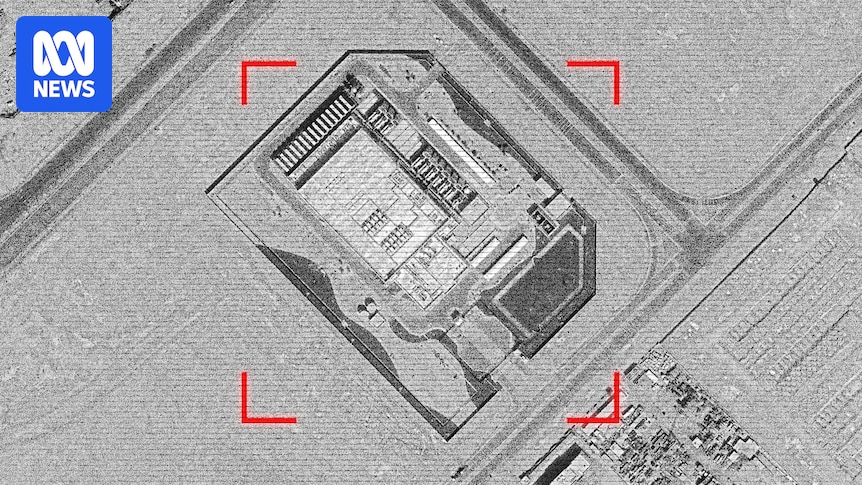
This Amazon data center is located on the outskirts of Abu Dhabi, directly across the Iranian coast.
This structure, with its high-powered computers running day and night, is where the “cloud” takes physical form.
Amazon has six data centers in Bahrain and the United Arab Emirates (UAE).
Last week, two of the US tech giant’s centers in the UAE were hit by Iranian drones, according to an Amazon status report. There were also “close range drone attacks” in some parts of Bahrain.
Due to the secretive nature of the U.S. war effort, it is unclear which three facilities were attacked.
In addition to Amazon In addition to data centers, several other U.S. companies, including Microsoft and Google, also rent capacity from various companies. run locally Equipment.
More are in the pipeline. This is a region with ambitions to become the next AI superpower.
Coordinated attacks on these assets, which Iran claims are contributing to the U.S. war effort, pose a threat to more than just military capabilities.
This is also a strike against the industry on which the region has relied on economic growth.
Following three attacks on data centers, Iran has indicated that its technology infrastructure remains in the line of attack.
Gulf countries come under shelling
The UAE, with its political stability and access to cheap energy, was meant to be a hub for the next wave of AI development.
Over a four-day period in May 2025, US President Donald Trump visited Saudi Arabia, Qatar, and the UAE, announcing over $2.8 trillion in investment commitments.
The highlight was Abu Dhabi’s $700 billion AI data center, built in partnership with Open AI, NVIDIA, Oracle, and Cisco. OpenAI claimed that the facility could eventually serve half of the world’s population.
In October 2025, Australia’s Air Trunk also announced a separate $4.2 billion contract to build a data center in neighboring Saudi Arabia.
The future of AI in the Gulf region looked bright. But that all changed during three drone strikes.
ANU senior lecturer in political economy Jesse Moritz says the region is no longer a safe place to build this kind of infrastructure. “No country wants to put its data centers in an unstable environment.”
Dr. Moritz said the attack was part of Iran’s “asymmetric warfare” strategy.
Iran has launched attacks on civilian infrastructure in the Gulf state, from hotels to oil refineries to desalination plants, in an effort to make the conflict costly to its adversaries.
Oil prices are already rising. Major transportation routes were halted. Air travel is in disarray.
Data centers are now also a strategic target.
Big tech companies added to Iran’s target list
U.S. Army Secretary Pete Hegseth has been speaking like a tech executive lately.
The U.S. military will become “AI first,” he said. It would “unleash experimentation” and “eliminate bureaucratic barriers.”
The US and Israeli militaries also use AI to identify targets.
Big tech companies, including Amazon, have long worked with the U.S. military and been targeted in the conflict with Iran.
Iran’s Revolutionary Guards cited military use in justifying one of its attacks on Amazon data centers last week. On Thursday, that dynamic only deepened.
According to Al Jazeera, Iran’s Revolutionary Guards has released a list of “new targets” including data centers and offices of several US-based tech companies.
A state media spokesperson said that the US raids on bank branches in Tehran made these technology assets a legitimate target for retaliatory attacks.
War drives up costs and increases data center risk
Operating a reliable data center is expensive even under normal circumstances. They consume large amounts of water and electricity, require highly trained workers to work around the clock, and must be protected from cyberattacks.
The costs only increase if you become involved in a conflict zone.
“Protecting it from missiles, drones, explosion impacts, debris, fire, water damage and cascading utility failures is even more difficult,” said Christian Alexander, a senior researcher at Abu Dhabi’s Rabdan Institute for Security and Defense.
These strikes “drive up insurance premiums; [and] It could make it harder to attract engineering talent,” Sam Winter-Levy, a fellow at the Carnegie Endowment for International Peace, told Bloomberg TV.
Data centers are also notoriously difficult to hide. They are huge structures that emit large heat signatures and have a distinctive appearance in satellite images.
Dr. Alexander estimates that the cost of hardening the largest data centers against these new threats could reach “in the low hundreds of millions of dollars” per facility.
It is wise to spread the risk, and these systems are already built with redundancy in mind. Amazon has three data centers each in the UAE and Bahrain and should be able to adequately handle the loss of a single facility in both.
But even that wasn’t enough to continue the service.
Two centers that were attacked in the UAE went down at the same time, causing severe outages. All types of services were disrupted in Dubai and Abu Dhabi, including banks, taxis and food delivery apps.
This type of coordinated attack exposes vulnerabilities in these systems, even when they have significant built-in redundancies. This only increases risk and cost.
“If data centers become increasingly the target of war, it is reasonable to expect that technology companies will consider that risk when deciding where to build future centers,” said Zachary Callenborn, a postdoctoral fellow at King’s College London.
Additionally, threats to the Middle East’s digital infrastructure do not begin and end with the data center. There is another equally important piece of digital infrastructure that can be at risk.
Internet arteries can be vulnerable
An extensive network of undersea cables spans the Middle East’s two major waterways.
If these cables are cut or damaged, it can cause major disruption to global interconnections.
More than 90 percent of the data that flows between Europe and Asia is transmitted via cables under the Red Sea.
Alternative technologies, such as satellites, can only process a fraction of the data that passes through this network.
These cables are clustered in places like the Bab al-Mandab Strait off Yemen’s southeast coast, where Iranian and Houthi forces have carried out several attacks on oil tankers.
Experts have warned that repairing undersea cables in conflict zones is risky.
Oil tankers have also been attacked by Iranian drones in the Strait of Hormuz in recent days.
Cables under this waterway connect several Gulf countries with the world.
Locations where these cables land, such as the city of Fujairah in the United Arab Emirates, are also potential targets.
“Land-based infrastructure is a concern because landing bases are vulnerable to even simple sabotage,” Dr. Alexander said.
When three of the cables running through the Red Sea were cut; damaged Back in 2024, they became collateral damage after a missile reportedly hit a cargo ship.
It wasn’t an obvious act of sabotage, but people had been warned about the possibility for years.
Reactions reached as far away as the UK, South Africa and China.
Hong Kong’s telecommunications company reported a 25% disruption to internet traffic due to the incident.
Whether the target is data centers, undersea cables, or other types of digital infrastructure, disruptions in the Middle East could spill over.
Last year, Dr. Karenborn spoke with senior U.S. officials about these risks.
He concluded that “infrastructure protection policies are very nationally focused” and often do not apply to foreign infrastructure, even when it is important to national interests.
But since publishing the study’s results, he’s heartened to see officials recognize that “there are real problems that are not being addressed.”
“The open question is what happens next,” he says, “and what specific policies, programs and regulations can most effectively reduce risk?
“Honestly, I don’t know.”
data source
- Data Center Locations — A map of Baxtel and data centers visually verified by ABC News.
- Undersea cables — TeleGeography.
- Map data — OpenStreetMap.
credit
- development: ashley kidd
- Report: Julian Fell
- Design and research: Jarrod Funkuser
- system design:Ben Spragon
- edit: matt liddy


