AI Engineering Market Summary
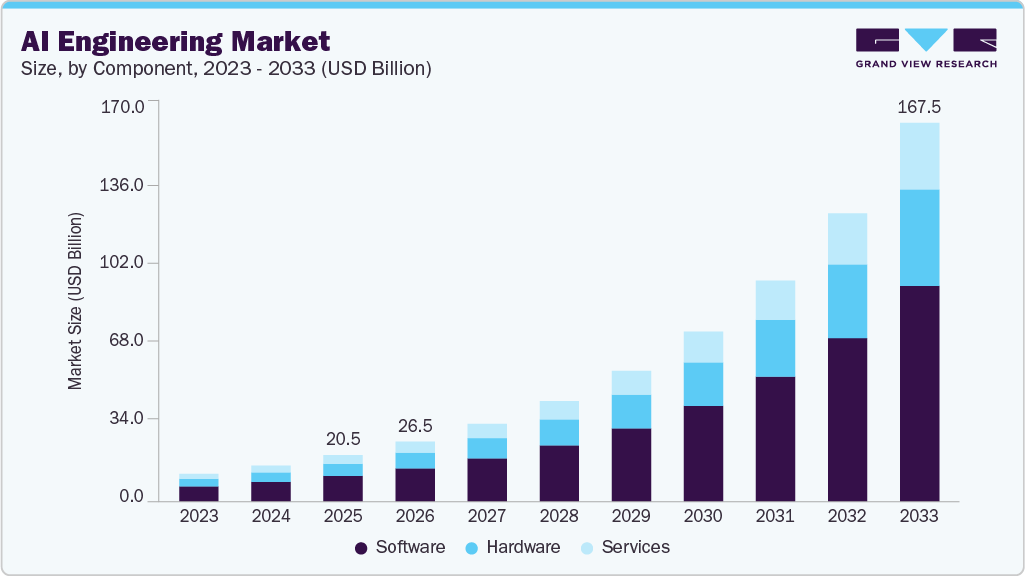
The global AI engineering market size was estimated at USD 20.50 billion in 2025 and is projected to reach USD 167.52 billion by 2033, growing at a CAGR of 30.1% from 2026 to 2033. The market is growing rapidly as enterprises move beyond experimental AI projects toward full-scale production deployments, requiring robust integration, model management, and MLOps capabilities.
Key Market Trends & Insights
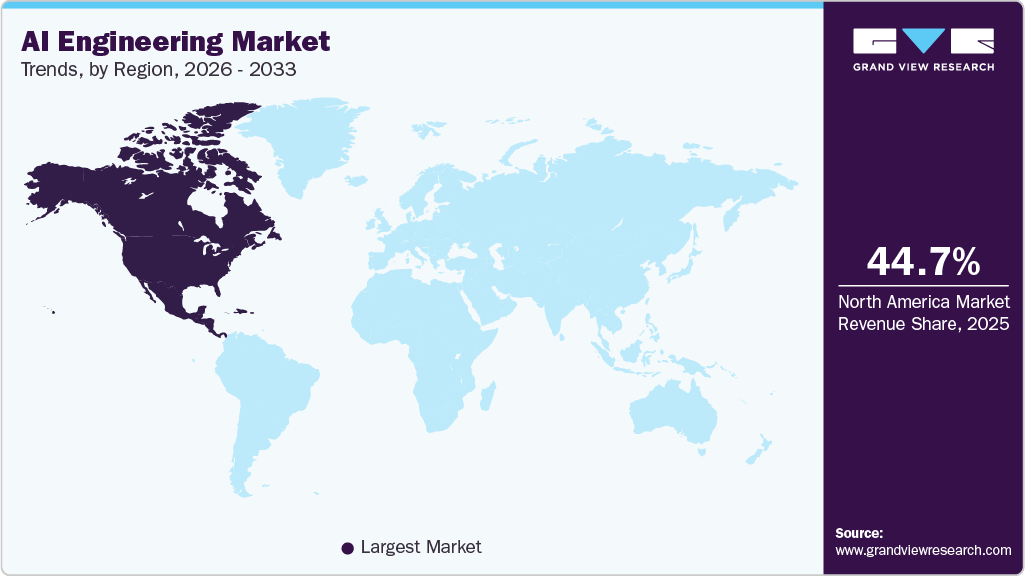
- The North America AI engineering market held the largest global revenue share of 44.7% by 2025.
- The U.S. AI engineering industry led North America, with the largest revenue share in 2025.
- By component, the software segment dominated the market with the largest revenue share of 55.3% in 2025.
- By technology, the Machine Learning (ML) segment accounted for the largest revenue share of 48.1% in 2025.
- By end use, the IT & telecommunications segment is expected to grow at the fastest CAGR of 31.8% from 2026 to 2033.
Market Size & Forecast
- 2025 Market Size: USD 20.50 Billion
- 2033 Projected Market Size: USD 167.52 Billion
- CAGR (2026-2033): 30.1%
- North America: Largest Market in 2025
The surge in generative AI, large language models, and advanced analytics has increased the need for scalable infrastructure, governance, and continuous monitoring systems. Additionally, accelerating cloud adoption and digital transformation initiatives across industries are driving demand for reliable, secure, and enterprise-grade AI engineering solutions to operationalize AI at scale.
The AI engineering industry’s growth is strongly driven by the rapid shift in enterprises from pilot AI initiatives to full-scale production deployments, which require scalable model lifecycle management, integration frameworks, and robust MLOps capabilities. Increasing regulatory scrutiny, data privacy requirements, and the need for responsible AI governance are boosting demand for monitoring, explainability, and compliance-oriented engineering solutions across industries. Organizations are increasingly integrating generative AI, large language models, and automation into core business processes, driving the need for high-performance cloud infrastructure, optimized compute environments, and advanced deployment architectures. The growing importance of real-time analytics, edge AI, and data-driven decision-making is accelerating demand for reliable model orchestration, performance optimization, and continuous retraining systems. Additionally, widespread digital transformation initiatives and cross-industry AI adoption are significantly increasing demand for scalable, secure, and enterprise-grade AI engineering platforms and services.
The accelerating shift toward cloud-native architectures, AI-as-a-Service platforms, and digital-first enterprise strategies is driving strong demand for advanced AI software solutions, thereby increasing reliance on scalable development platforms, MLOps tools, and model lifecycle management systems. Enterprises are expanding their use of AI across customer engagement, operations, cybersecurity, and analytics, which is boosting demand for configurable, interoperable, and high-performance AI software frameworks. Rising data governance requirements and regulatory scrutiny are also increasing the adoption of AI monitoring, explainability, and compliance software integrated directly into enterprise workflows. This convergence of cloud expansion, enterprise AI scaling, and governance priorities is significantly strengthening demand for AI engineering software solutions. As a result, these factors are major growth drivers for the software segment of the AI engineering market.
The steady increase in global enterprise software spending, supported by rapid adoption of generative AI, automation platforms, and real-time analytics systems, is accelerating demand for subscription-based AI development environments and integrated deployment tools. Organizations increasingly prefer software-led AI solutions due to their flexibility, scalability, and lower upfront capital requirements compared to hardware-intensive models. The shift toward API-driven ecosystems, low-code/no-code AI platforms, and continuous integration/continuous deployment (CI/CD) pipelines is further embedding AI software across industries, including BFSI, healthcare, retail, manufacturing, and telecommunications. This expanding role of AI software as the core enabler of scalable, enterprise-grade AI deployment is expected to sustain its dominant position in the market.
Component Insights
The Software segment dominated the AI Engineering market, accounting for over 55.3% in 2025, driven by the accelerating adoption of cloud-native AI platforms, model development frameworks, and enterprise-grade MLOps solutions across industries. Rising enterprise demand for scalable AI deployment, automated model lifecycle management, and integrated analytics capabilities has pushed organizations toward software-centric solutions, driven by their flexibility, interoperability, and lower upfront capital requirements. The rapid expansion of generative AI, large language models, and real-time decision systems has further strengthened demand for AI engineering software by enabling faster experimentation, seamless integration, and continuous monitoring across cloud and hybrid environments. As enterprises prioritize agility, scalability, and faster time-to-market, software remains the dominant component of the global market.
The Software segment is expected to grow at the highest CAGR due to increasing reliance on subscription-based AI platforms, low-code/no-code development tools, and API-driven ecosystems that simplify AI adoption. The growing need for governance, explainability, compliance monitoring, and secure AI deployment is further driving investment in advanced AI software solutions. Software platforms support continuous integration and deployment (CI/CD), automated retraining, and cross-functional collaboration, making them central to enterprise AI operationalization. The rising shift toward SaaS-based AI services and cloud-hosted development environments is accelerating adoption due to scalability and cost efficiency. Additionally, the expanding use of AI across BFSI, healthcare, retail, manufacturing, and telecommunications is reinforcing software as the preferred and fastest-growing market segment.
Technology Insights
The Machine Learning (ML) segment dominated the AI engineering market, accounting for over 47.8% in 2025, driven by its widespread application in predictive analytics, fraud detection, recommendation engines, and process automation. As enterprises increasingly rely on data-driven decision-making, ML has become the foundational technology powering most AI deployments, enabling systems to learn from structured and unstructured data at scale. The growing integration of ML into cloud platforms, enterprise software, cybersecurity systems, and customer experience solutions has further accelerated demand for robust ML engineering frameworks, data pipelines, and model optimization tools. As organizations prioritize accuracy, automation, and operational efficiency, machine learning remains the dominant technology in the global market.
The machine learning segment is expected to grow at a strong CAGR over the forecast period, driven by expanding enterprise adoption, greater data availability, and advancements in automated machine learning (AutoML) and MLOps practices. The rapid growth of real-time analytics, personalization engines, and intelligent automation across industries is driving continuous investment in ML model development, deployment, and monitoring systems. ML supports scalable training environments, continuous retraining, and performance optimization, making it essential for long-term AI success. Additionally, the increasing demand for explainable, reliable, and production-ready AI solutions is reinforcing machine learning as the core and most widely adopted technology in the AI engineering ecosystem.
Deployment Mode Insights
The cloud deployment segment dominated the AI engineering industry, accounting for a share of over 70.0% in 2025, driven by increasing enterprise reliance on scalable, on-demand computing infrastructure for AI model development and deployment. Organizations are rapidly adopting cloud-native AI platforms to access high-performance GPUs, distributed training environments, and integrated MLOps tools without significant upfront capital investment. The expansion of hyperscale data centers, multi-cloud ecosystems, and AI-as-a-Service offerings has further accelerated demand for cloud-based AI engineering solutions by enabling faster experimentation, seamless integration, and global accessibility. As enterprises prioritize flexibility, cost efficiency, and rapid time-to-market, cloud remains the dominant deployment model in the global market.
The cloud segment is expected to grow at the fastest CAGR over the forecast period, driven by the rising adoption of generative AI, real-time analytics, and large language models, which require elastic, high-performance computing environments. Cloud platforms support continuous integration and deployment (CI/CD), automated scaling, and centralized monitoring, making them ideal for managing complex AI workloads across geographies. The increasing shift toward subscription-based software models and hybrid cloud strategies is further strengthening cloud adoption across industries, including BFSI, healthcare, retail, and manufacturing. Additionally, enterprises seeking operational agility, lower infrastructure management burden, and enhanced collaboration are reinforcing cloud as the preferred and fastest-growing deployment segment.
End-use Insights
The IT & telecommunications segment dominated the market with a share of 31.1% in 2025, driven by rapid digital transformation, large-scale data generation, and the continuous expansion of cloud and network infrastructure. Telecom operators and IT service providers are heavily investing in AI engineering to optimize network performance, enable predictive maintenance, enhance cybersecurity, and automate customer support operations. The growing deployment of 5G infrastructure, edge computing, and hyperscale data centers has further accelerated demand for scalable AI development, integration, and monitoring solutions. As the industry prioritizes network intelligence, service personalization, and operational efficiency, IT & Telecommunications remains the leading end-use segment.
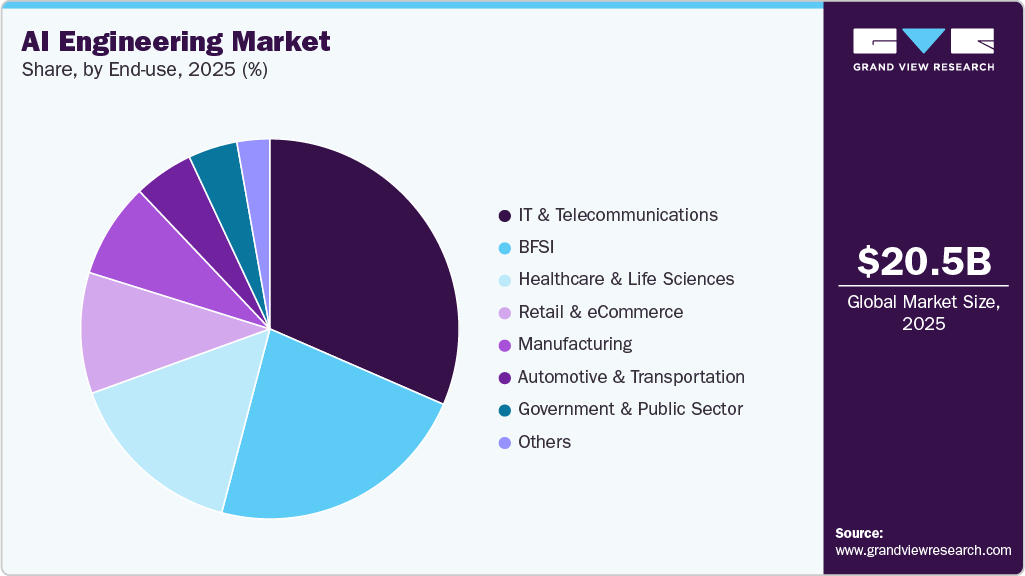
The IT & telecommunication segment is expected to grow at a strong CAGR over the forecast period, driven by the increasing adoption of AI-driven network automation, real-time traffic management, and intelligent service orchestration platforms. The surge in data consumption, IoT connectivity, and cloud-based enterprise services is driving demand for advanced AI engineering frameworks capable of managing complex and high-volume workloads. AI-enabled fraud detection, anomaly monitoring, and cybersecurity systems are becoming critical for telecom operators, further strengthening investment in AI engineering capabilities. Additionally, the industry’s early adoption of emerging technologies such as generative AI, network analytics, and autonomous networks is reinforcing IT & Telecommunications as the most dominant and innovation-driven market segment.
Regional Insights
North America AI engineering market dominated the global industry with a share of 44.7% in 2025, driven by the strong presence of leading cloud providers, AI technology companies, and advanced digital infrastructure. The U.S., in particular, hosts major AI platform developers, hyperscale data centers, and global system integrators that heavily invest in AI research, model development, and enterprise deployment capabilities. High enterprise technology spending, early adoption of generative AI and large language models, and a mature startup ecosystem have further accelerated demand for scalable AI engineering solutions across industries. As organizations prioritize automation, analytics, and AI-driven transformation, North America remains the largest regional market in the global AI engineering landscape.
U.S. AI Engineering Market Trends
The U.S dominated the North America AI engineering industry with the largest share in 2025, driven by its strong concentration of global technology leaders, hyperscale cloud providers, and advanced AI research institutions. The country is home to major AI platform developers, semiconductor companies, and system integrators that heavily invest in AI model development, deployment frameworks, and scalable MLOps infrastructure. High enterprise IT spending, rapid adoption of generative AI and automation technologies, and early commercialization of advanced AI solutions have significantly accelerated demand for AI engineering capabilities across industries. As many organizations are increasingly prioritizing digital transformation and intelligent automation, the U.S. continues to lead regional AI engineering adoption and innovation.
Asia Pacific AI Engineering Market Trends
The Asia Pacific AI engineering industry is growing due to rapid digital transformation, expanding cloud infrastructure, and strong government-backed AI initiatives across major economies such as China, India, Japan, and South Korea. Increasing enterprise adoption of automation, advanced analytics, and AI-driven customer engagement solutions is significantly accelerating demand for scalable AI development, integration, and deployment platforms. The expansion of 5G networks, smart city programs, and edge computing ecosystems is further strengthening the need for robust AI engineering capabilities to manage large-scale, real-time data environments. Additionally, rising startup activity, increasing availability of skilled technical talent, and supportive national AI strategies are reinforcing the Asia Pacific’s position as the fastest-growing region in the market.
Europe AI Engineering Market Trends
The Europe AI engineering industry is growing, driven by the increasing enterprise adoption of digital transformation strategies, strong regulatory focus on responsible AI, and expanding investments in cloud and data infrastructure. Organizations across Germany, the UK, France, and the Nordics are accelerating AI integration to enhance operational efficiency, customer analytics, and industrial automation capabilities. The region’s emphasis on data privacy, compliance, and the implementation of AI governance frameworks such as the EU AI Act is driving demand for explainable, secure, and compliant AI engineering solutions. Additionally, Europe’s strong industrial base, particularly in manufacturing, automotive, and energy sectors, is fueling demand for advanced AI deployment and optimization platforms. Growing public–private partnerships, research funding programs, and innovation hubs are further strengthening the regional AI ecosystem.
Key AI Engineering Company Insights
The AI Engineering Market features several key players that significantly shape its global landscape. Microsoft Corporation is a leading AI engineering platform provider, supporting large-scale enterprise AI development and deployment through its Azure AI and machine learning infrastructure. Amazon Web Services (AWS) offers comprehensive AI engineering solutions via SageMaker and cloud-native MLOps tools that enable scalable model training, integration, and monitoring across industries. Google Cloud specializes in advanced AI development frameworks through Vertex AI, delivering high-performance model lifecycle management and data engineering capabilities for global enterprises. Meanwhile, Accenture focuses on end-to-end AI engineering services, including strategy, system integration, and large-scale production deployment across BFSI, healthcare, telecom, and manufacturing sectors. These companies play a critical role in shaping innovation, scalability, governance standards, and enterprise-grade AI adoption within the global market.
-
Microsoft Corporation is a global technology leader delivering enterprise-grade AI engineering solutions through its Azure AI and machine learning platforms. The company supports a wide range of industries, including BFSI, healthcare, retail, manufacturing, and telecommunications, by enabling scalable AI model development, deployment, and lifecycle management. Microsoft’s strong cloud infrastructure, integrated MLOps capabilities, and responsible AI frameworks enable secure, compliant, and cost-efficient AI implementation. Its continuous investments in generative AI, large language models, and cloud innovation position it as a dominant force in the global AI engineering industry.
-
Amazon Web Services (AWS) provides end-to-end AI engineering capabilities through services such as Amazon SageMaker, AI analytics tools, and scalable cloud infrastructure. The company serves high-growth sectors including financial services, e-commerce, media, automotive, and public sector organizations. AWS emphasizes automation, high-performance computing, and seamless integration to support complex AI workloads and real-time data processing. Through its global cloud footprint, continuous innovation in AI services, and strong ecosystem partnerships, AWS enables enterprises to accelerate AI deployment, optimize operational efficiency, and scale intelligent applications worldwide.
Key AI Engineering Companies:
The following key companies have been profiled for this study on the AI engineering market.
- Microsoft Corporation
- Amazon Web Services (AWS)
- Google Cloud (Alphabet Inc.)
- IBM Corporation
- NVIDIA Corporation
- Accenture plc
- Tata Consultancy Services (TCS)
- Infosys Limited
- Deloitte Touche Tohmatsu Limited
- Capgemini SE
- Databricks Inc.
- OpenAI
- SAP SE
- Oracle Corporation
- HCLTech
Recent Developments
-
In November 2025, Microsoft Corporation announced major AI engineering advancements at Microsoft Ignite 2025, introducing enhanced Azure Copilot agents and AI infrastructure innovations designed to modernize cloud-native AI development and deployment. These updates include new agent-driven tools and scalable AI service capabilities within Azure AI, enabling enterprises to streamline model orchestration, monitoring, and integration across cloud environments, a move that strengthens Microsoft’s position in the AI engineering market by accelerating enterprise AI adoption and operational efficiency
-
In November 2025, Amazon Web Services (AWS) announced several significant advancements for the AI engineering industry at AWS, including the general availability of new AI agent services. They enhanced architectural guidance for building and deploying AI workflows at enterprise scale. These updates introduced Bedrock AgentCore for trusted agent deployment with improved policy controls and quality monitoring, as well as a focused set of Responsible AI, Generative AI, and Machine Learning Well-Architected Lenses designed to help organizations implement secure, scalable, and efficient AI workloads.
-
In October 2025, OpenAI released GPT-5.1, a significant update to its large language model family designed to enhance reasoning, contextual understanding, and developer workflows, including models optimized for agentic coding tasks and adaptive conversational profiles. This release improved response accuracy, expanded customization options, and strengthened the model’s utility for enterprise-scale AI engineering workloads, helping organizations build more reliable and capable AI services in production environments.
AI Engineering Market Report Scope
|
Report Attribute
|
Details
|
|
Market size value in 2026
|
USD 26.51 billion
|
|
Revenue forecast in 2033
|
USD 167.52 billion
|
|
Growth rate
|
CAGR of 30.1% from 2026 to 2033
|
|
Actual data
|
2021 – 2025
|
|
Forecast period
|
2026 – 2033
|
|
Quantitative units
|
Revenue in USD billion, and CAGR from 2026 to 2033
|
|
Report coverage
|
Revenue forecast, company ranking, competitive landscape, growth factors, and trends
|
|
Segments covered
|
Component, technology, deployment, enterprise size, end-use, region
|
|
Regional scope
|
North America; Europe; Asia Pacific; Latin America; MEA
|
|
Country scope
|
U.S.; Canada; Mexico; Germany; UK; France; China; India; Japan; Australia; South Korea; Brazil; UAE; South Africa; KSA
|
|
Key companies profiled
|
Microsoft Corporation; Amazon Web Services (AWS); Google Cloud (Alphabet Inc.); IBM Corporation; NVIDIA Corporation; Accenture plc; Tata Consultancy Services (TCS); Infosys Limited; Deloitte Touche Tohmatsu Limited; Capgemini SE; Databricks Inc.; OpenAI; SAP SE; Oracle Corporation; HCLTech
|
|
Customization scope
|
Free report customization (equivalent up to 8 analysts working days) with purchase. Addition or alteration to country, regional & segment scope.
|
|
Pricing and purchase options
|
Avail customized purchase options to meet your exact research needs. Explore purchase options
|
Global AI Engineering Market Report Segmentation
This report forecasts revenue growth at the global, regional, and country levels and provides an analysis of the latest industry trends in each of the sub-segments from 2021 to 2033. For this study, Grand View Research has segmented the global AI engineering market report based on component, component type, technology, distribution channel, end-use, and region:
-
Component (Revenue, USD Billion, 2021 – 2033)
-
Hardware
-
Software
-
Services
-
-
Deployment Mode Outlook (Revenue, USD Billion, 2021 – 2033)
-
Technology Outlook (Revenue, USD Billion, 2021 – 2033)
-
End-use Outlook (Revenue, USD Billion, 2021 – 2033)
-
IT & Telecommunications
-
BFSI
-
Healthcare & Life Sciences
-
Retail & eCommerce
-
Manufacturing
-
Automotive & Transportation
-
Government & Public Sector
-
Others
-
-
Regional Outlook (Revenue, USD Billion, 2021 – 2033)
Frequently Asked Questions About This Report
b. The global AI engineering market size was estimated at USD 20.50 billion in 2025 and is expected to reach USD 26.51 billion in 2026.
b. The global AI engineering market is expected to grow at a compound annual growth rate of 30.1% from 2026 to 2033 to reach USD 167.52 billion by 2033.
b. North America dominated the AI engineering market with a share of 44.7% in 2025. This is attributable due to the strong presence of leading technology companies such as Microsoft, Google, and IBM, along with high investments in AI research, advanced digital infrastructure, and early adoption of AI-driven technologies across industries.
b. Some key players operating in the AI engineering market include Microsoft Corporation; Amazon Web Services, Inc.; Google LLC (Alphabet Inc.); IBM Corporation; NVIDIA Corporation; Accenture plc; Tata Consultancy Services Limited; Infosys Limited; Deloitte Touche Tohmatsu Limited; Capgemini SE; Databricks, Inc.; OpenAI, L.L.C.; Oracle Corporation; SAP SE; HCL Technologies Limited; Cognizant Technology Solutions Corporation.
b. Key factors that are driving the market growth include Key factors that are driving the market growth include the increasing adoption of AI-driven solutions across industries, rising investments in AI research and development, advancements in machine learning and deep learning technologies, and the growing demand for automation and data-driven decision-making