

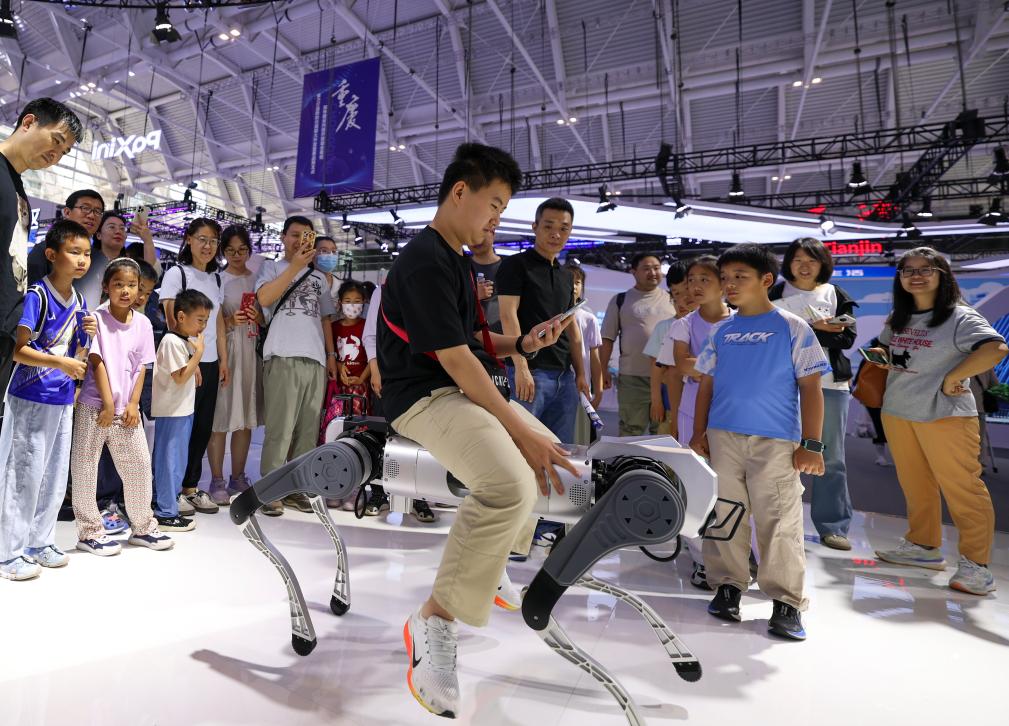
TIANJIN, May 31 (Xinhua) – What once looked like science fiction is becoming part of China’s daily life, with smart mirrors providing instant snapshots of people’s health, robotic arms deftly cooking delicious Chinese crepes, and robots playing Go and telling stories to children at the 2026 World Intelligence Expo in the northern Chinese city of Tianjin.
The four-day exhibition, which concluded on Sunday, attracted more than 700 exhibitors, showcasing cutting-edge technologies, products and application scenarios in the field of artificial intelligence (AI).
Industry participants at the event said AI is accelerating its integration into education, public services, manufacturing and daily life, improving the efficiency of traditional industries while creating new business models and growth opportunities.
At the booth of iFLYTEK Co., Ltd., a leading Chinese AI company specializing in intelligent voice and AI technology, a smart blackboard called iFLYTEK AI Board attracted attention.
Combining a traditional chalkboard and an electronic display, this device digitizes handwritten equations the moment they are written, turning abstract mathematical concepts into vivid visual representations.
Similar AI-powered applications are already being implemented in classrooms.
During physical education class at Tianjin Second Xinhua High School, students crouch, jump, and land according to the announcer’s instructions. Their jump distance is instantly broadcast by the audio system and uploaded to the teacher’s device in real time, allowing for instant analysis of physical performance and fitness metrics.
“AI is transforming education in an unprecedented way,” said Dong Bin, Deputy General Manager of iFLYTEK’s Brand Marketing Center.
“This frees teachers from repetitive tasks and allows them to focus on educational research, and allows students to spend less time on overtraining and more time on meaningful self-improvement.”
According to the company, iFLYTEK provides smart education products and solutions to more than 50,000 schools across China, benefiting more than 130 million teachers and students.
In the expo’s Embodied Intelligence Zone, different types of robots demonstrated their capabilities in real-life scenarios, including cooking, providing massage services, refueling vehicles, and playing music.
Among them was the Aimoga Smart Police Robot, a wheeled traffic police robot that demonstrated its ability to direct traffic in real-life situations, waving its arms with the precision of an experienced police officer.
The robot has already been deployed in several cities in China, including Hefei, Wuhu and Changzhou, where it acts as an intelligent assistant for traffic police officers.
“The robot is equipped with lidar and a 360-degree camera, and is capable of autonomous navigation, environment recognition, and human-machine interaction,” said Chen Gaoyuan, a staff member of AiMOGA Robotics Technology Co., Ltd..
“It can assist in traffic direction and road patrolling and help deter traffic violations, while also taking on repetitive and labor-intensive tasks during peak traffic periods during major events and holidays,” Chen added.
The company focuses on the development and commercial applications of embodied intelligent robots, accelerating the transition of robotics from technology demonstration to real-world deployment.
The company’s humanoid robots, traffic police robots, and medical service robots have been exported to more than 50 countries and regions and are used in automobile dealerships, exhibition halls, public service venues, hospitals, traffic management, etc.
Its popularity is evident at the nearby PaXini Technology booth. The company specializes in the development of multidimensional tactile sensing technology and humanoid robots, and has already introduced its products on a large scale in precision manufacturing, automotive production lines, and medical rehabilitation.
Lin Tong, senior executive of PaXini Technology (Tianjin) Co., Ltd., said the company’s TORA series of humanoid robots can perform a wide range of tasks, including meal preparation and delivery, coffee making, table cleaning, housekeeping, and other service functions.
Mr. Lin added that the company has established partnerships with several leading international companies, and its products and solutions serve markets in North America, Europe, and Asia Pacific.
“China’s embodied intelligence industry enjoys clear advantages in deployment speed, scenario diversity, and supply chain coordination,” Lin said.
“With the world’s richest manufacturing scenarios, comprehensive supply chains, and extensive robotics application environment, China provides a natural real-world training ground for embodied intelligence,” Lin added.
Behind these increasingly rich application scenarios lies sustained policy support.
In 2017, China announced a new generation AI development plan, and last year released guidelines to further implement the “AI Plus” initiative. The country’s 15th Five-Year Plan (2026-2030) also calls for fully implementing initiatives to promote AI-driven development and fostering rapid growth in AI innovation.
According to the National Data Bureau, China has become the world’s largest holder of AI patents, accounting for about 60% of the global total, and the size of its core AI industry exceeds 1.2 trillion yuan (approximately US$176 billion).
“AI is accelerating deep integration with a wide range of industries, upgrading traditional fields, and driving breakthrough advances in productivity and efficiency,” said Chen Jiachang, vice minister of China’s Ministry of Science and Technology.
Chen hopes that technologies such as embodied intelligence, brain-inspired AI, and brain-computer interfaces will create new growth areas and business models, propelling China toward becoming an AI superpower. ■


