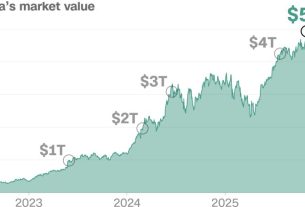
Thanks to the artificial intelligence (AI) boom, Nvidia has surpassed Apple and Microsoft in market capitalization to become the world's most valuable company.
 advertisement
AI darling NVIDIA's shares rose 3.5% on Tuesday to $135.58 per share, giving it a market cap of $3.34 trillion, overtaking Apple and Microsoft to become the world's most valuable company. Microsoft is now in second place with a market cap of $3.32 trillion, followed by Apple at $3.28 trillion.
The price surge was sparked by news that the chipmaker could secure a 20% weighting in the S&P 500 Technology Select Sector SPDR Fund (XLK) under valuation rules, a move that could see the exchange-traded fund acquire more than $10 billion in Nvidia shares.
Nvidia shares have risen 12% since its 1-for-10 stock split began on June 10 and are up 170% since the start of the year. Meanwhile, Microsoft shares are up 20% this year and Apple shares are up 15%. The company's shares are up about 591,000% since it went public in 1999.
NVIDIA emerged as the biggest AI winner since 2023, thanks to its advanced graphic processing units (GPUs) that specialize in supercomputing capabilities to support generative AI training. The company's revenue nearly quadrupled in the first quarter of fiscal 2025.
The company holds a monopoly in AI chip manufacturing, with roughly 80% of the market share. Its customers include all the big tech companies, including Microsoft, Amazon, Meta Platforms, Alphabet, and OpenAI. CFO Colette Kress revealed that roughly 45% of Nvidia's data center revenue comes from these cloud providers.
Nvidia has released a new supercomputing AI GPU, Blackwell, that is expected to spearhead the company's growth over the coming year. CEO Jessen Huang also expressed a desire to push product offerings across a range of verticals, including consumer internet companies, automakers and healthcare providers, rather than focusing solely on the cloud business.
A look back at Nvidia's history
Nvidia was founded in Sunnyvale, California, USA in 1993. CEO Jensen Huang was one of three co-founders and had previously served as director of CoreWare and microprocessor designer at Advanced Micro Devices (AMD). The company's main product is the graphics processing unit (GPU), a specialized electronic circuit designed in its early days to speed up the rendering of images and videos.
Rather than relying on big revenue from data centers, Nvidia initially gained market share in the gaming industry through deals with Microsoft's Xbox in 2000 and Sony's PlayStation in 2004. Nvidia joined the S&P 500 in 2001, but the dot-com bubble caused its stock price to crash nearly 90% between January and September 2002. After a multi-year recovery, fueled by GPU sales and the creation of the CUDA platform, Nvidia's stock price soared 635% from late 2004 to a peak in 2008, before the global financial crisis.
CUDA, a parallel computing platform and programming model introduced in 2006, enabled Nvidia to enter the data center market by leveraging Nvidia GPUs for general computing tasks essential for AI and deep learning applications. Nvidia's sales of supercomputing chips were boosted in 2017 and again in 2020 by cryptocurrency mining. During the COVID-19 pandemic, gaming revenues soared and its market valuation surpassed Intel's.
Nvidia shares have fallen 67% from their 2021 peak until October 2022, when the Fed began aggressively raising interest rates. But sales of the company's advanced AI chips have exploded over the past year, fueled by the AI boom that Microsoft started in 2023.
Is Nvidia overvalued?
NVIDIA's price-to-earnings ratio of 78x is the highest among companies with a market capitalization of $1 trillion. However, its dividend yield is low at 0.03%, typical of a growth company. NVIDIA needs to keep investing billions of dollars to maintain its market share. Some analysts believe the company's market capitalization could exceed $4 trillion in the near future.
With annual revenue growth exceeding 200%, Nvidia's stock appears to be fairly valued, but the stock has risen sharply and may be in for a period of profit-taking.