Insider Brief
- Scientists have developed physics-based machine learning methods that automatically identifies the origin of iron loss in soft magnetic materials, providing a path to more efficient electric motors.
- This study combines the extended Ginzburg-Landau framework with interpretable machine learning to analyze the non-uniform magnetic domain structures of materials such as non-directional electric steel.
- This method reveals that energy loss occurs near grain boundaries due to competitive factors for magnetization reversal, allowing for accurate identification of loss mechanisms that could not be detected previously through visual inspection alone.
Press Release – Magnetic hysteresis loss or iron loss of soft magnetic materials accounts for about 30% of the energy loss of electric motors. This loss has led to major energy losses worldwide and represents an immediate environmental concern. However, the origin of iron loss remains elusive despite decades of research. Currently, scientists are developing new physics-based machine learning approaches that automatically identify the origin of iron losses, establishing new paradigms for designing efficient soft magnetic materials.
The loss of magnetic hysteresis or loss of iron is an important magnetic property that determines the efficiency of an electric motor and is therefore important for electric vehicles. This occurs when the magnetic field inside the motor core, made of soft magnetic material, is repeatedly inverted due to the change in current flow through the winding. This inversion causes a small magnetic region called a magnetic domain to repeatedly change the direction of magnetization. However, this change is not entirely efficient and results in energy losses. In fact, iron loss accounts for around 30% of the total energy loss of the motor, leading to carbon dioxide emissions, which represents pressing concern for the environment.
Despite research over half a century, the origin of iron loss in soft magnetic materials remains elusive. The energy spent during the reversal of magnetization of these materials depends on complex changes in the magnetic domain structure. These are primarily interpreted visually, and the underlying mechanisms are only discussed qualitatively. Researchers believe that investigating the correlation between energy loss and the microstructure of the magnetic domain is a promising direction. However, while most current physical models for analyzing magnetization inversion are designed for uniform systems, practical soft magnetic materials such as non-directional electric steel (NOES) are non-uniform, making analysis difficult. \
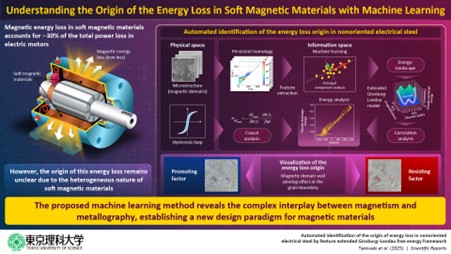
Currently, in the breakthrough, Michiki Taniwaki from TUS has developed a new approach using the Extended-Ginzburg-Landau (Ex-GL) framework, along with a research team from the Department of Materials Science and Technology (TUS) at Tokyo University of Science (TUS) in Japan. This method successfully tracks the origin of iron loss into magnetic domain structures. Professor Kotsugi explained:Ginzburg – Landau (GL) free energy was a useful concept for analyzing magnetization inversion in uniform systems. Recent advances in data science have made it possible to use EX-GL models for analysis of heterogeneous systems. This study combined the EX-GL framework with interpretable machine learning for automatic analysis of complex magnetization inversions in NOES.“Their research was published in the journal Scientific Report July 15, 2025.
The team first quantified the complexity of the magnetic domains from microstructured images of NOEs using persistent homology (PH), a mathematical tool for multi-scale analysis of topological features of data. Next, we applied the statistical technique Principal Component Analysis (PCA) to extract important features hidden in complex pH data. Two characteristics have appeared. In other words, PC1, which represents magnetization, and PC2, which represents magnetic domain walls.
Next, using these features, the team built an extended energy environment using the Ex-GL framework. This mapped the changes in the magnetic domain structure with energy as a graph with each point corresponding to the magnetic domain image. The team then used this graph to perform a comprehensive correlation analysis between function and physical parameters, revealing a physically meaningful function that explains energy losses during magnetization reversal.
Their analysis revealed the presence of facilitators in the process of magnetization reversal. Interestingly, both factors were found at the same location, mainly near grain boundaries. This is the interface between different crystals of the crystal material. This suggests competition between these factors. “Competition between facilitators and resistive factors automatically identifies the pinning location of magnetic domain walls, a key phenomenon that causes energy loss in soft magnetic materials.,” Professor Kotsugi.In places where only resistance factors are present, we found that segmented magnetic domains are the main contributors of energy loss.”
The importance of this approach lies in automated, accurate, data-driven insights into both the mechanism and location of energy loss.
“Our approach allowed us to extract information that was difficult to obtain through visual inspection alone. Professor Kotsugi.
The research paves ways to realize the United Nations sustainable development goals, including affordable and clean energy, industrialization, innovation, infrastructure and combating climate change. In summary, this study presents an innovative data-driven approach to identifying origins and addressing the energy losses of soft magnetic materials, leading to more efficient and environmentally friendly electric vehicles, paving the way for a sustainable future.