
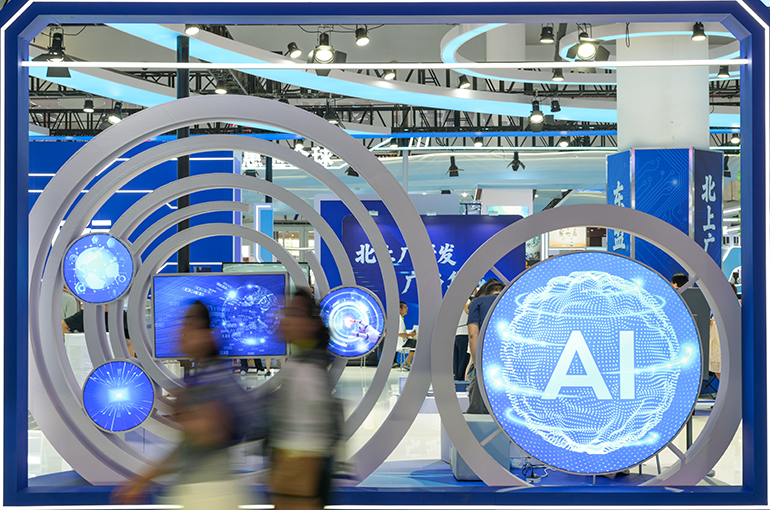
(Yicai) April 16 — Consumer products powered by artificial intelligence took center stage at the 6th China International Consumer Products Expo held in Hainan province, with the technology dramatically transforming its capabilities for commercialization.
At the expo held in Haikou from April 13 to 18, a representative from BCI start-up BrainCo told Yicai that AI technology has greatly contributed to the research and development and application of brain-computer interfaces, making it possible to “read the brain” quickly and accurately.
BrainCo showcased the Brain Science AI Robotic Arm Maker Kit, BCI’s entry-level tool aimed at the education sector, according to the Hangzhou-based company. This kit aims to enable the general public, especially teenagers, to experience, learn and practice brain control + AI + robotic arm technology at a low cost.
“The signals sent by the brain are very weak and vary from person to person,” a BrainCo official said. “In the past, we had to spend a lot of time training systems to recognize human intent, but now AI can quickly extract important information from cluttered signals.”
Intelligent human-computer interaction and BCI products can become everyday accessories that bring new experiences to consumers and extend human cognition and intelligence in medicine, education, daily life and other fields, the official noted.
Song Tao, vice president of Alibaba Group Holding’s Taobao and Tmall Group, told Yeatsai that smart glasses, smart robots, and AI computers are among the top three most popular categories of Tmall’s 3C (computer, communication, consumer) products. Song added that during last year’s Double 11 Shopping Festival, sales of smart glasses soared more than 25 times compared to the previous year, transforming them from “otaku toys” to mass consumer goods.
AI is also helping sellers on e-commerce platforms enhance their business capabilities, Song said. Song pointed out that the 2 billion products for sale on Taobao and Tmall are better understood and organized thanks to this technology, resulting in a two-digit improvement in the accuracy of matching products with potential users.
Integration with AI is significantly changing the production and sales models of traditional consumer goods suppliers, Tu Honyan, chairman of Wensli Group, told Yicai. Tu added that the company is transforming from a traditional silk supplier to one that utilizes AI to innovate the entire process from design, production, marketing and after-sales service.
Wensli has achieved personalized customization and flexible production of silk products, Tu said. “With the help of AI agents, the company can design silk scarves according to customers’ individual requirements, complete production within an hour of a consumer placing an order, and deliver the product within two hours.”
Alfred Yin, managing partner of China Ernst & Young’s retail and consumer products industry, told media outlets such as Yicai that this year will be an important year for AI to be deeply integrated into daily business operations. “The importance of AI to the retail industry has gone beyond being an IT tool to reduce costs and increase efficiency to an infrastructure that reshapes the fundamental logic of business.”
Yin said that as competitive barriers in the market shift from scale-driven cost advantages to algorithm-driven agile response capabilities, companies need to equip themselves with new content and data operational capabilities. He added that while AI algorithms can provide ultimate business efficiency, it is still the immense emotional connection and brand consistency that truly transcends the cycle and wins consumer loyalty.
Editor: Shihua Tang, Martin Kadyev


