AI apps are rapidly filling the world’s largest app stores. Many developers now believe that adding AI features will increase downloads and revenue.
But new data suggests this strategy has its limits. AI-powered apps often generate high revenue initially, but have difficulty keeping customers paying over time.
A new industry report finds that AI apps quickly attract users, but lose subscribers faster than traditional apps.
RevenueCat recently released its 2026 State of Subscription Apps report. This analysis leverages a large dataset from the global subscription app industry.
Data and trends
RevenueCat has created the report based on extensive transaction data. More than 75,000 app developers use the company’s tools to manage their subscriptions.
These apps process over 1 billion in-app transactions and generate over $11 billion in revenue each year.
This large sample provides a clear picture of the subscription app market. As a result, this report provided insight into current trends.
There was one pattern.
AI apps churn faster than non-AI apps. In other words, users cancel their subscriptions sooner.
At the median level, people cancel annual subscriptions to AI apps about 30% faster than they cancel subscriptions to non-AI apps.
High churn rates can reduce long-term revenue.
AI app
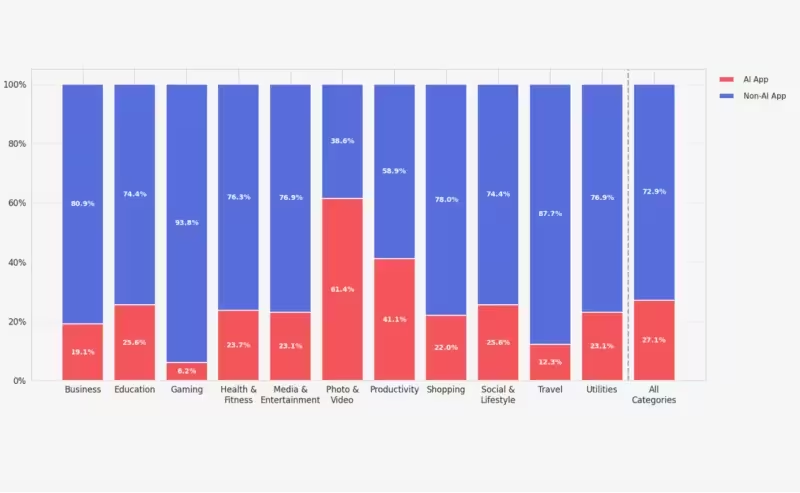
Despite worrying churn rates, AI-powered apps continued to grow. According to the report, 27.1% of subscription apps currently identify as leveraging AI.
Meanwhile, non-AI apps still account for the majority at 72.9%. Still, roughly one in four apps now power AI capabilities.
The definition of an AI-powered app is broad. It includes famous AI chatbots such as ChatGPT and Gemini. It also includes apps that integrate AI into other services.
For example, many photo editing tools now use AI to enhance images. Similarly, writing assistants utilize AI to generate text. Productivity apps can also use AI to automate tasks.
App category
Adoption rates vary widely. Photo and video apps are the most popular. In this segment, 61.4% of apps include AI functionality.
AI tools can easily edit photos, improve lighting, remove objects, and generate new visuals. These features provide immediate value to users.
Other sectors are seeing a decline in ridership. Gaming apps have the lowest AI presence, with only 6.2% of apps currently having AI capabilities.
Travel apps follow at 12.3%, while business apps also remain relatively low at 19.1%. Developers in these categories may be slower to adopt AI.
Retention rate
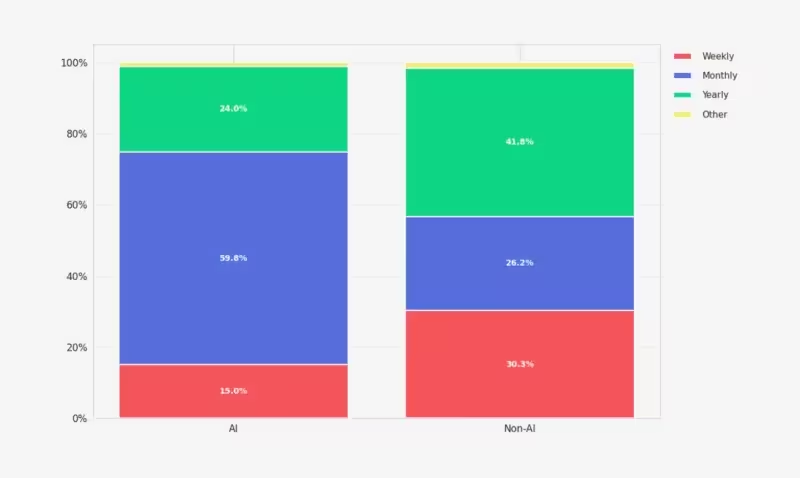
Although AI apps have generated strong initial interest, retention rates remain low. AI apps have an annual retention rate of 21.1%.
In contrast, non-AI apps retain approximately 30.7% of their subscribers after one year. Monthly retention shows a similar pattern.
AI apps retain approximately 6.1% of users each month. On the other hand, non-AI apps remain at around 9.5%.
This difference may seem small at first. However, in a subscription business, even small changes in retention can have a big impact on long-term revenue.
Interestingly, AI apps outperform non-AI apps on certain short-term metrics.
The weekly retention rate for AI apps is 2.5%. The percentage of non-AI apps is lower at 1.7%.
However, weekly subscriptions are not the most common pricing model for AI tools. Therefore, the impact of this benefit is limited.
rapid innovation
The fast pace of AI development may help explain the retention gap. New AI tools emerge frequently, and developers release new models, features, and updates at a rapid pace.
As a result, users often test several different AI apps. For example, let’s say someone tries out one writing assistant this month. They may then switch to another tool that promises better results.
This continued experimentation encourages short-term use. But it weakens long-term loyalty.
Traditional apps often build deeper habits. Once users rely on them for daily work, it becomes difficult to switch.
AI apps have not yet reached that level of long-term dependence.
Also read: 20 Top Free AI Apps to Start Using Now
Refund rate
AI apps have higher refund rates than non-AI apps. At the median level, AI apps refund approximately 4.2% of purchases. Non-AI apps average 3.5%.
The difference becomes more noticeable the higher you go. The refund rate for AI apps can reach 15.6%. Non-AI apps amount to approximately 12.5%.
High refund amounts may indicate user dissatisfaction. In some cases, AI tools may not live up to expectations.
These refund patterns result in high revenue volatility for developers.
powerful monetization
Despite these challenges, AI apps are performing well on several financial metrics. First, AI apps more effectively convert trial users into paid subscribers.
The median conversion rate for AI apps reaches 8.5%. The conversion rate for non-AI apps is approximately 5.6%. This is an improvement of approximately 52%.
AI apps also generate more revenue per download. On average, they monetize downloads about 20% better than non-AI apps.
There is another important metric. AI apps generate higher realized lifetime value (RLTV). This metric measures the total value created by the average paying user over time.
For AI apps, the median monthly RLTV reaches $18.92. Non-AI apps cost approximately $13.59. Annual RLTV revenue for AI apps is approximately $30.16, while revenue for non-AI apps is approximately $21.37.
These numbers suggest that AI capabilities are still attracting paying customers. However, long-term retention remains a key challenge.