
With 81% of Southeast Asian companies already piloting and expanding AI-powered projects, Singapore has the potential to become a hub for regional AI innovation.
issued Friday, March 27, 2026 · 05:50 AM
Southeast Asia is slightly above the global average in artificial intelligence (AI) adoption, with nearly 90% of companies planning to experiment with agent-based AI.
This is according to the “AI in Southeast Asia: The Age of Opportunity” report published by McKinsey & Company, the Economic Development Board of Singapore (EDB), and Tech in Asia on February 11, 2026.
The survey of 330 respondents from a variety of industries and company sizes found that 81 percent of companies in the region have moved beyond experimentation to pilot and expansion stages (compared to the global average of 63 percent).
Amid global economic headwinds, Singapore has emerged as a regional hub for cloud and AI innovation, strengthening its role as a hub for companies expanding AI across Southeast Asia. The city-state is home to more than 60 AI centers of excellence, including centers of excellence operated by Alibaba Cloud, IBM, Nvidia, and Oracle.
View the infographic to understand how companies across Southeast Asia are adopting AI and the key trends shaping the region’s digital transformation.
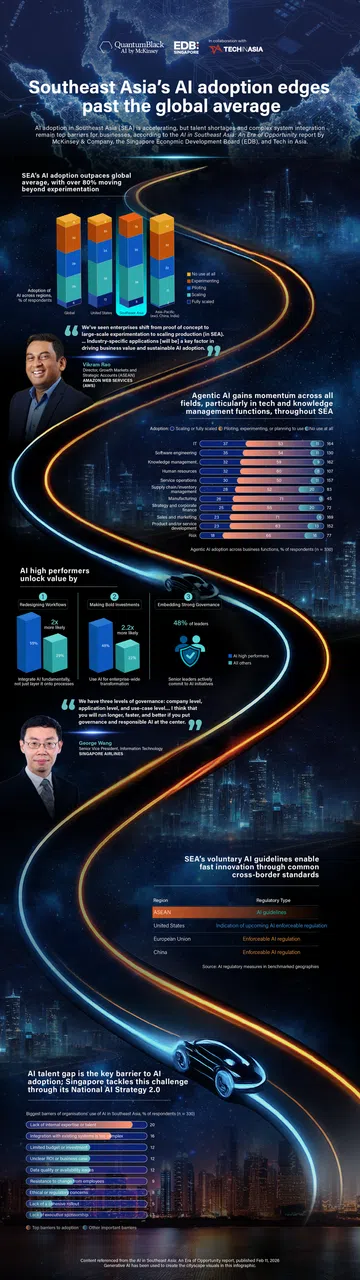
The region’s leading technology companies are moving beyond experimenting with AI and applying it to real-world use cases. Grab, Southeast Asia’s largest ride-hailing platform, is rolling out AI-driven applications across its ecosystem, including Merchant AI Assistant and Driver AI Copilot.
Nikhil Dwarakanath, Group Head of Data and Analytics at Grab, said, “Our Merchant AI Assistant is currently deployed to over 1.2 million merchants. AI is helping drive revenue growth.”
Cloud providers see this momentum accelerating. Vikram Rao, Director of ASEAN Growth Markets and Strategic Accounts at Amazon Web Services (AWS), said in the report that AI is a turning point for the region.
“AI is the biggest opportunity since cloud computing and perhaps since the internet. Our customer base will grow five times from 2024 to 2025 alone, across every industry use case,” he said.
AWS has committed to investing an additional US$9 billion (S$11.5 billion) in Singapore by 2028, indicating strong expectations that enterprise demand for AI infrastructure in the region will continue.
Integration of people and systems remains the biggest barrier
Despite rapid experimentation with AI, companies cite the lack of skilled AI workers and the difficulty of integrating AI into existing systems as the biggest obstacles.
One in five executives cite the lack of AI professionals as their top barrier, impacting their ability to attract talented leaders, upskill their staff, and retain critical expertise. Industry observers say the talent shortage could be a constraint for companies looking to expand AI adoption.
Singapore is addressing the skills gap through policy and training. The government’s National AI Strategy 2.0, along with workforce initiatives such as the TechSkills Accelerator, aims to increase AI literacy across the city-state, including non-technical staff.
Complementing these national efforts are collaborations between higher education institutions and industry. Examples include the Singapore Institute of Technology’s AI Center in partnership with Nvidia, the National Institute of Education in partnership with AWS, and Nanyang Technological University’s long-standing corporate lab in partnership with Rolls-Royce.
These collaborations provide training pipelines, testbeds, internships, and cloud credits to help companies hire talent, reskill staff, and advance their AI initiatives.
Industry leaders emphasize the importance of responsible governance.
George Wang, Singapore Airlines’ Senior Vice President of Information Technology, said: “I think if we put governance and responsible AI at the center, we can run longer, faster and better.”
Despite strong momentum, only a small percentage of companies surveyed said they had fully scaled AI adoption across their organizations.
Still, progress is happening. Singapore stands out as a regional leader, with 56% of local businesses reporting progress towards large-scale AI adoption.
Read the full report Discover how your company can scale adoption and maximize the value of AI in Southeast Asia..