news
December 12, 2025

lisa daigle
Deputy editor
military embedded systems
Andover, Massachusetts Modular power components company Vicor, in collaboration with UK-based space consultancy and design firm Spacechips, reports that it has launched a compact artificial intelligence (AI) accelerator card that enables on-orbit AI applications.
Spacechips announced the AI1 transponder, a small onboard processor card with ACAP. [adaptive compute acceleration platform] AI accelerator. According to information from Vicor, AI1's reconfigurable receiver and transmitter will deliver up to 133 tera operations per second (TOPS), enabling new Earth observations. In Space Service, Assembly, and Manufacturing (ISAM). Signals Intelligence (SIGINT); Intelligence, Surveillance, and Reconnaissance (ISR), as well as communications applications that support real-time autonomous computing and ensure reliability and longevity to complete longer missions.
“Many spacecraft operators do not have enough RF spectrum bandwidth to download all the acquired data for real-time processing,” said Dr. Rajan Bedi, CEO of Spacechips. “An alternative solution is to perform the processing in orbit and simply downlink the intelligent insights.”
Given the constrained operating environment of space, precision power management is urgently needed for AI-enabled computing. The need is further exacerbated by the growing number, scope, and variety of missions requiring spacecraft of various types, as well as by the growing reliance on some form of solar power to provide adequate power.
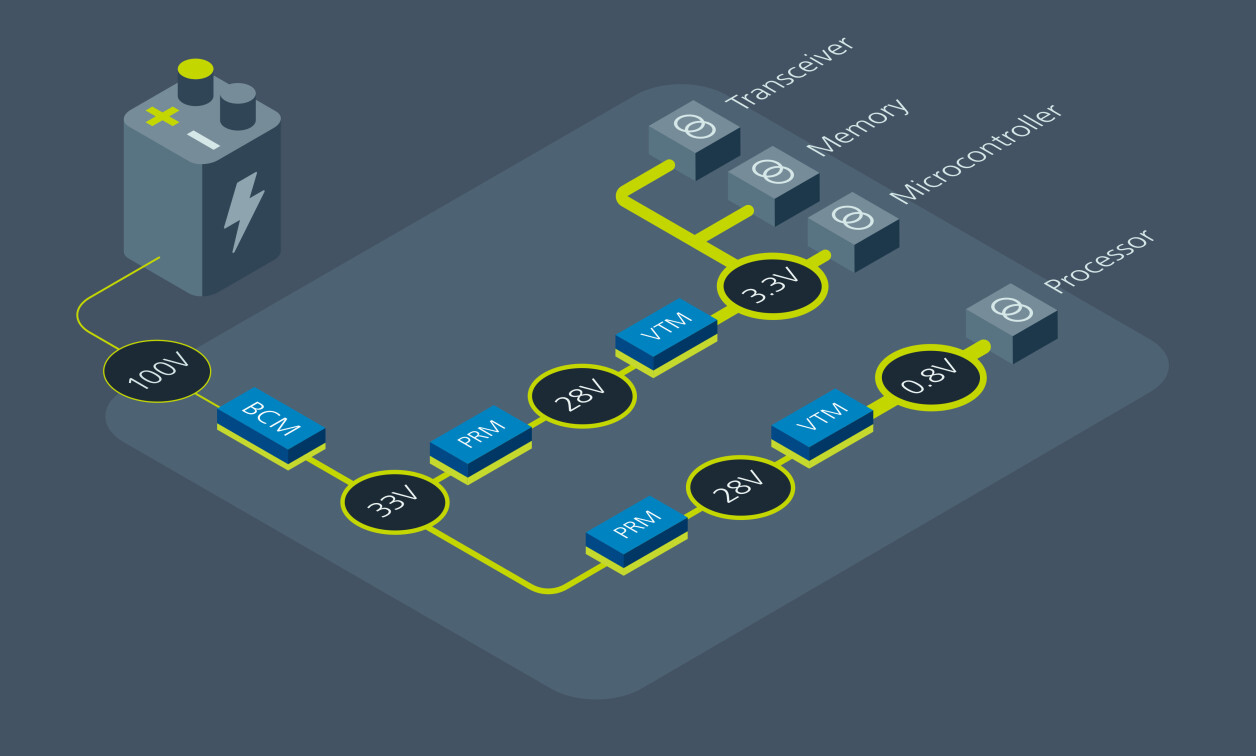
The need for precision power management in the constrained operating environment of space led to the partnership between Vicor and Spacechips, where AI1 used the Vicor Factorized Power Architecture (FPA) to place high-density power modules on Spacechips transponder boards. FPA is a power delivery system design that separates the function of DC-DC conversion into independent modules. The value of the Vicor solution is that it is extremely compact and power-dense, reducing size and weight, increasing efficiency and flexibility, and enabling higher power density, especially in high-performance computing applications, Bedi said.
Featured companies