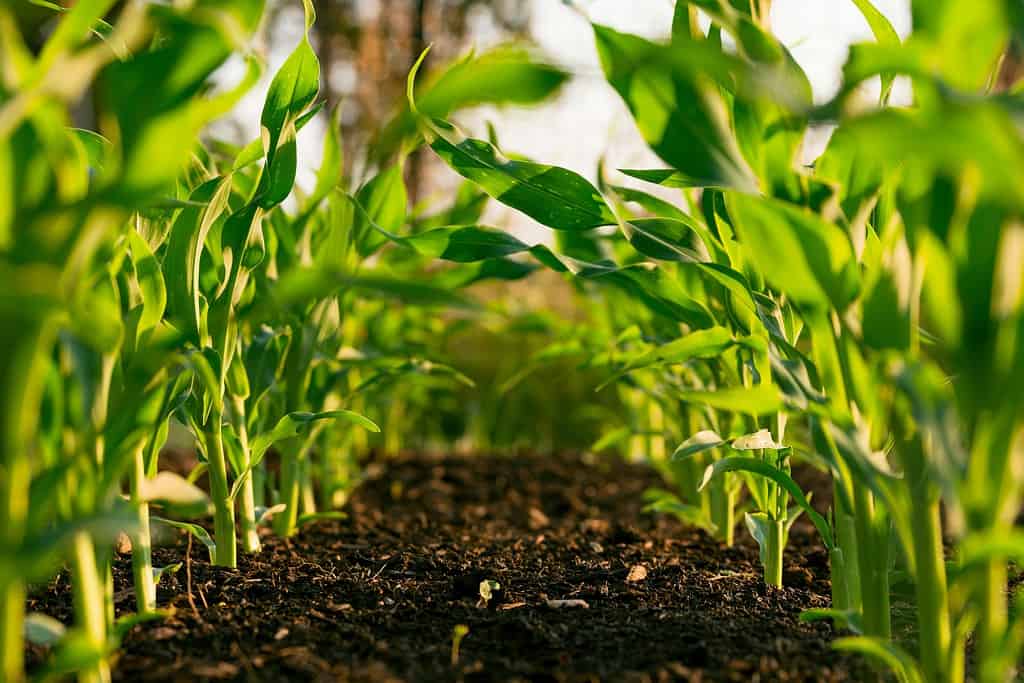
Making agriculture sustainable is one of the greatest challenges of our time. Not only does agriculture produce nearly a third of total greenhouse gas emissions, it also consumes huge amounts of water and fertilizer, and contributes to soil erosion and degradation. At the same time, the planet's population continues to grow, and agricultural practices must keep up. Thankfully, promising new technologies are emerging to help.
The integration of such new technologies is sometimes referred to as Agriculture 5.0 and represents the latest paradigm shift in agriculture, incorporating elements such as machine learning (ML), the Internet of Things (IoT) and robotics.
We've written before about how IoT and ML can help agriculture. In fact, several young researchers at the Heidelberg Laureate Forum (HLF) are working in this field. But the range of applications for this cutting-edge technology is broad: inexpensive sensors can monitor things like moisture levels and fertilizer usage, helping to optimize resource use and reduce waste; smart algorithms can detect pests and health problems; and even weed-killing robots.
Weeds vs. Robots
It's amazing how well one of the oldest practices (one that may define humanity) – agriculture – and cutting-edge technology work together. Take weed control, for example. Weeds have been one of farmers' biggest challenges for thousands of years, and are one of the primary focuses of Agriculture 5.0.
In case you forgot about “agriculture,” Agriculture 4.0 (also known as precision agriculture) introduced a data-driven approach to optimize farming practices. It focused on using telematics, remote data, and precision agriculture to improve crop quality and yields. However, Agriculture 5.0 goes beyond data-driven practices to incorporate autonomous and unmanned technologies. In Agriculture 5.0, robotics and AI play a central role, facilitating tasks such as soil analysis, crop monitoring, and weed management. Although the term is not accepted everywhere, it has become common in the scientific literature because it easily captures the range of technologies and approaches most commonly used.
But in any iteration of agriculture, weeds and pests have always been a problem.
Traditional weed management methods, such as uniformly applying herbicides, are often inefficient and harmful to the environment. These methods can lead to overuse of chemicals in some areas and undertreatment in others. Overuse of herbicides can harm non-target plants, deteriorate soil health, contaminate water sources, and lead to the development of herbicide-resistant weed species.
This is where the new robot comes in.
The approach of using machine learning robots to identify and combat weeds has already been discussed many times in peer-reviewed studies. The “combat” part is relatively easy: remove the weeds with a laser or strategically spray small amounts of insecticide and the job is done. However, identifying weeds in a real-world situation with many unknowns is much harder.
Different algorithms for different types of weeds
The steps required to train such a weed detection robot are already familiar to these algorithms: first, data must be acquired, which in this case is essentially a set of high-quality images of agricultural fields at different wavelengths, either in the visible range or with a multispectral camera. These images then undergo pre-processing, such as removing background noise, enhancing relevant features, and possibly using vegetation indices or other metrics.
“To train an effective model for weed detection and evaluate the performance of the learned model, a dataset is typically split into training and test data,” write the authors of a 2022 review of existing technologies. “The training set is used to train and tune the model's hyperparameters. The test set is used to provide an unbiased evaluation of the final model fitted by the training set. In some cases, it is also necessary to split a validation set from the training samples to observe the performance of the learned model and help select the final model.”
Features are then extracted that can be used to distinguish between crops and weeds. These features can be based on color, shape, texture, or relevant spectral characteristics. For example, weeds look relatively similar to crops, but they may have higher (or lower) reflectance, which is detected (this is where multispectral cameras come in handy, especially as they can see features invisible to the human eye). Various ML algorithms are then used to classify the extracted features into weed and crop categories.
Popular algorithms include k-nearest neighbors (KNN), support vector machines (SVM), and convolutional neural networks (CNN). Each algorithm has its strengths, and CNNs are particularly good at image recognition tasks because they can automatically learn and extract relevant features from raw images. The selected algorithm is usually trained, validated, and tested using a labeled dataset.
A big challenge is that even if such a model works, it will likely only work for the specific instance it was trained on. Not all weeds are the same, and not all crops are the same, so a model cannot be trained for all weeds and crops, but must be done with specific plants in mind. Although there are already some publicly available datasets for training algorithms, there is no “cure-all” algorithm that works optimally in all cases.
A recent survey from December 2023 summed up the challenge:
“The main challenge in crop and weed classification using annotation-based techniques is building a classification model and optimizing the model parameters. A classification model, like any other image classification problem, is created for a specific application and its parameters need to be fine-tuned and optimized. Classification optimization requires the use of multiple algorithms to achieve a high classification rate while minimizing false positives and overfitting to the data.”
“The biggest question is how the technology will be used, and then how it will be used depending on the crop and weed morphology. As a result, it is very difficult to determine which technology is better on an 'equal footing' basis.”
This is already happening
Automated weeding is not just a good idea: several such systems have already been developed at universities and are beginning to be commercialized. Automated weeders (equipped with lasers or poisons) typically achieve weed removal rates of around 70%. Although they still require subsequent “manual” verification, this allows farmers to use less pesticides and make more sustainable decisions.
Additionally, ML models can be used in conjunction with autonomous robots or IoT devices to build fully integrated weed management systems. For example, fields can be continuously monitored to detect weeds and remove them without human intervention. Another approach is to use drones to monitor a larger area to detect weeds and then use a separate tool to remove them.
Significant challenges remain, especially when it comes to scaling up the approach to different crop types and weeds, which must be done on a case-by-case basis and is time- and resource-intensive. But ultimately, automated weeding has come a long way in just a few years, with improvements in imaging technology, sensors, and machine learning algorithms pushing the limits of what automated weeders can do.
Future iterations of these technologies may integrate more advanced AI models that can learn and adapt to new weed species and changing field conditions. Furthermore, collaboration between researchers and farmers could also improve the robustness and adaptability of automated weeders as this approach is implemented in real-world situations.
Agriculture has been a cornerstone of our societies for thousands of years, and will continue to be so for many years to come. Feeding the world sustainably is no easy task, but we have new weapons in our arsenal. By harnessing these technologies, we can increase crop yields, reduce agriculture's environmental impact, and contribute to a greener future for agriculture.