

Companies are competing to deploy AI agents that can make decisions and take action at machine speed and scale. However, when judgment moves from human to machine, the margin of error disappears. A single bad data feed is not just inconvenient. It can cause financial, compliance, or reputational damage before you have the opportunity to intervene.
Most enterprise data environments are not built for this new reality. Fragile pipelines, batch processing and siloed systems still dominate. According to Gartner, 63% of organizations are unclear whether they lack the right data management practices for AI. Gartner also predicted that 60% of AI projects that are not AI ready will be abandoned until 2026.
The challenges are exacerbated by the way some vendors are dealing with data more and more. For example, large CRM software vendors have recently moved to “turn off information” within their ecosystems, banning data sharing with other applications. Other SaaS applications follow the same playbook. This approach benefits vendors by controlling workflows, but it steals businesses from the 360-degree view that AI agents need to work effectively.
Solutions build a comprehensive context system, not just data and more data.
What is a system of context?
A system of context is an intelligence layer built on top of a semantic data layer. It integrates trustworthy internal data with external sources, organizes enterprise data by relationships, history and meaning, ensuring that all downstream AI decisions are based on a comprehensive understanding of the situation.
for example:
- Customers are more than just records of CRM. This is an entity linked to contracts, recent interactions, product use, and open service requests.
- A supplier is more than just a name for a procurement system. It is linked to active purchase orders, performance assessments and pending disputes.
A system of context is a continuous, updated, multi-domain data fabric that provides a comprehensive 360° view of relationships, governance, and lineage-rich entities (customers, products, suppliers, locations, etc.).
Unlike systems of records (transaction systems) and engagement systems (apps such as CRM/ERP), the contextual system allows AI agents and workflows to always work with the most relevant, governed, contextually rich data.
This level of context allows AI agents to act with nuance. Create accurate recommendations, trigger the right workflow and avoid costly mistakes.
Data Layer Foundation
A system of context can only be built on a powerful foundation, the enterprise data layer. This layer integrates, manages, and standardizes data across customers, products, suppliers, and transactions (all domains). So there's a single, reliable version truth available in real time.
Important features include:
- Continuously updated and reliable 360° views Enrich your relationships and history
- Real-time data fabric This eliminates delays from batch jobs
- Integrated Governance Pedigree for explainable and auditable decisions
- Native MCP Connection So AI platforms can be plugged in without custom integration
- Built-in security, access control, and auditability To ensure that only authorized agents and applications can act on trustworthy data
Figure 1: Context Systems Continuously Provide Trusted Data for Agents, Apps, and Analytics
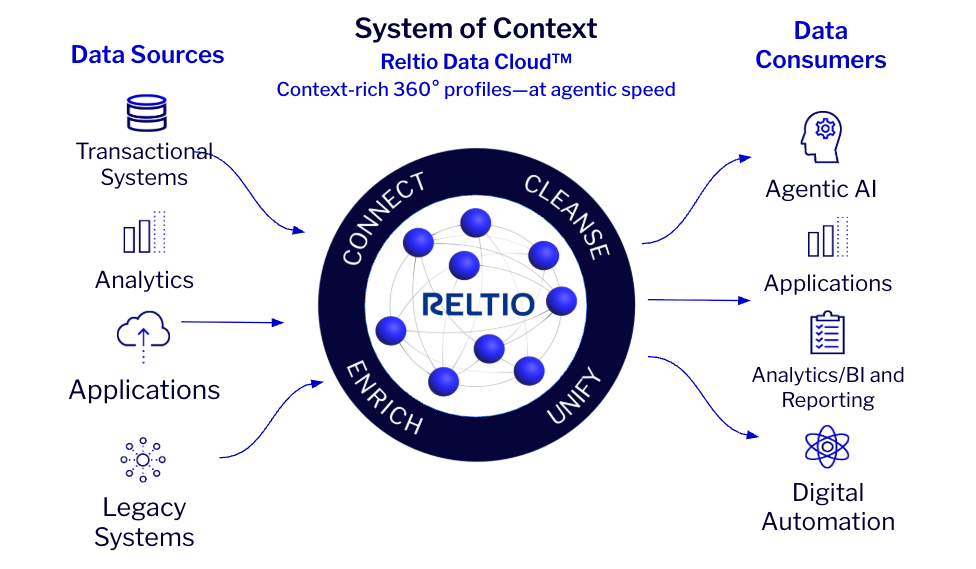
Once the Enterprise Data Layer is introduced, external intelligence and domain-specific enrichment can be added, providing AI agents with a comprehensive enterprise-wide perspective.
Why is this important?
Raw data alone does not prepare you for autonomous decision-making. Additionally, data locked within a single application ecosystem only limits the possibilities of AI. A system of contexts that operates through the Semantic Enterprise Data Layer ensures that all AI agents work from the same, reliable, real-time understanding of your business.
This will result in the company:
- Reduce AI risks by ensuring that decisions are accurate and based on relevant information.
- Provide contextual awareness across the enterprise using accurate data rich in relationships, governance rules and business meanings.
- Ensure AI agents that manage and act on data inherit enterprise-grade policy, security, and compliance guardrails.
Agent AI moves at the speed of data. Without the entire enterprise context, its speed could quickly turn into exposure.
Large companies are currently investing in a system of context. reltio data cloud, To ensure that AI agents act on reliable, real-time, intelligent data across their business.
Older rules no longer apply. read more About 10 new rules for rebuilding enterprise data and additional resources to guide your AI journey.


