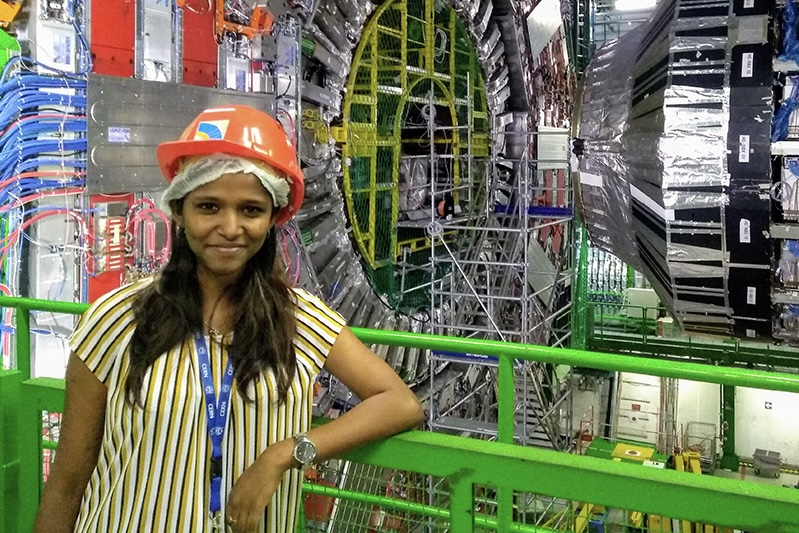
Abhirami Harilal is an Indian-American applied scientist who specializes in machine learning and statistical modeling of large-scale real-world systems, using AI to solve one of the universe’s greatest mysteries: dark matter.
Harilal earned his bachelor’s and master’s degrees from the Indian Institute of Science Education and Research (IISER) in Kolkata, India, then earned his doctorate in physics from Carnegie Mellon University, where he now helps physicists search for new particles.
During her four years at CERN (European Organization for Nuclear Research), she used machine learning to improve the way physicists detect the signatures of rare particles, which has enhanced the search for the Large Hadron Collider, according to a feature article in CMU.
Along the way, she also upgraded CERN’s detector technology by developing algorithms that are now deployed within the Compact Muon Solenoid (CMS) experiment to autonomously identify anomalies more accurately than ever before.
“There are still many fundamental questions about the universe that cannot be fully explained by current physics,” said Harilal, who graduated from Carnegie Mellon University with a doctorate in physics. “At the Large Hadron Collider, we’re looking for signatures of new particles that might help answer those questions.”
Only about 5% of the universe is made of matter that humans can see with our own eyes or detect with scientific instruments. The rest of the universe is made up primarily of dark matter and dark energy, which are invisible to the naked eye but influence the movements of galaxies, stars, and planets.
Read: Indian-American researchers develop tool to identify AI-generated radiology reports
CERN researchers are working to understand what these particles are and how they behave. In 2012, they discovered the Higgs boson, a particle that represents a physical manifestation of the quantum field that pervades the universe.
“The Higgs boson plays a very special role in what we know about fundamental particles, and many theories suggest that if new particles exist, they may be related to the Higgs boson,” Harilal said. “I was trying to see if this Higgs particle decays, or if it decays into a new particle called the A particle, which may be associated with dark matter and other hidden sectors.”
Harilal used machine learning models to improve how researchers detect A particles. She used computational modeling to simulate thousands of particle collisions similar to those occurring at the LHC. Using these methods, Harilal improved the experiment’s sensitivity to particles with unusual or hard-to-detect characteristics, potentially including A particles.
In addition to conducting his own research, Harilal used similar machine learning techniques to improve CERN’s CMS detector and automate the data monitoring system.
Harilal’s machine learning models not only alert researchers to anomalous activity, but also help identify how data differs from expected results. Her research has made it easier for CERN scientists to diagnose potential problems when collecting data. + “We are especially proud because this was actually deployed and used during live data capture,” Harilal said.
Harilal supports other CMS-related projects from Pittsburgh. Once she finishes her studies, she said she hopes to apply her machine learning skills to other areas of research and industry.
“A big part of my job is recognizing meaningful patterns in large amounts of noisy data, and this applies to many other applications as well,” says Harilal. “Similar ideas apply to fields such as medical imaging, financial data, and drug discovery. I look forward to finding other opportunities to utilize these skills.”