

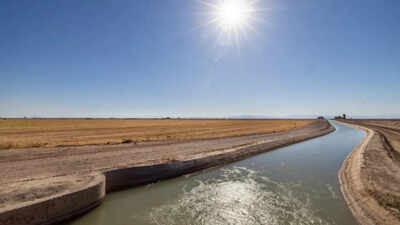
The AI boom has spread data centers around the world faster than most technology projects. These AI lifelines operate on two key resources: water and electricity, and use resources from the regions in which they are installed. Resources are limited and scarce, often leading to conflicts between local residents and the tech giants that own the data centers.A great example is the AI data center being built in Southern California’s Imperial Valley. The 330-megawatt unit, considered the state’s largest AI data center, previously pledged not to use Colorado River water. But now the developers behind the project are suing to gain access to the river’s water, which is already a threatened source of fresh water for 40 million people and the center of countless disputes over water use in the West. The Colorado River is the Imperial Valley’s only source of fresh water and has faced drought and water supply problems for years. It is also the largest water user among the seven states that depend on the river. Farmers are using about 80% of the state’s full allocation.The lawsuit, filed in June 2026 by Imperial Valley Computer Manufacturing, says the company needs access to 287 million gallons of water for its data centers. The lawsuit was filed after two cities, El Centro and Imperial, rejected bids to recycle wastewater to cool proposed data centers. The Imperial Irrigation District, the local agency that supplies Colorado River water to the Imperial Valley, denied the company’s request to provide water for the project. This also comes with a backlash against data centers from communities across the United States. People in the Imperial Valley criticize the data center. At a meeting in late March, California’s KPBS News reported, the board went into recess after the crowd became unruly during Rucci’s remarks.Developer Sebastian Rucci, a Huntington Beach lawyer and businessman who is pushing the plan, said the project would not increase overall demand on the river because the company would leave nearby farmland fallow or stop irrigating it and instead use that water to cool data centers. He said the proposal would have “zero impact” because the data center would not require additional allocations from the Colorado River, adding that its water needs would be on par with a 160-acre farm. However, the developer retracted its statement that it had no intention of using over-allocated Colorado River water.For water experts and local advocates, the lawsuit raises bigger questions than just how much water a single data center should use. As water becomes scarce and new industries increase demand, should water historically used for agriculture be redirected to fuel the AI boom?
From agriculture to data centers?
The Imperial Valley is known for growing beef, alfalfa lettuce, and spinach as its main agricultural products. “Taking land away from agricultural production for other uses, even in small amounts, is a question of values,” John Fleck, a water policy expert and author at the University of New Mexico, told Business Insider.Michael Cohen, a senior research fellow at the Pacific Institute who focuses on water use in the Colorado River Basin, said the problem is not necessarily the amount of water, but rather developers’ plans to access, dry, and reallocate agricultural land to industrial use.The Imperial Valley’s economy has long relied on Colorado River agriculture. Rhett Larson, a water law expert at Arizona State University, said that without the areas around Imperial and Yuma, Arizona, “no American would be able to afford a salad in February.” He added that while farmers may make money selling their land and water rights, those who often suffer are fertilizer salespeople, tractor repairmen, teachers, dry cleaners, or people in rural areas who don’t have land or water rights to sell.
A bright future?
Rucci said his company has contracts to buy land and water allotments from farmers. He also said he pursued this strategy after his proposal to use reclaimed water was rejected. Citing an independent economic study prepared for the county, he added that the data center will bring significant economic benefits to Imperial County, including 1,688 construction jobs, more than 100 permanent jobs and an estimated $2.95 billion in economic improvements over 30 years. While individual landowners may benefit from this practice, taking farmland out of production can have cascading effects on farming communities, including fewer farm-related jobs.“Economic diversification is exactly what this region needs,” Rucci said in an emailed statement to the magazine, pointing to Imperial County’s high unemployment rate. The county’s unemployment rate was about 17% in May, according to state data.Eric Reyes, an Imperial Valley resident and executive director of the advocacy group Los Amigos de la Comunidad, said he is concerned that the lawsuit is an attempt to circumvent the Imperial Irrigation District (IDD), a publicly owned facility controlled by an elected board of directors that has long held water rights in the area, rather than private landowners. He said the developer’s plans “raise a big red flag because they could use it for their own purposes through private deals with landowners.””But Rucci rejected the idea that the company is trying to circumvent IID control, saying farmers have a right to allocate water under state law and the proposal doesn’t require “another drop” from the Colorado River.“The Colorado River Basin needs to decide what we want to be when we grow up and what it will take to get there,” Larson said. “We have enough water to do many good things, but not enough water to do all good things.”As data centers proliferate around the world, the Imperial Valley incident offers an early glimpse into the environmental and social conflicts that could define the next stage of the AI revolution.


