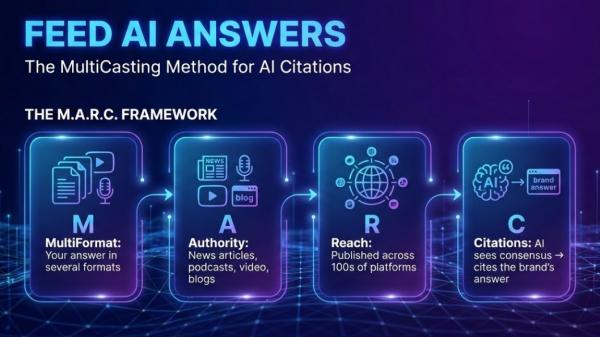
A new framework called MARC helps brands become AI citation sources by delivering trusted formats and consistent messaging across platforms. Designed for the AI era, it transforms isolated content visibility into structured authority that AI systems automatically recognize, repeat, and reference.
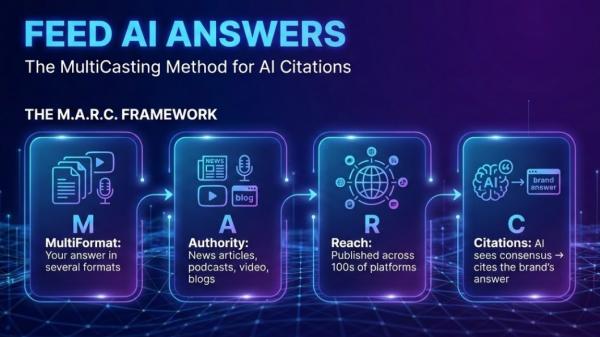
— A new content distribution framework is gaining traction among marketing professionals and digital strategists looking to future-proof brand awareness in the age of artificial intelligence. The model, called MARC, outlines a structured approach to increasing your chances of being cited by AI-powered platforms like ChatGPT, Gemini, and Perplexity.
As more consumers turn to AI tools for answers, the ability for businesses to participate in those answers is quickly becoming a competitive advantage. MARC’s methodology addresses this shift by focusing on how brands can align their messaging with the way AI systems detect and repeat information.
Rather than trying to “optimize” for individual search rankings, this framework positions brands as part of a broader consensus that AI tools use to generate responses. This change marks a major departure from traditional SEO and isolated social media strategies.
Multi-format distribution increases surface area
The first principle of the MARC framework, multi-format delivery, focuses on how AI systems observe content across media. Brands that only publish blog content or social posts are limiting their visibility footprint, according to the strategists behind this model.
Instead, this model suggests that key brand messages should be reused in multiple formats, including long-form articles, short-form videos, audio clips, infographics, slide decks, and social threads. The goal is not to generate new ideas for each channel, but to amplify a single core idea through a variety of formats.
AI systems are trained to recognize patterns across different content structures. When people see the same message in different forms, they are more likely to perceive it as a trustworthy answer.
Authority through a trusted environment
The second principle, Authority, focuses on the importance of distribution through a trusted platform. Publishing only on a company website or on proprietary assets limits the trustworthiness of AI systems that rely on third-party verification.
MARC focuses on strategic placement in media such as news sites, expert interviews, podcasts, industry publications, and platform-native content hubs. Each of these environments is sent an existing trust signal. When a message appears consistently across these sources, it increases the perceived authority of the brand behind that message.
The result is a shift in perception from brand-generated content to externally verified expertise.
Broad reach indicates consensus
The framework’s Reach component supports scale across platforms and ecosystems. Rather than focusing on follower counts or viral trends, this strategy seeks so-called “visibility density.”
AI systems work by mapping conceptual information clusters across the web. When a brand’s message is expressed consistently across different nodes such as social platforms, blog networks, video repositories, and aggregation sites, it begins to resemble consensus.
This cross-platform iteration creates a reinforcement loop that strengthens the message’s presence in the AI’s search logic. Repetition across categories is valued over repetition within a single platform, and visibility across formats and channels is prioritized.
Quote: New Digital Shelf Space
The last step, citation, represents the results of the system. When an AI tool starts repeating a brand’s message in response to user queries, that brand effectively becomes part of the new knowledge layer AI system reference.
Unlike traditional search engine rankings that focus on individual pages, AI-generated answers are built on aggregated patterns. Brands that succeed in being consistently referenced across formats, platforms, and trusted environments are more likely to emerge as part of those answers.
Experts suggest that in this new environment, quotes are becoming a new form of digital shelf space, a space where brands are not just found but chosen by default.
Strategic relevance beyond 2026
The MARC framework is positioned not as a passing marketing trend, but as a structural response to how information is being reshaped by artificial intelligence. In a digital environment that increasingly relies on machine learning models, brand awareness relies more on its presence within AI-observed consensus than on direct promotion.
As platforms continue to evolve from keyword-based discovery to conversational search, brands that invest in strategic content architecture are likely to gain a lasting advantage.
Industry analysts suggest this shift could redefine how organizations allocate resources to marketing, public relations, and thought leadership, with an emphasis on systemic visibility rather than individual campaigns.
The release of the MARC framework marks a key moment for companies looking to align messaging with the next generation of digital interactions.
For more information on how this works, please visit https://mediadrive.clientcabin.com/app/info.
Contact information:
Name: Bill Bertonière
Email: Send email
Organization: MediaDrive AI
Address: 8660 Dry Needle Place, Colorado Springs, CO 80908, United States
Phone: +1-719-427-5511
Website: https://mediadrive.clientcabin.com/app/info
Source: News Network
Release ID: 89182428
If you encounter any issues, inconsistencies or concerns regarding the content provided in this press release that require your attention, or if you require the press release to be removed, please contact us without delay at error@releasecontact.com (it is important to note that this email is the authorized channel for such issues, and sending multiple emails to multiple addresses will not necessarily help expedite your request). Our response team is available 24 hours a day to respond to your concerns within 8 hours and take the necessary steps to fix any identified issues or guide you through the removal process. Ensuring accurate and reliable information is fundamental to our mission.