Gravitational waves are disturbances in the universe itself that occur when neutron stars and black holes merge. Until now, whenever giant detectors picked up on them, they required extensive research to pinpoint their source. But now scientists have developed machine learning techniques that can predict these events.
Searching for Gravitational Waves
Since the direct detection of gravitational waves in 2015, scientists have relied on a certain margin of error, meaning they can only detect waves that match theoretical predictions, but this is clearly not typical of science.
Now, a group of physicists has proposed a computational model that could capture all gravitational waves passing through Earth, not just the expected ones.
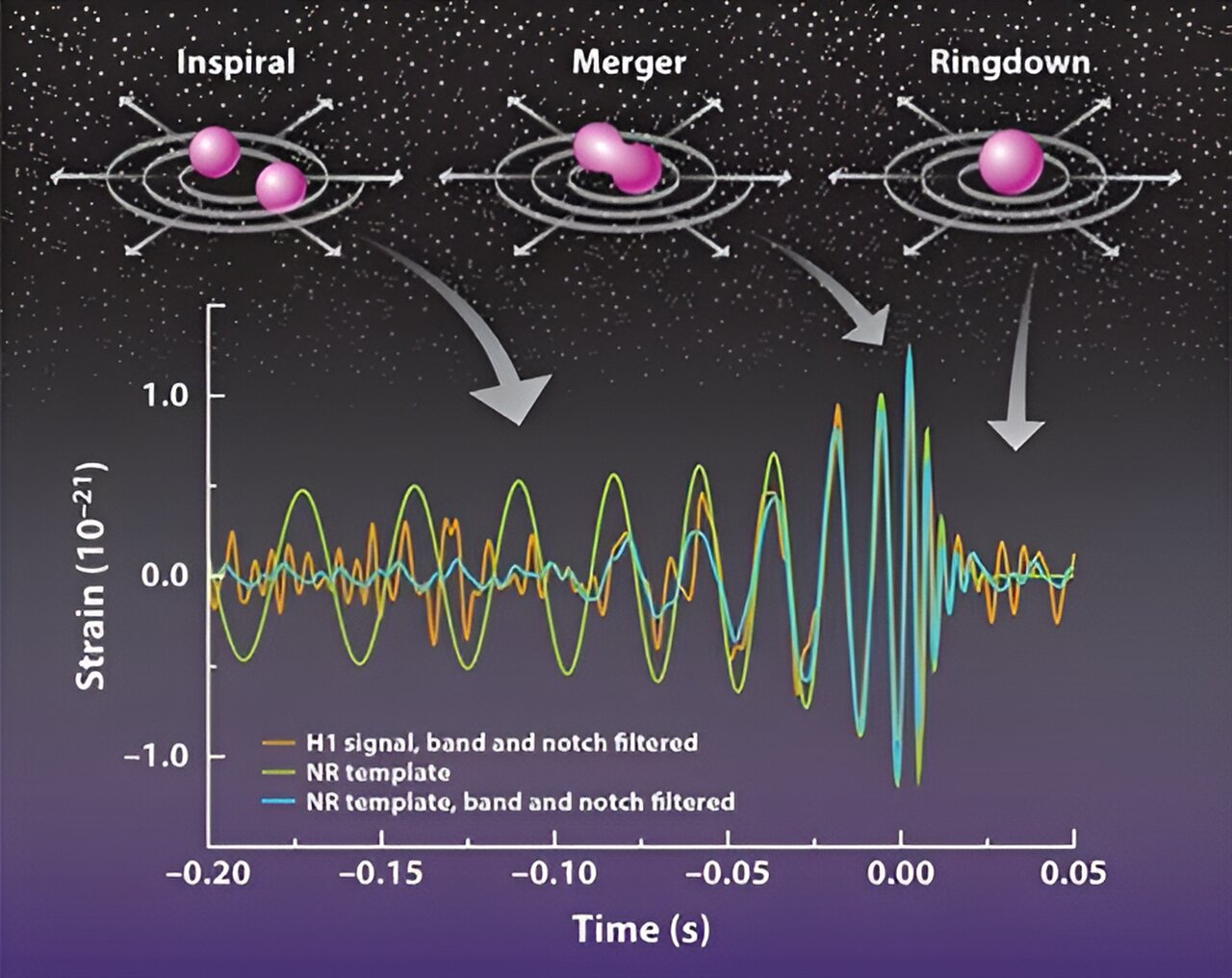
A decade after Einstein discovered that his theory of general relativity predicted gravitational waves — ripples that travel through the fabric of space-time — physicists had calculated their expected signature for several simple scenarios. One of these, a black hole merger waveform, was the first to be detected in interferometric data on September 14, 2015.
Observers needed to know what to expect to tell the interferometer what to look for, because a passing wave can only move the interferometer's arms by a thousandth of a proton's width. Ambient noise, even the sound of a passing truck, could easily affect the arms' movement, and this needed to be filtered out to identify true gravitational waves.
Calculations were also performed for neutron star-black hole mergers and neutron star-neutron star mergers. Furthermore, the data allowed the signatures of continuous gravitational waves generated by rapidly rotating symmetric neutron stars, and stochastic gravitational waves that originate, for example, from the Big Bang. Using these models, over 70 gravitational wave events were detected.
Various Gravitational Waves
But this method would miss gravitational waves that don't show up in any of the known predictions – so-called “transients” or “gravitational wave bursts” that arise from unexpected events based on other physics. What's more, current detection methods are simply too slow.
When a gravitational wave passes by, astronomers hope to quickly pinpoint its source and direct other observatories to look for accompanying electromagnetic waves and particle phenomena emanating from the same source: so-called interlocutor astronomy.
Large-scale, intense astrophysical activity, including regular binary star mergers, is expected to produce electromagnetic radiation, including visible light, and neutrinos. When a potential flux of gravitational waves is acquired, processing and communicating with other instruments currently requires hundreds of dedicated processors and can take tens of seconds to minutes, which is too slow for any “advance” warning.
Machine learning algorithms for wave detection
In recent years, physicists have tried to overcome the waveform limitations using a type of specialized deep-learning algorithm, convolutional neural networks (CNN), to circumvent detectors that are trained to only recognize certain events.
However, currently programmed CNNs require an accurate model of the target signal for training, and therefore cannot notice unexpected sources, such as those expected from a supernova core collapse or a long gamma-ray burst. Unknown physics and computational limitations can negate any chance of detecting signals in multiple locations.
So the researchers aimed to use a single processor to report gravitational wave events in about one second. They developed a multi-component architecture in which one CNN detects transients occurring simultaneously across multiple detectors, and a second CNN looks for correlations between the detectors to eliminate random noise and interference.
So “our search aims to harness machine learning to point 'conventional' telescopes at such sources within seconds,” said Vasileos Skurilis of the Gravitational Laboratory in the School of Physics and Astronomy at Cardiff University in Wales, UK. “This way we can extract as much information as possible from these unexpected events.”
The research group's approach to deep learning was quite different from previous methods: rather than teaching a CNN to identify specific waveforms in data, they created a CNN that could detect consistency in intensity and timing between two or more data streams.
The CNN was then trained using the simulated signal and random noise bursts with similar characteristics. Identical waveforms and noise were used so the neural network could not make judgments based on the waveform. The neural network learned to assess how well the detectors matched each other, allowing the model to detect gravitational wave transients in real time.
“In the 1960s, when gamma-ray astronomy took its first steps, gamma-ray bursts were a new marvel in astrophysics,” Skrillis said. “Gravitational wave astronomy is similarly in its infancy, and an exciting future may lie ahead of us.”
According to phys.org: