Donna Smith, University Marketing and Communications
Recent developments in artificial intelligence have allowed researchers to evaluate how the human voice can help predict and detect disease early. USF Health, in collaboration with the USF AI+X Institute, is launching a first-of-its-kind course dedicated to understanding how the voice can be used as a biomarker of health to help identify neurological, respiratory and psychiatric disorders, helping to prepare the next generation of medical professionals.
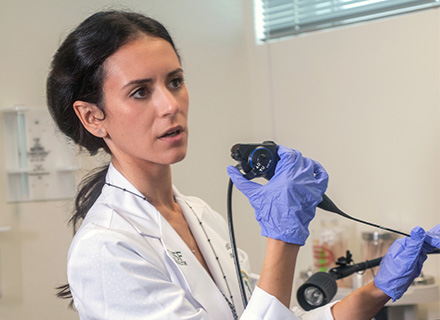
Dr. Yael Bensussan
“There are a lot of programs out there that teach students how to work with imaging and other clinical data, but being prepared to understand and analyze voice data puts these students in a unique position,” said Dr. Yael Bensoussan, an assistant professor of otolaryngology and laryngologist at USF Health. “There are a lot of startups in a variety of industries that are looking for that expertise because it's still so rare to find that talent. We're preparing them so they're ready to apply for those jobs.” Dr. Bensoussan is co-principal investigator for the National Institutes of Health-funded Bridge2AI-Voice program, a consortium of 50 experts, including clinicians, speech-language pathologists, information scientists, AI scientists and bioethicists, working to standardize AI datasets and their ethical use in healthcare.
As part of the program, USF is one of four universities nationwide to host the first Voice AI Summer School, a five-week course that will train a range of students, from undergraduates to medical students, to process voice audio, identify acoustic and speech characteristics like hoarseness or tremor, and train and test algorithms that aid in screening and diagnosis.
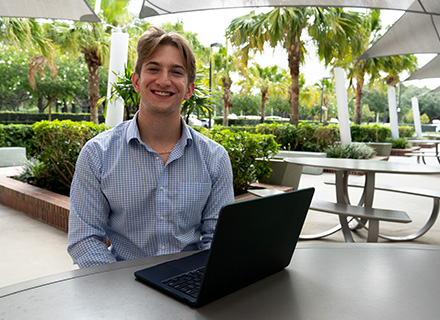
Trevor Farr
Trevor Farr, a second-year student at the USF Health Morsani College of Medicine, says his love of singing sparked his interest in becoming an ear, nose and throat doctor. Farr, who completed his double major in biochemistry and music at the University of North Carolina at Chapel Hill, is currently researching the groundbreaking field of voice AI.
“I never thought I'd be studying this, but it's kind of a coincidence that this really fascinating study of voice is happening now, because it's something I've been interested in for years,” Farr said. “I'm really happy to be a part of this experience.”
Forty-five students from across the country were selected for the intensive program, 15 of whom are based at USF. They were split into teams made up of technology and health students. They practiced how to collect audio data and were asked to volunteer their own voices, which Bensoussan said will give them a deeper understanding of the technology.
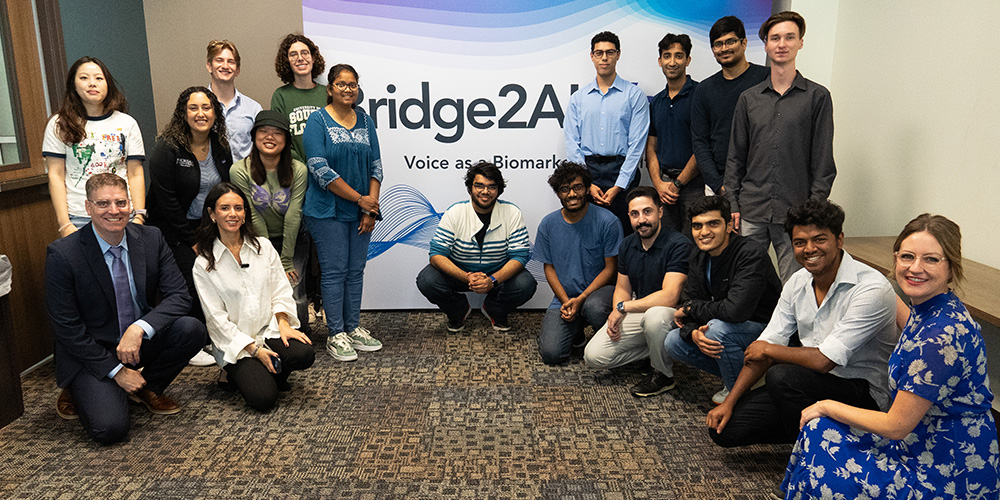
“Engineers are sometimes presented with data without necessarily understanding how it was collected,” Bensoussan says. “It's really important to understand how the data was collected, and the best way to understand it is to try it yourself.”
Faculty from USF's AI+X Institute, a multidisciplinary research and development center focused on AI, are teaching about the intricacies of developing AI models using acoustic data for medical purposes. Many of them are from the USF School of Computer Science and Engineering, including distinguished professor and dean Sudeep Sarkar, who is also USF's vice chancellor for research and innovation and director of the AI+X Institute.
“Our involvement underscores our commitment to educating the next generation of AI researchers and practitioners across disciplines, which is the '+X' part of our identity,” Sarkar said. “The program provides a unique platform for participants to gain hands-on experience, participate in cutting-edge research, and collaborate with leading experts in the unique problem domain of voice-based medical diagnosis.”
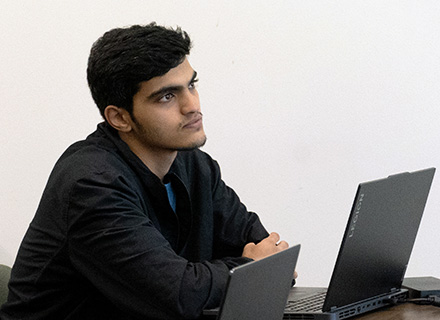
Shriamana Ganesh Sudhadkai
Shriamana Ganesh-Sudhadhakai is a second-year master's student in bioinformatics at Georgia Tech who is attending the Voice AI Summer School because she hopes to work in the field of bioinformatics.
“Bioinformatics sits somewhere between biology and computer science,” says Ganesh Sudhadkai. “I want to be in an industry that is focused on research and product development, so the ideal goal for me would be to learn all the technologies currently available.”
Bensoussan hopes the benefits of the Voice AI Summer School will be widespread beyond just the students who enroll.
“A lot of our projects are open science, so we hope that the curriculum we’re building can benefit the broader community, because it’s through open science that things are discovered.”
/Public Release. This material from the originating organization/author may be out of date and has been edited for clarity, style and length. Mirage.News does not take any organizational stance or position and all views, positions and conclusions expressed here are solely those of the authors. Read the full article here.