Credit: Unsplash/CC0 Public Domain
In the not-too-distant future, screening assessments for depression may include a simple brain scan to identify the best treatment.
Combining brain imaging with machine learning can help identify subtypes of depression and anxiety, according to a new study led by researchers at the Stanford University School of Medicine. The study, published June 17 in the journal Neuropsychiatry, Nature Medicineclassifies depression into six biological subtypes, or “biotypes,” and identifies treatments that are more or less effective for three of these subtypes.
“We desperately need better ways to match patients with treatments,” said lead study author Dr. Leanne Williams, the Vincent V. C. Wu Professor of Psychiatry and Behavioral Sciences and director of the Center for Precision Mental Health and Wellness at the Stanford University School of Medicine. Dr. Williams, who lost her partner to depression in 2015, has focused her research on pioneering the field of precision psychiatry.
About 30% of people with depression have what's called treatment-resistant depression, which means that multiple types of medication and therapy have failed to improve their symptoms, and up to two-thirds of people with depression never fully recover to healthy levels even with treatment.
One reason is that there's no good way to know which antidepressants or treatments will work for a particular patient: Medications are prescribed on a trial-and-error basis, so it can take months or years to land on one that works (or maybe not). And if you go a long time without seeing relief after multiple attempts at treatment, your depression symptoms can get worse.
“The goal of our research is to think about how we can treat people right the first time,” Williams said. “It's very frustrating in the field of depression that we don't have a better alternative to this one-size-fits-all approach.”
Biotype predicts treatment response
To better understand the biology underlying depression and anxiety, Williams and his colleagues used an imaging technique called functional MRI (fMRI) to measure brain activity and assess 801 participants who had been diagnosed with depression or anxiety.
The researchers scanned the subjects' brains while they were resting and while they performed a variety of tasks designed to test cognitive and emotional functioning. They focused on areas of the brain already known to be involved in depression and the connections between them.
The researchers used a machine learning technique called cluster analysis to group the patients' brain images and identified six distinct patterns of activity in the brain regions they studied.
The scientists also randomly assigned 250 of the study participants to receive one of three commonly used antidepressants or a behavioral therapy. Patients with one subtype, characterized by overactivity in cognitive areas of the brain, showed the best response to the antidepressant venlafaxine (commonly known as Effexor), compared with patients with the other biotype.
People with another subtype, who had higher levels of resting brain activity in three areas related to depression and problem solving, saw better symptom relief with behavioral therapy, while people with a third subtype, who had lower levels of activity in the brain circuits that control resting attention, were less likely to see symptom relief with behavioral therapy than people with the other biotypes.
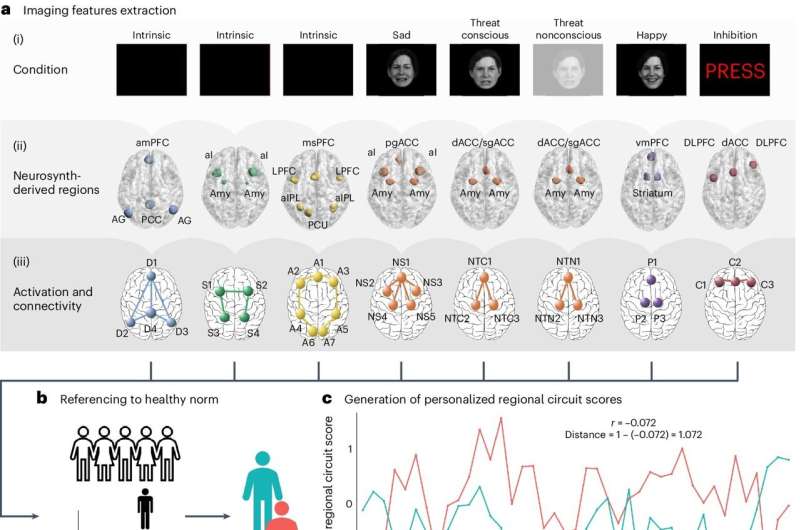
Overview of participant-level image processing and analysis pipeline. Credits: Nature Medicine (2024). Publication date: 10.1038/s41591-024-03057-9
The biotype and response to behavioral therapy make sense based on what is known about these areas of the brain, said Jun Ma, MD, PhD, the Beth and George Vittou Professor of Medicine at the University of Illinois at Chicago and one of the study's authors.
The type of therapy used in their trial teaches patients skills to better cope with everyday problems, and high activity levels in these brain regions may enable patients with that biotype to adopt new skills more easily.
Patients who have reduced activity in areas involved in attention and engagement may benefit more from talk therapy if they are first treated with medication to address that reduced activity, Dr. Marr said.
“To our knowledge, this is the first time we've been able to demonstrate that depression can be explained by multiple disturbances in brain function,” Williams said. “In essence, this is a demonstration of a personalized medicine approach to mental health based on objective measurements of brain function.”
In another study, Williams and her team showed that using fMRI brain imaging could improve the ability to identify individuals who are more likely to respond to antidepressant treatment. In that study, the scientists focused on a subtype of depression called the cognitive biotype, which affects more than a quarter of people with depression and is less likely to respond to standard antidepressants.
By using fMRI to identify patients with the cognitive biotype, the researchers accurately predicted the likelihood of remission in 63% of patients, compared to 36% accuracy without brain imaging. Improved accuracy means healthcare professionals are more likely to provide the right treatment the first time. Scientists are currently researching new treatments for this biotype, in the hope of finding more options for patients for whom standard antidepressants don't work.
Further exploration of depression
The different biotypes also correlated with differences in the study participants' symptoms and performance on tasks. For example, people with overactivity in cognitive areas of the brain had higher levels of anhedonia (the inability to feel pleasure) and performed worse on executive function tasks than people with other biotypes. People in the subtype who responded best to talk therapy also made mistakes on executive function tasks but performed better on cognitive tasks.
In one of the six biotypes found in the study, the regions imaged showed no noticeable difference in brain activity from those in people without depression. Williams believes they haven't explored the full range of brain biology underlying the disorder. While the study focused on areas known to be involved in depression and anxiety, it's possible that this biotype has other kinds of dysfunction that imaging didn't capture.
Williams and her team are expanding their imaging study to include more participants, and they also hope to test more types of treatments across all six biotypes, including drugs that haven't previously been used for depression.
Her colleague, Laura Hack, MD, PhD, assistant professor of psychiatry and behavioral sciences, is beginning to use the imaging technique in her clinical practice at Stanford University School of Medicine through experimental protocols. The team also hopes to establish an easy-to-understand standard for the technique so that other psychiatrists can put it into practice.
“To truly move the field forward toward precision psychiatry, we need to identify the treatments that are most likely to be effective for patients and get them on those treatments as soon as possible,” Marr said. “Knowing information about patients' brain function, particularly the effective features we assessed in this study, will help us more precisely treat and prescribe for individuals.”
Researchers from Columbia University, Yale School of Medicine, University of California, Los Angeles, University of California, San Francisco, University of Sydney, University of Texas MD Anderson and University of Illinois at Chicago also contributed to the study.
For more information:
Leonardo Tozzi et al. “Personalized brain circuit scores identify clinically distinct biotypes in depression and anxiety” Nature Medicine (2024). Publication date: 10.1038/s41591-024-03057-9
Courtesy of Stanford University Medical Center
Quote: Study combining brain imaging and machine learning identifies six distinct types of depression (June 17, 2024) Retrieved June 17, 2024 from https://medicalxpress.com/news/2024-06-distinct-depression-combining-brain-imaging.html
This document is subject to copyright. It may not be reproduced without written permission, except for fair dealing for the purposes of personal study or research. The content is provided for informational purposes only.