Companies using artificial intelligence technology
By 2023, 8% of EU companies with 10 or more employees and self-employed workers will use at least one of the following AI:
- Technology for analyzing written language (text mining)
- Technology that converts spoken language into a machine-readable format (speech recognition)
- Technology for generating written and spoken language (natural language generation)
- Technology to identify objects and people based on images (image recognition, image processing)
- Machine learning for data analysis (e.g. deep learning)
- Technologies that automate various workflows and support decision-making (AI-based software robotic process automation)
- Technology that enables machines to observe their surroundings and make autonomous decisions to physically move around.
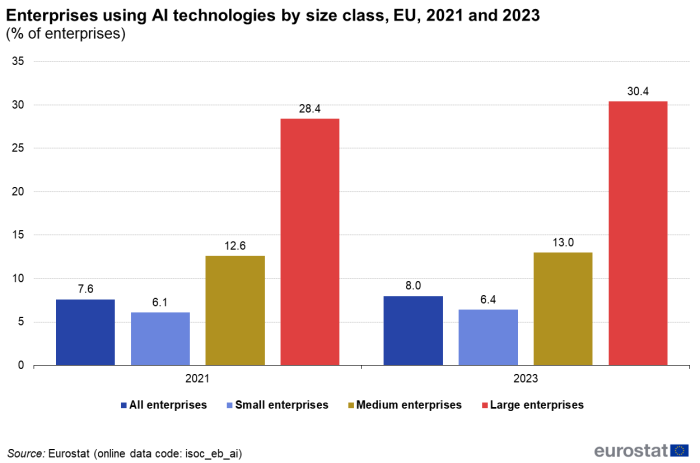
Compared to 2021, the use of AI technologies increased slightly by 0.4 percentage points (Figure 1).
As shown in Figure 1, large enterprises are embracing AI more than SMEs: 6.4% of SMEs, 13% of mid-sized enterprises, and 30.4% of large enterprises will be adopting AI in 2023. This difference can be explained, for example, by the complexity of implementing AI technologies in enterprises, economies of scale (i.e., enterprises with larger economies of scale can benefit more from AI), or costs (i.e., investing in AI may be more affordable for large enterprises).
(Percentage of companies)
sauce: Eurostat (isoc_eb_ai)
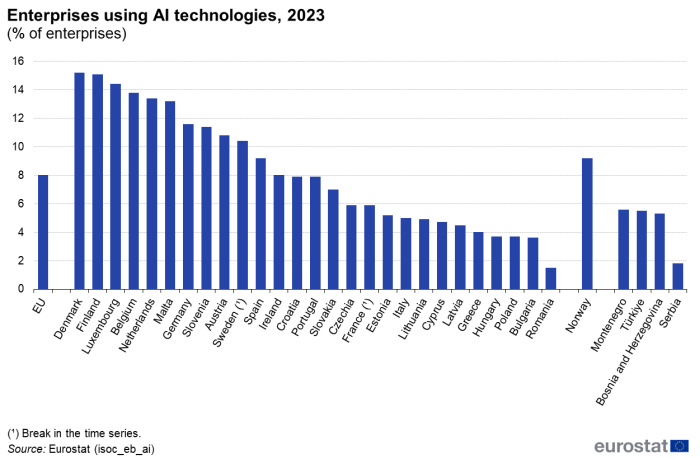
Comparing companies using at least one AI technology across EU countries (Figure 2), we find that the percentage of companies using AI ranges from 1.5% to 15.2%. The highest percentage is in Denmark (15.2%), followed by Finland (15.1%) and Luxembourg (14.4%), while the lowest percentages are in Romania (1.5%), Bulgaria (3.6%), Poland and Hungary (both 3.7%).
(Percentage of companies)
sauce: Eurostat (isoc_eb_ai)
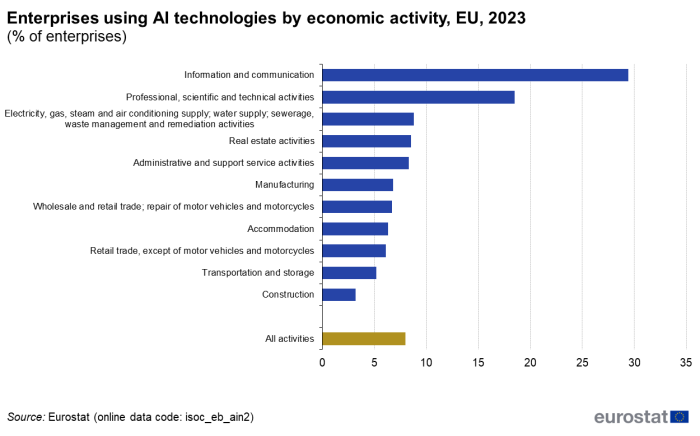
As shown in Figure 3, some economic activities use AI much more than others. This may indicate that AI is more relevant in certain activities. In 2023, the information and communications sector (29.4%) and professional, scientific and technical services activities (18.5%) had the highest percentage of companies using AI. In all other economic activities, the percentage of companies using AI was less than 10%. This ranged from 8.8% (electricity, gas steam, air conditioning and water supply) to 3.2% (construction).
(Percentage of companies)
sauce: Eurostat (isoc_eb_ain2)
Types of AI technologies used
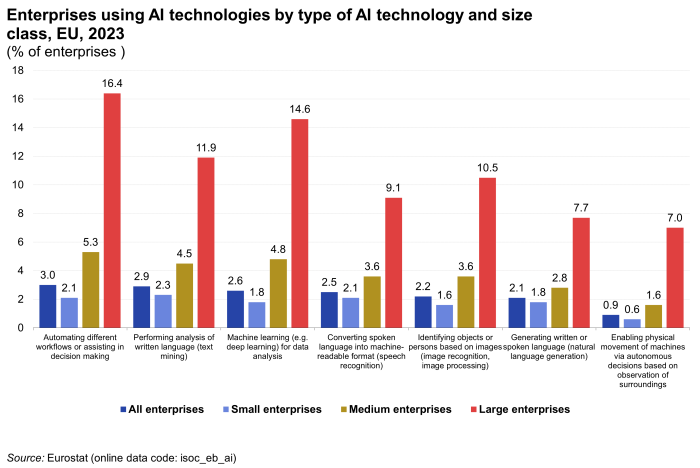
EU companies used different types of AI technologies. As shown in Figure 4, there was no dominant AI technology. Somewhat more frequently used AI technologies were AI technologies that automate various workflows or assist in decision making (e.g. AI-based software robot process automation). In 2023, these AI technologies were used by 3% of companies. AI technologies that analyze written language (text mining) followed at 2.9% of companies. Machine learning for data analysis (e.g. deep learning), technologies that convert spoken language into a machine-readable form (speech recognition), technologies that identify objects or people based on images (image recognition, image processing), and technologies that generate written or spoken language (natural language generation) were each used by 2.6% to 2.1% of companies. Technologies that enable machines to navigate physically by observing their surroundings and making decisions autonomously (e.g. self-driving cars) were used by less than 1% of companies (0.9%).
While no single leading AI technology was used by all companies, Figure 4 paints a different picture across company sizes, especially among larger companies. AI technologies that automate various workflows or assist with decision making were the most used at 16.4 percent, followed by machine learning for data analysis (14.6 percent). The least used AI technology was technology that enables physical movement of machines by making autonomous decisions based on observing the surroundings (7.0 percent).
(Percentage of companies)
sauce: Eurostat (isoc_eb_ai)
Table 1 shows the different types of AI technologies used in different economic activities. In the information and communications sector, which had the highest percentage of companies using AI, the most used AI technology was machine learning for data analysis (16.2%), followed by text mining (14.2%). In professional, scientific and technical services activities, speech recognition is used slightly more than other AI technologies (7.2%), followed by text mining and AI technologies that automate various workflows or support decision-making (both 6.9%). In all other activities, the percentage of companies using specific AI technologies ranged from less than 1% to 3.9%.
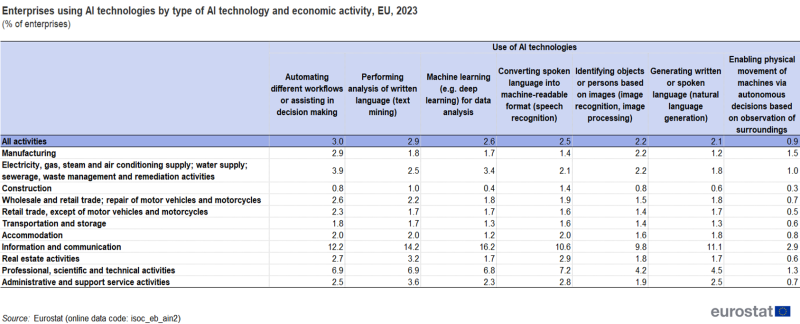
(Percentage of companies)
sauce: Eurostat (isoc_eb_ain2)
Purpose of using AI software or system
EU companies use AI software or systems for a variety of purposes: in 2023, 26.2% of companies using AI technologies used these software or systems for ICT security (e.g. using machine learning to detect and prevent cyber attacks), and 25.8% used them for accounting, control or financial management. AI software or systems for logistics were the least used by 9.6% of companies using AI technologies (Figure 5).
The purposes for which companies use AI software and systems vary depending on the size of the company, with the largest difference between large companies and SMEs being in ICT security (large companies 47.9%; SMEs 20.5%), followed by production processes (large companies 39.4%; SMEs 22.3%) and logistics (large companies 20.6%; SMEs 7.5%) (Figure 5).
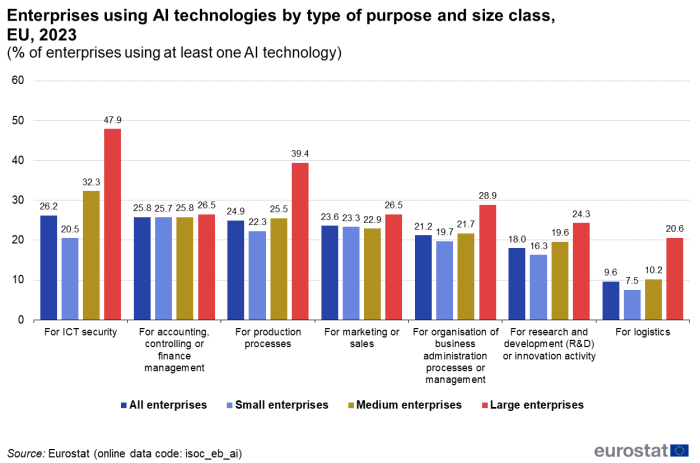
(% of companies using at least one AI technology)
sauce: Eurostat (isoc_eb_ai)
Companies use AI technologies for different purposes depending on the sector of the economy they operate in. In manufacturing, AI software or systems were mainly used for production processes (38.2%). Meanwhile, in the electricity, gas, steam, air conditioning and water supply sector (37.6%) and the information and communications sector (31.6%), AI software or systems were mainly used for ICT security. In the information and communications sector, the main use of AI was research and development (R&D) or innovation activities (41.3%). In the hospitality (51.4%) and retail (41.8%) sectors, companies mainly used AI software or systems for marketing or sales (Table 2).
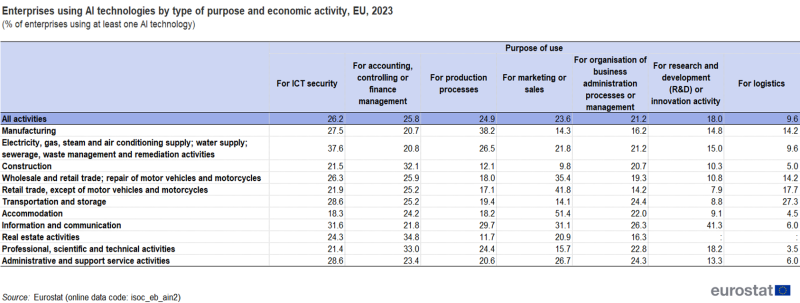
(% of companies using at least one AI technology)
sauce: Eurostat (isoc_eb_ain2)
Source data for tables and graphs
Data Source
The data presented in this article are based on the results of the survey “ICT Use and E-Commerce in Enterprises” in 2023. The statistics are taken from surveys carried out by national statistical authorities at the beginning of the year. In 2023, 150,400 of the 1.47 million enterprises in the EU were surveyed. Of the 1.47 million enterprises, approximately 83% were small enterprises, 14% were medium-sized enterprises, and 3% were large enterprises. Enterprises are classified by size: small enterprises (10-49 employees and self-employed), medium enterprises (50-249 employees and self-employed), large enterprises (250+ employees and self-employed). Source data marked with “:” indicates data that is unavailable, unreliable, confidential or not applicable. Unreliable data are included in the calculation of the European aggregate. The data presented in this article may differ from the data in the database due to updates made after the data extraction used for this article. The data in the database are organized according to the survey year. The statistical unit of observation is the enterprise as defined in Regulation (EC) No 696/1993 of 15 March 1993. The survey covers enterprises with 10 or more employees and the self-employed. The economic activities correspond to the NACE Revision 2 classification. The sectors covered are manufacturing, electricity, gas, steam, water, construction, wholesale and retail, motor vehicle and motorcycle repairs, transport and storage, accommodation and food service activities, information and communications, real estate, professional, scientific and technical activities, administrative and support activities, and repairs of computer and communications equipment.
context
In 2019, the new European Commission President Ursula von der Leyen explained how the EU wants to seize the opportunities that the digital age brings. A Europe fit for the digital age is one of the Commission's six priorities for 2019-2024. Such a digital transformation is based on the premise that digital technologies and solutions can open up new opportunities for businesses, foster the development of trustworthy technologies, foster open and democratic societies, enable vibrant and sustainable economies and help fight climate change. With this in mind, in February 2020 the Commission adopted a comprehensive presentation of the Commission's ideas and actions on shaping Europe's digital future, as well as concrete proposals on:
• The European Data Strategy (COM(2020) 66 final), which aims to promote the EU as a pioneering model for a society that uses data to make better decisions in business and the public sector.
• The White Paper on Artificial Intelligence – A European approach to excellence and trust (COM(2020) 65 final) supports a regulatory and investment-focused approach with the dual objective of facilitating the adoption of artificial intelligence and addressing the risks associated with certain uses of this new technology.
In 2021, the Digital Compass for the EU's Digital Decade (COM(2021)118 final) set out the EU's digital ambitions for 2030, which revolve around four guiding principles: skills, the digital transformation of enterprises, a secure and sustainable digital infrastructure, and the digitalisation of public services.