This week, Apple (finally) went all in on AI, announcing that it will be adding a suite of generative AI features to all of its operating systems. While not unexpected, Apple's AI push is an interesting development for two reasons.
First, there are signs that some companies are slowing down their AI investments, citing the cost and high failure rates of AI implementations, and second, despite Apple's push into consumer AI, many consumers don't seem interested.
Let's start with investing in AI. Overall, companies remain enthusiastic about the impact AI can have on customer experience, automation, and business operations, but the hype is giving way to reality. According to a new survey from Lucidworks, nearly two-thirds (63%) of companies globally plan to increase their spending on AI in the next 12 months. That's a sizable number, but it's up from 93% last year.
Not surprisingly, according to Lucidworks' 2024 State of Generative AI in Global Business report, 36% of companies plan to keep their spending flat this year, compared to just 6% in last year's survey. (Registration required).
The cost of AI is a concern
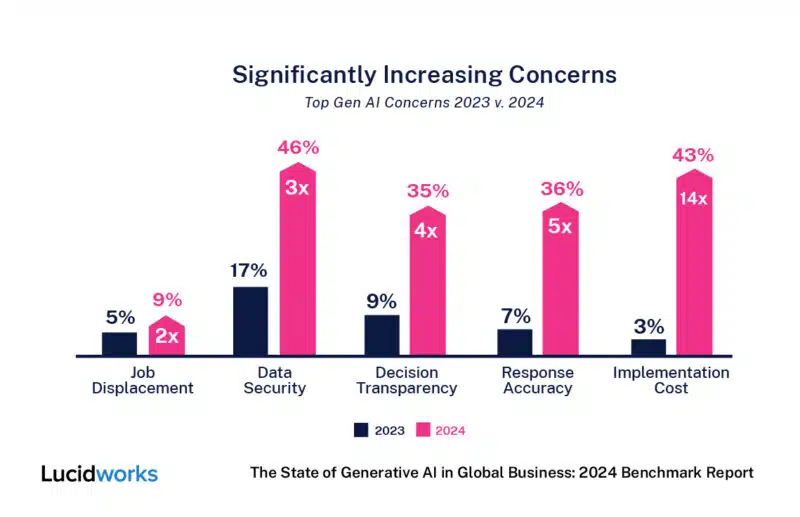
Last year, only 3% were concerned about implementation costs, putting it at the bottom of the list of concerns. This year, it's in second place at 43%.
This isn't surprising, as AI is one of the most expensive technologies ever: Silicon Valley venture capital firm Sequoia has calculated that the industry will spend $50 billion on chips alone in 2023. This explains why it costs OpenAI $700,000 per day to run ChatGPT.
“You're paying for it indirectly,” Krishna Tamannaah, CTO at conversational messaging platform Gupshup, told MarTech. “Right now, we're not buying chips directly, but to train and fine-tune some of our models, we get the most powerful machines from one of the cloud vendors to train them, and that's very expensive. We're using that for an hour a day, a week, a month. We're paying a significant amount.”
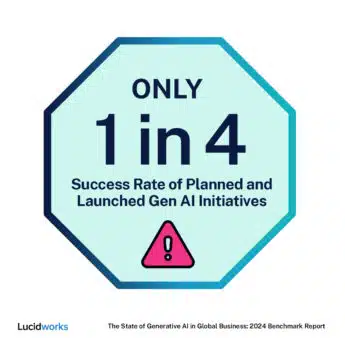
Even when AI implementations are successful, they are a significant cost to bear. But according to Lucidworks, only 25% actually do so successfully. “The financial benefits of implemented projects have been dismal,” the report states. “42% of companies have yet to realize significant benefits from their generative AI initiatives.”
The Technology sector has the most adoption, with half already realizing financial benefits, while Retail comes in a close second with the most adoption of revenue and growth initiatives.
Putting AI to good use
One company that's succeeding at this is Texas-based Tricolor, which offers responsible, affordable credit-building loans to Hispanic consumers with limited or no credit history. Chief Strategy Officer Mauricio Delgado says Tricolor is able to achieve this by leveraging the wealth of data it has accumulated about its target audience and AI.
“It all comes down to what outcomes we can achieve with AI,” he told MarTech. And one of those outcomes is lowering customer acquisition costs. “Our customer acquisition costs have dropped dramatically. We're under $150 per customer, whereas Carvana is around $1,000 per customer and CarMax is around $500.”
Chat. No bots.
So far, the biggest business benefit of AI is cost savings through automation and data analytics. So why do so many companies think AI can attract consumers? AI is still primarily used for chatbots designed to answer customer questions. People like the speed and availability that bots offer, but would rather talk to a human.
According to one study, 45% of people prefer to communicate with companies through chat, but only 5% prefer to chat with a bot.
Tricolor does its best to keep interactions with the bot as short as possible. Delgado said WhatsApp is extremely popular with Hispanic consumers in the U.S.
“WhatsApp has a bot that handles the initial interaction, such as asking basic questions and scheduling an appointment,” he says. “We also found that after the initial set of questions, many leads want to interact with a human, and we can connect them to a human.”
Chatbots are evolving rapidly and may reach a point where people don't mind them as much. In fact, as Dr. Maria Panagiotidi points out, people already like them: “In situations where consumer concerns about self-presentation are high, such as when purchasing embarrassing products, a clearly identified chatbot may actually lead to a more positive consumer response.”
That said, Apple's GenAI product line is unlikely to be a big selling point: Pew Research found that 52% of Americans are concerned about AI and only 10% are open to using it.