

Buildots, an AI construction technology company, recently released its latest feature called “Delay Prediction.”
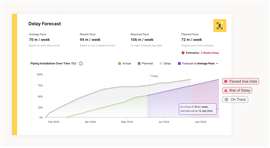 Buildots says it developed this feature after conducting research that found 62% of construction site activities are consistently behind schedule (Photo: Buildots)
AI-powered tools predict delay risks and alert construction teams to potential pacing issues, so they can take proactive steps to mitigate potential delays before they escalate.
Additionally, this feature provides detailed activity-level analysis of the root causes of delays, helping project managers continuously improve performance and strategy.
The delay prediction feature is intuitively integrated into Buildots' main dashboard and flags activities that are at risk of falling behind schedule.
Quantify those risks through predictions of expected delays and provide pacing recommendations to prevent delays. Once users receive a delay alert, they can enter new pacing assumptions and see how these changes impact their timeline, allowing them to optimize and fine-tune their strategy and chart the best path forward. You can decide.
Dashboards also allow project teams to track risk trends on a weekly basis so they can see how their decisions impact reality.
Buildots says it developed this feature after research found that 62% of construction site activities are consistently running slower than planned, and 25% are running at half the planned pace.
The study also revealed that performance of critical activities often degrades on a weekly basis, and these issues go unnoticed until they have a significant impact on the project schedule.
“At Buildots, we believe that accurate progress data, performance metrics, and data-driven insights are critical to solving problems that plague nearly every construction project, such as delays and inefficiencies.” said Aviv Leibovich, co-founder and CPO.
“These core beliefs inspire everything we do, from developing performance-driven construction management (PDCM) methodologies to designing new tools like delay prediction.”
The new feature has been beta-tested at a number of construction sites around the world and is said to have been shown to help reduce delay times by 50% when used in conjunction with PDCM techniques.
One of these is a large Danish government complex currently under construction by leading Scandinavian contractor NCC Denmark.
Project Manager Niels Frank Jensen said: “By using delay prediction, we can not only identify risks very early on, but also inform trades of the exact pace they need to stay on schedule. We can finally trust our intuition and prioritize our activities based on actual performance and what is actually at stake. became.”


