

Today, there are few problems that AI and machine learning cannot solve. Researchers at Yokohama National University are using this latest advantage to overcome things that are impossible with traditional methods.
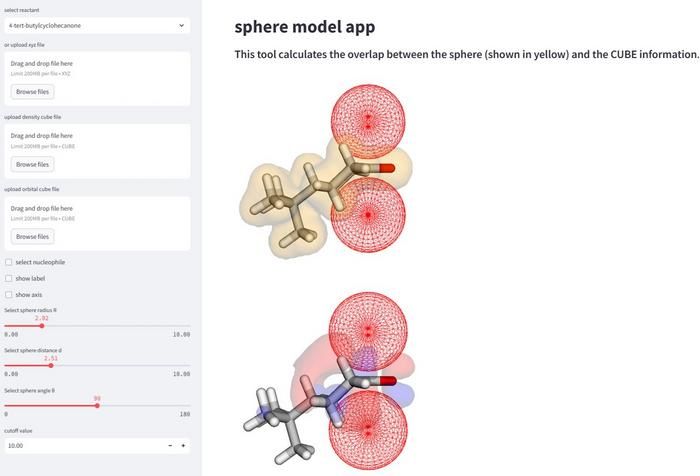
This is a web application created by our company for experimental chemists. You can upload files calculated using commercially available software and analyze the electronic state. We are working to build a platform that allows chemists around the world to analyze their unique reaction systems.
Yokohama National University
There are many rules to remember when it comes to interactions of carbon-containing (or organic) molecules. The location of groups on molecules that interact with the environment, the size, shape, and location of molecules and the molecules that interact. The outcome of a particular reaction can vary widely depending on these and many other factors, and predicting these outcomes has proven very difficult in the chemical field. Controlling outcomes is a critical component in chemical synthesis, but prediction alone is not always sufficient. Fortunately, machine learning and artificial intelligence (AI) are once again helping to drive progress forward by predicting the speed and selectivity of certain reactions. Therefore, this technology helps predict what kind of products to expect.
The researchers presented their findings as follows. Journal of Chemical Information and Modeling April 9th.
In organic chemistry, every detail matters. Two common areas that can influence how molecules bond with other molecules are steric and orbital. Stericness refers to the arrangement of molecules, and steric effects determine the shape and reactivity of molecules. This may be due to the size or charge of the molecule or individual atoms. Orbital is a way to describe the arrangement of electrons that can interact with other molecules or atoms and cause reactions. These factors can significantly alter where a nucleophile or electron-donating reactant can bind to a recipient molecule. This is known as 'selectivity' and depending on where the molecule binds, it can result in different products being formed or varying yields of the desired product. Researchers are using AI and machine learning, as well as current knowledge of chemical reactions, to better explain these aspects of molecular selectivity.
“To determine what kind of chemical information can be used as essential chemical information to provide to AI, it is necessary to combine knowledge of chemistry with knowledge of AI and machine learning,” said corresponding author Hiroaki Goto, associate professor at the Yokohama School of Engineering. speaks. National university.
First, the computer needed to be given information to learn. To begin the AI education process, information from the computational chemistry literature and from previous research was used. After manually entering data and setting the optimal parameters for the specific molecules used, data analysis was performed based on the predicted results of the test dataset. These analyzes allow AI to learn and predict future selectivity based on known information. “This method allows for a more comprehensive analysis and interpretation of the reaction mechanism through the calculation of the parameters of the spherical space that mimics the approach of the nucleophile,” said the study's first author, a professor at Yokohama National University of Chemistry and Biotechnology. Daimon Sakaguchi from the Faculty of Science said.
This study was successful in explaining 323 reaction selectivities of eight nucleophiles based on which “face” of the molecule produces the most desired amount of product. Selectivity varies based on the orbital factor as well as the conformation of the molecule. Researchers found that for some molecules orbital factors are more important in determining surface selectivity, while for others it depends more on the conformation of the molecule when interacting with nucleophiles. did.
Combining predictive techniques and machine learning with established knowledge in chemistry will yield better results from chemical reactions and enable chemists to synthesize natural products and medicines in a more efficient manner.
Streamlining this process using machine learning and artificial intelligence allows for more experimentation. Ideally, the researchers would like to work with experimental chemists to design reactions and continue to develop more predictive techniques for chemical reactions.


