

This paper was first published GPD 2023.
Link to full text GPD 2023 Conference Book: https://www.gpd.fi/GPD2023_proceedings_book/

author:
- Dr.-Ing. Michael Anton Kraus, M&M Network-Ing UG
- Dr.-Ing. Michael Drass, M&M Network-Ing UG
- Henrik Riedel, MSc M&M Networking UG
- Raphael Bischoff, MSc M&M Networking UG
- Leon Schmeiser, MSc M&M Networking UG
- Ingo Stelzer, Kuraray Europe GmbH
abstract
In modern architecture, transparent building envelopes are in high demand. Glass facades are usually designed based on various objectives, one of which is to meet sound insulation requirements. Reliably and fairly accurately estimating the sound insulation properties of different glass assemblies is time-consuming and difficult due to the complexity of experimental tests and numerical simulations. Therefore, this paper presents a machine learning approach to predict the acoustic properties (weighted sound insulation values RW, STC, OITC) of different glass systems. For this purpose, extensive research has been carried out on different glass systems consisting of different glasses, cavities, interlayer thicknesses, and different glass assemblies with different types of interlayers and gas fillings. I got it.
Based on this, a sufficiently large database was created and used for training and evaluation of several machine learning algorithms. Finally, the best performing algorithms were used to be integrated into the SOUNDLAB AI tool, a comprehensive web-based program recently published. The app uses machine learning to quickly analyze and accurately predict glass assemblies, interlayer types, and gas filling for different sound insulation values. Kuraray and his M&M's recent research considers machine learning (ML) based on structural performance analysis of various glass systems under load and has been released as the StrengthLAB AI tool. Its aim is to provide designers, engineers and architects with an effective and economically efficient tool to facilitate ecological and reliable planning in terms of acoustic and structural properties.
1.First of all
Sound insulation is an important aspect of modern building design, especially for buildings located in noisy urban environments. Glass facades have become a popular choice for architects and designers who want to create a visually beautiful and transparent building envelope. However, in the design of glass facades, sound insulation requirements must be carefully considered to ensure the protection of occupants from unnecessary external noise. Traditional approaches for estimating the sound insulation properties of various glass assemblies (laminated glass (LG), insulated glass units (IGU), etc.) are time-consuming and expensive as they require experimental tests or numerical simulations. . Generally applicable theory. To overcome these limitations, this paper describes the acoustic properties (weighted sound insulation value RW used in Europe, sound transmission class (STC) used in the United States, and outdoor-indoor transmission class (OITC) values) We introduce a machine learning approach for predicting. Information on different glass systems based on a large database covering different glass systems.
This case study reports on an ML project between Kuraray Europe GmbH and M&M Network-Ing UG that led to the creation of the SOUNDLAB AI tool. This paper provides an overview of the methodology used to develop and validate the SOUNDLAB AI tool and provides a detailed analysis of its performance.
2. Method
This section briefly describes the methods used to develop machine learning approaches to predict the acoustic properties of various glass systems.
2.1 Cutting edge technology and database
Previous studies have shown that glass thickness, the use of laminated safety glass or special acoustic interlayers, and the use of insulating glass with cavities filled with gases such as argon or krypton affect the acoustic properties of glazing systems. It has been proven that it is an important parameter that gives [1, 2]. Nevertheless, there is still no efficient and generally applicable tool available to accurately and conveniently estimate the sound insulation performance of window and facade systems. [1, 2]. Although laboratory tests remain the most reliable method of evaluating the acoustic performance of various glazing options, practical approaches such as empirical, analytical, or numerical methods can help improve the performance of glazing, especially in the early stages of design. can provide a useful preliminary evaluation of the setup and its acoustic properties. The scope of application in architectural projects remains limited and in broader applications.Data-driven method for sound insulation prediction of non-glazing glass [1, 2] It has not been reported in the literature so far.
2.2 Database
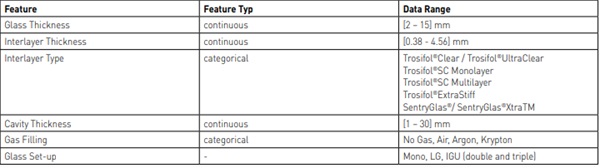
Data-driven methods rely on high-quality and diverse databases. The data used in this project was created approximately 10 years ago. We performed 1,000 sound transmission loss (STL) measurements at accredited laboratories around the world and compared the sound attenuation index third octave (range 100 to 3,150 Hz) or octave (range 125 to 2,000 Hz) band spectra. Masu. Reference curve specified by DIN EN ISO 717-1, covering the characteristics of different glass assemblies with different glasses, cavities, interlayer thicknesses, and different types of interlayers and gas fillings. The database was enriched with RW, STC, and OITC as ML targets. Table 1 provides an overview of the features and their intervals within the database.
The database only contains structured data with positive values for regression only. The only ML preprocessing step required was to compare three methods for the two categorical features: categorical variable removal, label encoding, and one-hot encoding.
2.3 Machine learning algorithms and training
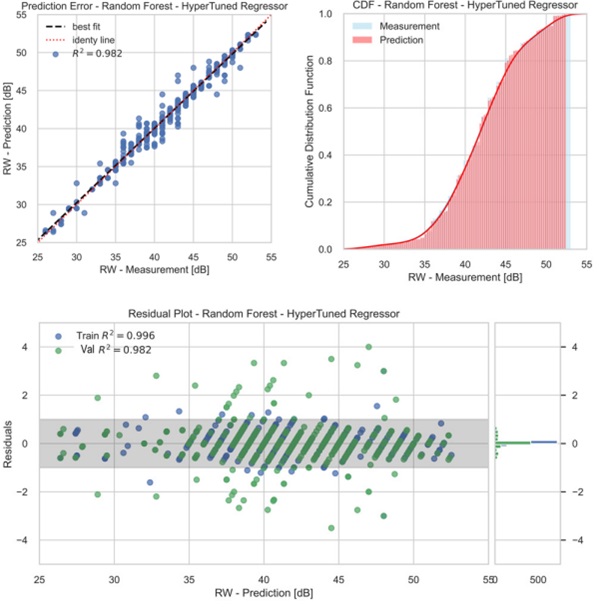
Although we used correlation analysis to investigate feature redundancy, in reality this is not the case and all features are used in subsequent ML modeling. The ML part of the project is performed in two steps: (i) scanning for ML algorithms, and (ii) fine-tuning the selected ML algorithms by hyperparameter tuning. The first step is performed to select the best ML algorithm for the tool by evaluating three algorithms: “Linear Regressor,” “Decision Tree Regressor,” and “Random Forest Regressor.” Deep learning algorithms along with neural networks are not considered. For training, the entire dataset was split 60:40 into training and validation sets for model preselection, training, and hyperparameter tuning. After training and testing the three algorithms using the acoustic database, the model features information obtained from the prediction error plot and the cumulative distribution function (CDF) of the model predictions and ground truth database values are used for hyperparameter tuning. A random forest regressor algorithm was chosen. For detailed information on that step and quantitative results, please see: [1, 2].
2.4 Tuning hyperparameters and completing the optimal random forest regressor
Based on the evaluation results, we selected the random forest regressor algorithm as the best performing algorithm for predicting the acoustic properties of different glass systems. The random forest regressor algorithm was trained using a database of simulated acoustic features, and its performance was validated using a separate test dataset. The algorithm was optimized using a grid search method with a 5-fold cross-validation approach to find the optimal hyperparameters (max_Depth, n_estimators, max_features, bootstrap, min_samples_split). For more information and quantitative results on hyperparameter tuning, please refer to the following URL: [1, 2].
2.5 SOUNDLAB AI Tools
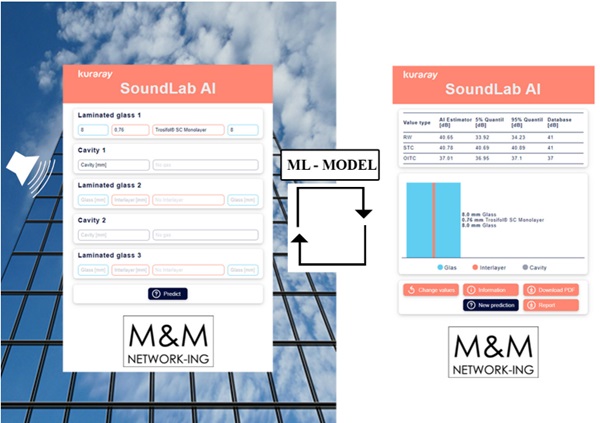
The best-performing Random Forest Regressor model has been integrated into the SOUNDLAB AI tool, a web application. The SOUNDLAB AI tool includes a user-friendly web interface that allows designers, engineers, and architects to easily enter the required parameters and obtain predicted sound insulation values. The program is publicly available and available here: https://soundcalculator.trosifol.com/
Meanwhile, since its release in 2021, this web application has undergone extensive testing both within Kuraray as well as external experts for various architectural projects around the world, and so far, its reliability, We have received very positive feedback regarding ease of use and speed.
3. Summary, discussion, and outlook
This case study describes the development of the SOUNDLAB AI tool, an ML-based predictive tool for estimating sound insulation values for arbitrary glass assemblies. In Figure 1, ML tools are evaluated based on various quality measures. The error plot yields a correlation coefficient R² = 0.982 for the validation data, indicating good performance in predicting sound insulation values. The CDF plot also proves the excellent agreement between the measured and predicted values. The residual plot and gray bars representing customer specifications ±1dB for RW showed that most training and validation data points were within the ±1dB confidence band and met customer specifications. Finally, the hyperparameter-tuned model was tested to predict sound insulation values on an unverified dataset of 20 different glazing configurations provided by Kuraray Europe GmbH. The model showed very good prediction on the test data with R² = 0.947, showing evidence of the generalization ability of the SOUNDLAB AI tool.
In summary, this tool is a suitable and cost-effective method for predicting the sound insulation properties of any glass assembly available online for a wide range of users.
The SOUNDLAB AI tool is further developed by training a generative conditional neural network. [4] Allows forward and reverse prediction of sound insulation and/or glazing settings to meet sound insulation requirements. These findings will be released in 2024 with a new version of SOUNDLAB AI. In addition, he plans to release his StrengthLAB AI tool in 2023 for performing artificial intelligence-based structural performance analysis of various glass systems under loading.
literature
[1] Drass, M., Kraus, M.A., Riedel, H., Stelzer, I. (2022). SoundLab AI – Machine learning predicts sound insulation values for different glass assemblies. Glass Structure and Engineering, 7(1), 101-118.
[2] Drass, M., Kraus, M.A., Riedel, H., Stelzer, I. (2022). SOUNDLAB AI Tools – Best Reviews on Machine Learning. ce/papers, 5(1), 147-156.
[3] Krauss, M. A., Dras, M. (2020). Artificial Intelligence for Structural Glass Engineering Applications – Overview, Case Studies, and Future Possibilities. Glass Structure and Engineering, 5(3), 247-285.
[4] Balmer, V. M., Kuhn, S. V., Bischof, R., Salamanca, L., Kaufmann, W., Perez-Cruz, F., and Kraus, M. A. (2022). Design space exploration and description via conditional variational autoencoders in metamodel-based conceptual design of pedestrian bridges. arXiv preprint arXiv:2211.16406.


