

Manufacturing productivity is affected by billions of changing variables every day. Variations due to operator calls due to illness, humidity caused by weather phenomena, changes in supplier materials, etc. This fluctuation can lead to billions of dollars in losses over time.
Fortunately, technological advances in data monetization have enabled many of these variables to be addressed, allowing manufacturers to reap benefits that were previously out of reach.
Impact of variables on core manufacturer KPIs
Manufacturers are always aiming to produce more for less while aiming to meet quality specifications. Introducing variability complicates this by making ideal scenarios nearly impossible to achieve or reproduce. To make matters worse, variations exist at every step of the production process, from what products are made to which operators are assigned in shifts, compounding complexity. This creates multivariate problems that are difficult to proactively identify, analyze, and correct, especially before they cost the manufacturer time, material, and employee resources.
Therefore, variations in the production process affect key key performance indicators (KPIs) as follows:
- availability: Process, material, and operator variations can lead to unplanned downtime and maintenance issues. To make matters worse, due to the volume of sources, the causes and reasons for unplanned downtime are hidden and unclassified. This prevents you from being able to fix or prevent future downtime. According to GE, oil and gas manufacturers that take this reactive approach to downtime fluctuations experience an average of 8.43% unplanned downtime, compared to companies that invest in predictiveness. So he's close to 5.42%. This difference can mean millions in lost productivity.
- performance: Line speeds are often set by machine specifications, financial models, and even intuition. This creates a gap between the speeds that can be repeatedly achieved without loss of quality and the average line speed. It is in a company's best interest to know what line speeds are achievable at the product and line combination level and to incentivize operators to run lines as close to that target (usually the 75th percentile) as possible.
- quality: If any part of the production process is subject to variation, the quality specifications should be over-indexed to ensure that the quality does not fall below the minimum requirements. An example of this is providing free material for 5% of the wall thickness of the product.
Of course, this does not address all sources of performance loss due to fluctuations, but these are the ones that have a large impact. Addressing fluctuations in each of these areas will improve your company's bottom line.
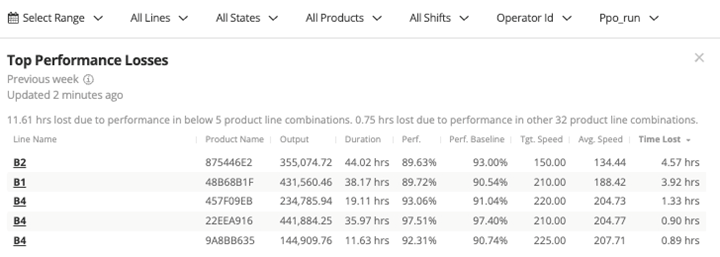
The difference in line speed to achievable performance can result in hours of lost productivity. Photo courtesy of Oden Technologies
Variable costs have a direct correlation to labor
Historically, manufacturers have relied on experienced operators and other front-line employees to reduce the negative impact of fluctuations. These experienced staff know how to respond and compensate to achieve high productivity. In general, we find that the top 10% of operators run their lines 22% faster than average, and the bottom operators run 10% slower.
As most manufacturers face workforce challenges, it is no longer possible to rely on years of expertise..
Fortunately, artificial intelligence (AI) and machine learning have made significant advances in recent years, putting people at the forefront of making informed and beneficial decisions, regardless of their tenure. Ta.
What AI is good at
AI can't do everything. Manufacturers shouldn't expect AI to come along and solve all their problems. AI is great at:
- Cleanse large datasets quickly
- Analyze patterns in large datasets
- Optimize quickly towards quantifiable goals
AI can analyze billions of intersecting data points created by manufacturing processes in real time, providing the most important information and patterns to frontline teams. This can significantly reduce or even eliminate the need to rely on intuition and experience to make effective decisions.
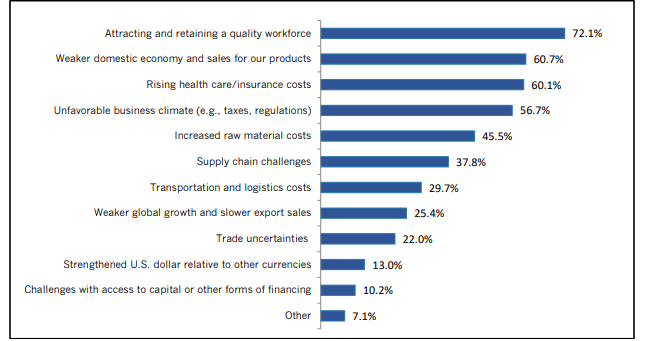
Key business challenges facing manufacturers in Q3 2023, based on research conducted by the National Association of Manufacturers. Labor issues were at the top of the list. Note: Answer exceeds his 100% as respondent is allowed to check multiple answers.Photo credit: NAM Q3 2023 Manufacturer Outlook Survey
Utilizing AI in the real world
A real-world example that some manufacturers are currently using is the use of AI-generated prescriptive process configuration recommendations that best fit an organization's goals. For the operator, what process settings should be implemented during the run, what is the expected quality from those process settings, and what are the expected material and cost savings? You can see. These process settings recommendations are significantly different from traditional recipe guides because they automatically adjust to account for your current constraints.
How to use:
- Through scaled data architectures and models, production and process data is cleansed, combined, contextualized, and enriched in real-time.
- Predictive quality models match quality outcomes to current variables and identify periods of stability from which process settings can be sourced.
- The stability period is checked against configured constraints such as quality targets and line speed limits.
- The most cost- or output-efficient group of process settings is identified and presented to the operator.
All of this happens in real time, so operators don't have to wait for analysts or engineers to make adjustments based on changing conditions or new information. With the help of AI, new operators can now perform the same tasks as long-time staff. Using this system, one large manufacturer was able to increase his line speed by 3% while reducing associated material and energy costs by 5%.
“The Process AI operator interface allows operators to see in real-time how value is being added as they strive to reduce costs, while leveraging predictive quality models to ensure that quality is not compromised. ” – Senior Process Engineer
Ultimately, by raising operator-dependent processes to higher standards, creating real-time adjustments to unforeseen events or variable changes, and filtering out process settings that do not proactively meet quality standards, Reduces the variation of
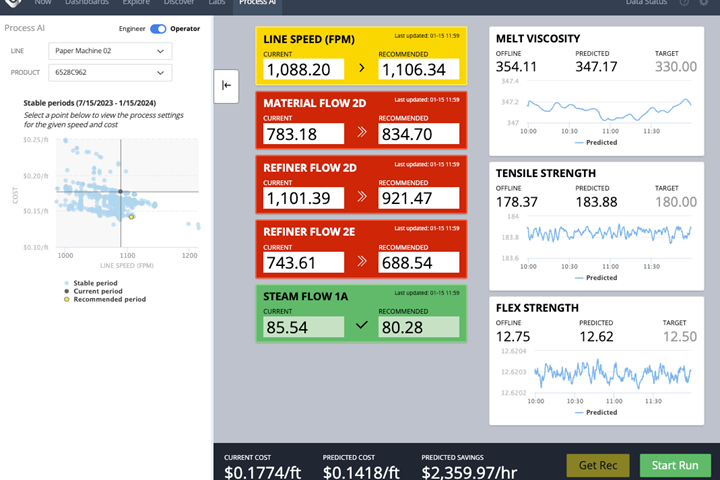
Improve the capabilities of every operator with prescriptive process configuration recommendations based on real-time conditions and predictive quality. Photo courtesy of Oden Technologies
Preventing trash intrusion and trash outflow
AI is highly dependent on sourcing clean and relevant data. To collect this data, many manufacturers are investing in unified namespaces, data warehouses, or data lakes. However, many companies underestimate or overlook the unique challenges of preparing manufacturing data for action.
In fact, data quality issues are the biggest challenge for analytics efforts in manufacturing, according to LNS. A data analyst, engineer, or scientist spends 70% of his time and effort cleaning and preparing data.
Plastics typically require processing more than 5 million data points per row each day to obtain the information needed for AI. These data points require aggregation, windowing, custom calculations, enrichment, and special handling of outliers. Additionally, periods of stability must be identified so that productivity gains are optimized not only for the execution as a whole, but also for parts of the execution.
Given that AI requires real-time data to make prescriptive recommendations for the field based on current conditions, a data warehouse or data lake structure is required for AI to be productive. Building it would be a large project in itself. That's why it's important to work with a partner or make a significant investment in a team that understands the entire process, from data integration to prescriptive directives.
About the author: Willem Sundblad is co-founder and CEO of Oden Technologies. Oden Technologies is a company that helps manufacturers produce more, reduce waste, and innovate faster through manufacturing analytics and AI. In his spare time, he writes for Forbes.com and takes every opportunity to enjoy the green mountains of Vermont.


