AI and predictive analytics are essential features of modern storage systems, helping storage automation features assess infrastructure health, identify issues, and keep these systems running smoothly.
Gartner recently ranked augmented data management at number two on its list of top 10 trends in data and analytics for 2020. Vendors are adding machine learning and AI capabilities to provide self-configuring and self-adjusting data management, freeing up IT staff to focus on higher-level tasks. According to the research firm, the task has value.
AI and predictive analytics are also part of that trend, but there's a lot of hype and hyperbole surrounding the use of these technologies. Vendors may apply AI labels in vague and imprecise ways. Nevertheless, predictive analytics tools offer tangible benefits in terms of storage automation performance, efficiency, and reduced operational costs.
Below are answers to six important questions about AI, predictive analytics, and storage automation.
How can predictive analytics help with storage?
Predictive analytics uses technologies such as data mining, analytical queries, predictive modeling, AI, and machine learning to uncover patterns in storage system data, identify anomalies, predict future outcomes, and improve storage automation capabilities. use to solve the problem. Predictive analytics capabilities in storage products offer several benefits, including improved performance and resource usage, reduced management overhead, reduced downtime, and workload optimization.
Predictive analytics capabilities in storage products offer several benefits, including improved performance and resource usage, reduced management overhead, reduced downtime, and workload optimization.
Machine learning is especially important for improving predictive analytics in modern storage systems. Data collected from across your storage infrastructure is used to train predictive algorithms to understand trends and recognize when bottlenecks and problems occur. You can then continually optimize your storage components and address potential issues.
What's behind the shift to more intelligent storage?
The increasing use of all-flash arrays and hybrid and hyperconverged infrastructure is one of the factors driving the demand for smarter storage. Storage no longer exists in a vacuum. For many enterprises, this is an integrated part of a data center technology stack that is managed as a whole and requires the more real-time data about storage capacity and performance that intelligent storage provides.
What role does cloud storage play in making storage smarter?
Cloud storage includes predictive analytics to help predict trends, plan infrastructure, and reduce overhead. These applications use AI, machine learning, and other advanced techniques to continuously collect and analyze telemetry data from flash arrays in the storage stack. Again, the goal is to analyze IOPS, bandwidth, fault tolerance, latency, and other storage-related information, identify issues, and proactively address them using storage automation capabilities.
“Cloud-based predictive analytics platforms go far beyond previous generations of remote monitoring systems,” Eric Bergener, vice president of research at IT analyst firm IDC, said in a white paper. He identified three key features that differentiate cloud-based predictive analytics from traditional remote monitoring: data sharing, surveillance coverage, and the use of AI and machine learning to drive autonomous operations. .
In the cloud context, predictive analytics brings storage infrastructure one step closer to self-healing technologies that identify and resolve issues with minimal intervention.
What technologies are making storage smarter?
Data collection is part of the foundation of smart storage. Vendors aggregate and analyze anonymized telemetry data from their customers to learn about different storage scenarios, workloads, or issues that may impact other customers. Vendors can provide detailed information about storage performance metrics and patterns, and can predict trends, bottlenecks, and other potential problems before they occur.
Predictive analytics works in conjunction with machine learning and deep learning to make these systems work without pre-programmed instructions.
What features do I need in a storage predictive analytics tool?
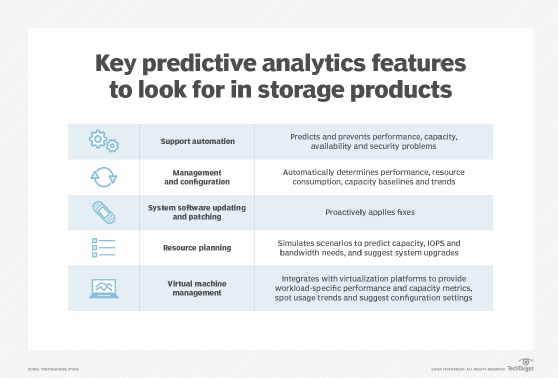
When scouring storage systems, look for these five key predictive analytics capabilities to ensure you get the functionality you need.
Supports automation. The system can predict various issues related to performance, capacity, availability, and security. For example, you can use predictive analytics to analyze storage space usage by device, volume, and application to proactively identify when you will reach your goals. Administrators can use storage automation features to configure the system to automatically add or rebalance capacity.
Automated management and configuration. Look for tools that offer automatic storage setup and management. These systems automatically determine performance, resource consumption, and capacity needs to optimize workload placement and improve resource utilization.
Software updates and patches. The system uses analytics to proactively update software and ensure your site has code available that meets your requirements to address potential issues before they become problems.
resource planning. Predictive algorithms identify trends and help you plan ahead for future storage needs. Storage administrators can use this technology to predict capacity, IOPS, and bandwidth needs for different storage scenarios and upgrade possibilities.
VM management. Predictive analytics can be integrated with virtualization platforms such as VMware vSphere to provide workload-specific performance and capacity information, identify usage trends, and suggest better configuration settings.
Which vendors offer predictive analytics tools for storage?
AI-driven analytics software and its predictive and prescriptive capabilities are standard on most storage products from major vendors. IT buyers should compare AI-enhanced storage products from major vendors such as Dell EMC, Hewlett Packard Enterprise, Hitachi Vantara, IBM, Infinidat, NetApp, and Pure Storage, as well as smaller vendors and startups.