
Gorodenkov // Shutterstock
How machine learning and new AI technologies could change the cybersecurity landscape
Two cybersecurity professionals walking inside a data center.
The world is online like never before. From work meetings, emails and text messages to shopping, bill payments and banking, the possibilities are endless. Advances in technology save people time and give businesses new tools for growth.
But that connection comes at a price. The Internet also contains tools for searching for exploitable vulnerabilities, holding companies hostage with ransomware, performing sophisticated phishing and social engineering attacks, hacking sensitive information, and storing personal data such as social security numbers and addresses. Criminals exfiltrating data are more abundant than ever before.
Will artificial intelligence and machine learning make it easier or harder for businesses to defend against such attacks? Could other improvements provide additional defenses against cyberattacks?
The pros and cons of some advances have been in the news lately. Jeffrey Hinton, known as the “Godfather of AI,” recently left Google to warn of the dangers of the very technology he helped develop. He fears that generative artificial intelligence, which can generate text, images, video and audio, will be misinformed and one day even undermine human creativity. Some say such fears are hypothetical.
Drata has compiled a list of five technological innovations that are changing the way companies monitor and protect sensitive data critical to their digital operations.

Gorodenkov // Shutterstock
artificial intelligence
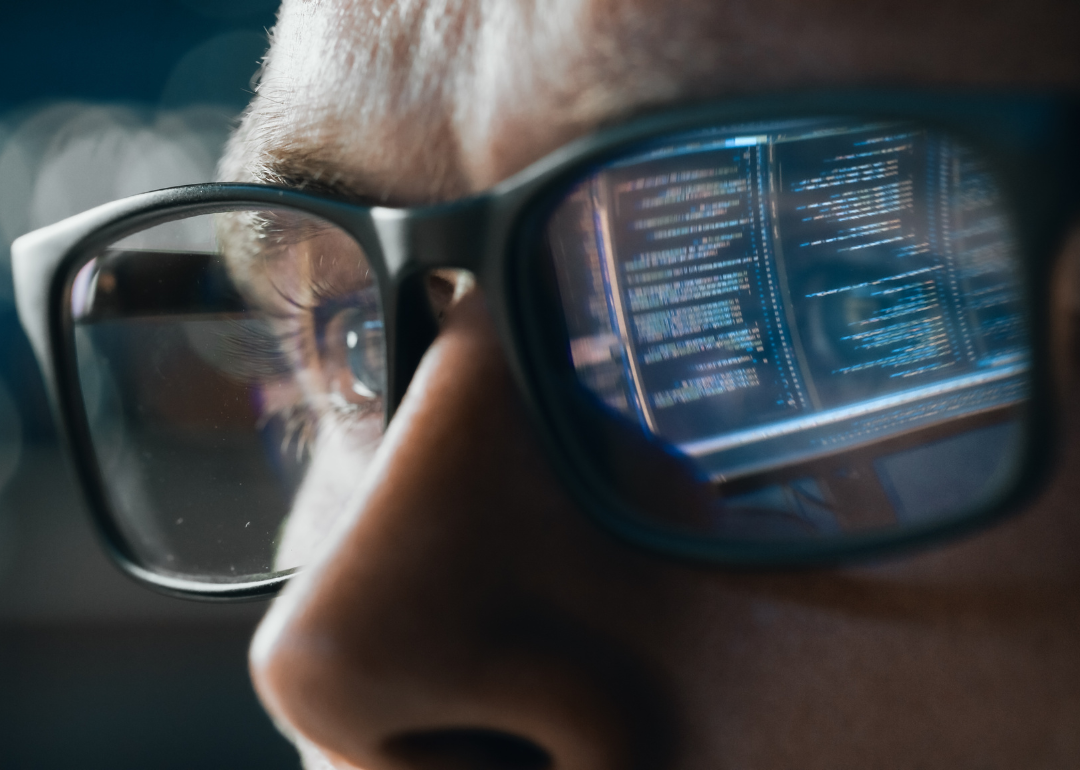
A software engineer working on a computer with lines of code reflected in his glasses.
Artificial intelligence will not only enable computers to analyze large amounts of data quickly, revolutionizing the response time of enterprise security operations, but also increasing knowledge as we collect more information. It deepens.
These systems include machine learning, natural language processing, and speech recognition, and can classify millions of research papers, news articles, and other data. Industries such as healthcare, finance, transportation, entertainment, and real estate all benefit from the patterns these systems identify.
A cybersecurity focus can help identify vulnerabilities and risks from hacking, phishing, and other attacks. But you can also discover potential new cyber defense opportunities. And these systems can be educated to modify their behavior.

NDAB Creativity // Shutterstock
machine learning
Three colleagues have a meeting and study a program on a computer screen.
A subset of AI, machine learning is often used interchangeably with AI and actually refers to how computers interact with data to improve performance. Computers learn in the sense that they can change their algorithms as they receive more data. Machine learning can help detect possible attacks more accurately and prioritize the most likely and potentially dangerous ones.
However, as Georgetown University’s Machine Learning and Cybersecurity report points out, in many cases these technologies are based on age-old techniques rather than new approaches, which in themselves lead to attacks. increase. The report predicts that unless there are new breakthroughs in machine learning capabilities, machine learning will likely bring incremental improvements rather than radical new approaches.

Mitsukit // Shutterstock
chatbot technology
People using ChatGPT on their computers.
Chatbot technology has made remarkable progress. ChatGPT is his AI chatbot developed by OpenAI, co-founded by tech billionaire Elon Musk. OpenAI says ChatGPT can answer follow-up questions, admit mistakes, challenge false assumptions, and reject inappropriate requests. Its name comes from the Generative Pre-trained Transformer language model.
Recently, business messaging app Slack announced plans to offer a chatbot technology called Slack GPT. Summarize messages you missed while on the go, help with writing, or take notes on calls.
ChatGPT can write text and create code, which makes it valuable for malicious use. The system creates convincing phishing emails and ransomware code, initiates the work necessary to build infrastructure, attacks targets, impersonates people, and deceives anyone within the enterprise into confidential You can create applications that generate emails with the possibility of sharing data. At the same time, it may be possible to identify security threats.

lightfield studios // shutterstock
virtual reality
Teachers supervise students as they experience virtual reality.
Virtual reality is a three-dimensional image created by a computer. Its immersive nature makes it particularly effective for cybersecurity and various trainings such as medical and military. Create realistic scenarios to simulate cyberattacks.
But virtual reality also comes with risks. We may collect data such as retinal scans, fingerprints, facial dimensions, and vocal characteristics that may facilitate impersonation within the metaverse.

Gorodenkov // Shutterstock
cloud computing
Two colleagues stand in front of multiple racks of servers that support cloud computing.
Cloud computing provides on-demand access to applications, servers, network functions, and more over the Internet. Cloud providers are often responsible for the security of their cloud infrastructure, and customers are expected to protect their data in the cloud. Cloud users can be vulnerable to data breaches, cyberattacks, malware infections, and other attacks that exploit the layers they are responsible for protecting on cloud providers.
Data report by Dom DiFurio. Story editing by Jeff Inglis. Copyedited by Paris Crouse. Photo selection by Abigail Renault.
This story was originally published and produced on Drata.
Distributed in partnership with Stacker Studio.